



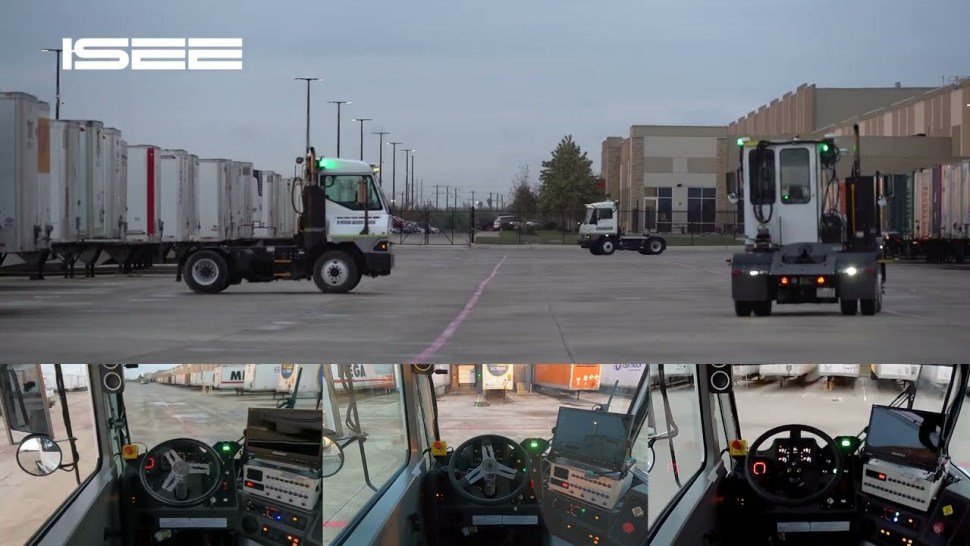
ISEE, the Cambridge, Massachusetts-based developer of autonomous yard trucks, has entered into a strategic partnership with Holman, the company announced Friday. Holman, which is also an investor in ISEE, will provide leasing, retrofitting and maintenance services for trucks operating with ISEE’s autonomous technology across North America.
The agreement gives customers several options for deploying the technology. ISEE’s autonomous system can be installed on trucks they already own, on vehicles leased through Holman, or on autonomous-ready trucks supplied by ISEE.
According to ISEE, vehicles will be retrofitted and integrated before being delivered to customers, while Holman will provide financing and fleet management services throughout the deployment.
For Debbie Yu, ISEE’s president and co-founder, the challenge extends well beyond the autonomous software itself. Customers looking to automate their yards may not necessarily have a fleet of trucks ready for deployment.
“First of all, you have to figure out where to get the truck. Either buy it, or lease it, or rent it,” Yu told FreightWaves. “Then we have to retrofit the truck with our autonomy kit, deploy to the customer site, do the maintenance, and run the yard.”
Much of that process, she noted, has little to do with software.
ISEE could have handled retrofits internally, but doing so would have required the company to significantly expand its technician workforce. Yu said that type of work falls outside ISEE’s core expertise.
Holman, by contrast, has years of experience retrofitting trucks and operates a nationwide network of shops and technicians alongside its leasing business.
The company also expanded into robotics fleet services in December 2025, when it launched Holman Robotics, a unit designed to combine financing with lifecycle management for robotic equipment.
“By combining Holman’s robot fleet leasing and management infrastructure with ISEE’s autonomous technology, we can provide customers with a practical solution covering the full vehicle lifecycle,” said Joe Foster, Holman’s vice president of robotics, in a statement.
From pilots to larger fleets
The partnership comes as ISEE moves beyond the prototype and pilot phase of its development.
During those earlier stages, the company did not require significant fleet capacity or extensive retrofit operations, Yu said. That situation is now changing as ISEE approaches what she described as an inflection point.
According to Yu, multiple F100 customers are interested in deploying autonomous yard truck fleets with ISEE, potentially involving thousands of vehicles over the next couple of years.
That expected increase in deployments is creating a need for a broader operational infrastructure capable of supporting vehicles throughout their lifecycle.
Retrofitting existing trucks and building new units
The partnership will cover both trucks already operating in customer yards and newly built vehicles.
Retrofits are intended for trucks that are already in service and can subsequently be equipped with ISEE’s autonomous technology.
For new units, ISEE is working with original equipment manufacturers, including terminal tractor manufacturer TICO. The two companies entered into a strategic partnership in April 2025 to deliver fully integrated autonomous yard trucks for customer operations.
“Not just retrofitting. We also need to do factory-built units through the TICO collaboration, starting from 2027,” Yu said.
The 2027 target is consistent with the serial production timeline reported by FreightWaves in June.
ISEE also plans to continue working with other yard truck OEMs on new models, including diesel, alternative-fuel and electric vehicles, according to the company’s release.
While factory-built autonomous trucks will become part of the offering, retrofits remain an important route for operators that already have yard trucks in service. Yu said this approach can allow those customers to automate their existing operations sooner rather than waiting for new vehicles to be manufactured and delivered.
ISEE sees growing demand for autonomous yard operations as investment expands across U.S. manufacturing, data centers and infrastructure.
The company is also seeing interest from enterprise customers that, according to Yu, are organizations “that we never imagined before.”
“We believe it’s critical to actually align the partnership quickly,” she said.