



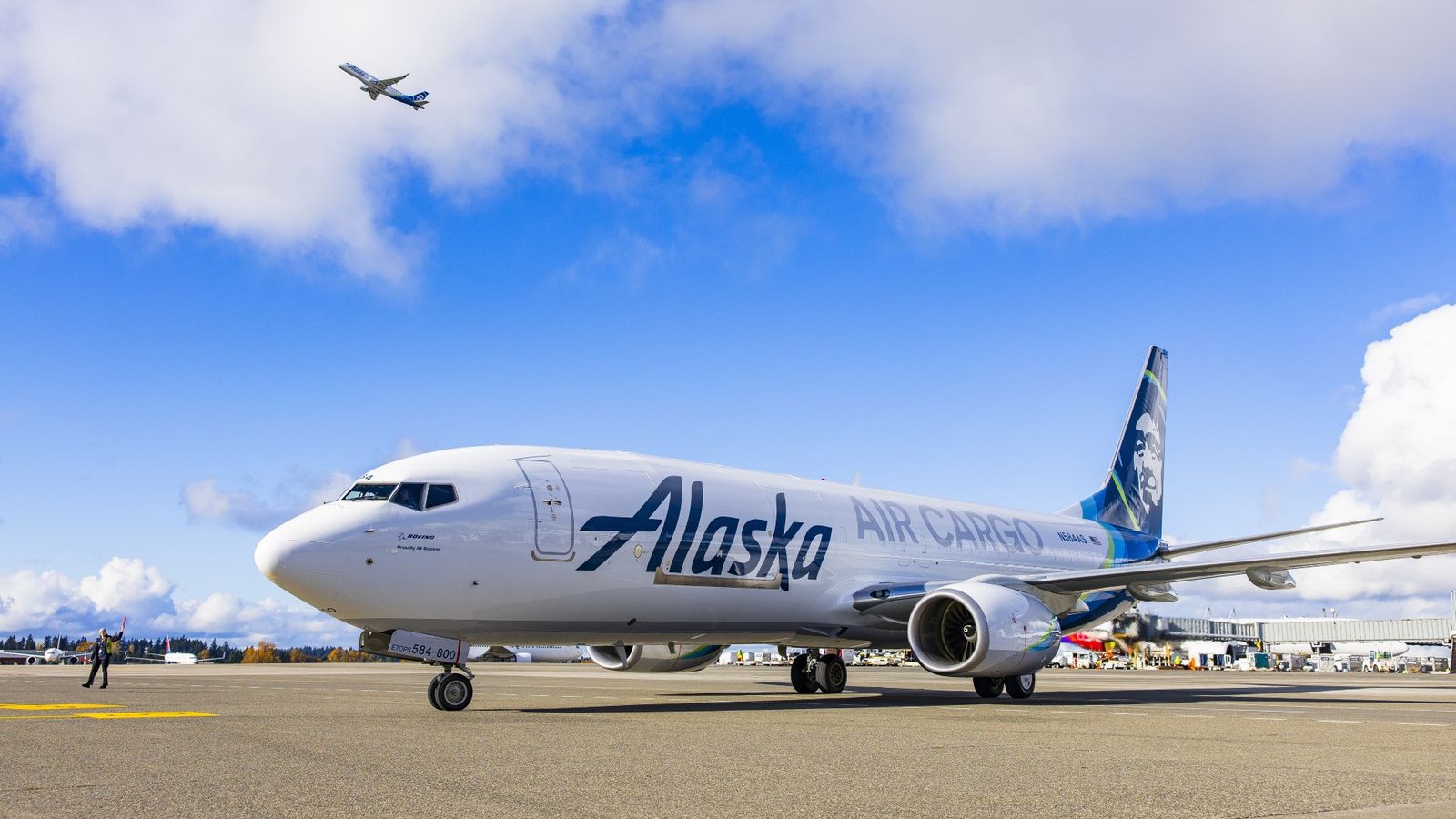
Alaska Airlines is preparing for a major expansion of its cargo business with the addition of four leased Boeing 737-800 converted freighters. The new aircraft, expected to enter service during the first half of 2027, will nearly double the airline’s dedicated cargo capacity and mark the first time it operates freighters in Hawaii.
The airline did not reveal the identity of the lessor providing the aircraft. However, its two existing Boeing 737-800 freighters are currently leased from San Francisco-based Babcock & Brown Aircraft Management.
Today, Alaska Airlines operates a fleet of three Boeing 737-700 converted freighters and two Boeing 737-800 freighters. Although the 737-700s are smaller, the airline says the three aircraft together offer cargo space roughly equivalent to two 737-800 freighters.
The fleet expansion comes as the company’s cargo business continues to grow. During the second quarter, Alaska Air generated $163 million in cargo revenue, up 17% compared with the same period last year. Cargo revenue for the first half of 2026 was $316 million and increased 21% year-over-year.
Those results were supported by payments from Amazon for operating 10 Airbus A330-300 converted freighters within its parcel network, along with higher cargo volumes carried on the airline’s expanding international passenger services.
Alaska Air Cargo plays a key role in connecting communities across Alaska, transporting freight through its Seattle hub before distributing shipments across the United States and selected international destinations using its passenger network. The division also manages cargo carried on both the airline’s domestic narrowbody aircraft and its international widebody fleet.
The four incoming freighters will strengthen service in both Alaska and Hawaii. According to an Alaska Airlines spokesperson, the aircraft assigned to Hawaii are expected to operate exclusively within the islands. They will be based in Honolulu and fly under the Hawaiian Air Cargo brand.
Beyond increasing capacity, the airline says the additional freighters will improve the reliability of deliveries, particularly for time-sensitive shipments such as e-commerce orders, medicines, groceries and other essential supplies. The aircraft will also help seafood producers, farmers, ranchers and fishermen move their products to market more efficiently.
Alaska’s cargo network has expanded alongside its international ambitions following the 2024 acquisition of Hawaiian Airlines. The deal added Airbus A330-300s and Boeing 787-9 Dreamliners to the fleet, allowing the airline to launch new routes from Seattle to Tokyo and Seoul last year, followed by London and Rome this year.
Ian Morgan, Alaska Airlines’ vice president of cargo, said the additional freighters will create new opportunities to export seafood and other commodities while ensuring customers continue to receive critical goods quickly and reliably.
Each passenger aircraft converted into a freighter undergoes extensive modifications, including the installation of a large cargo door, reinforced flooring, upgraded loading systems and structural improvements designed to handle heavy freight operations.
While cargo continued to perform well, the airline faced a difficult second quarter overall. Alaska Air reported a net loss of $76 million, citing an 85% jump in jet fuel prices linked to the conflict with Iran and tighter oil supplies, which added around $600 million in direct costs. Heavy rains in Hawaii during the spring break travel period also hurt the company’s financial performance.