




LONDON, ONT. — London’s planned Bus Rapid Transit (BRT) network is still several years from completion, but its two main routes are already beginning to influence development plans across the city.
Interest in transit-oriented development (TOD), however, remains limited compared with larger urban centres where subway and light-rail investments have generated significant development activity.
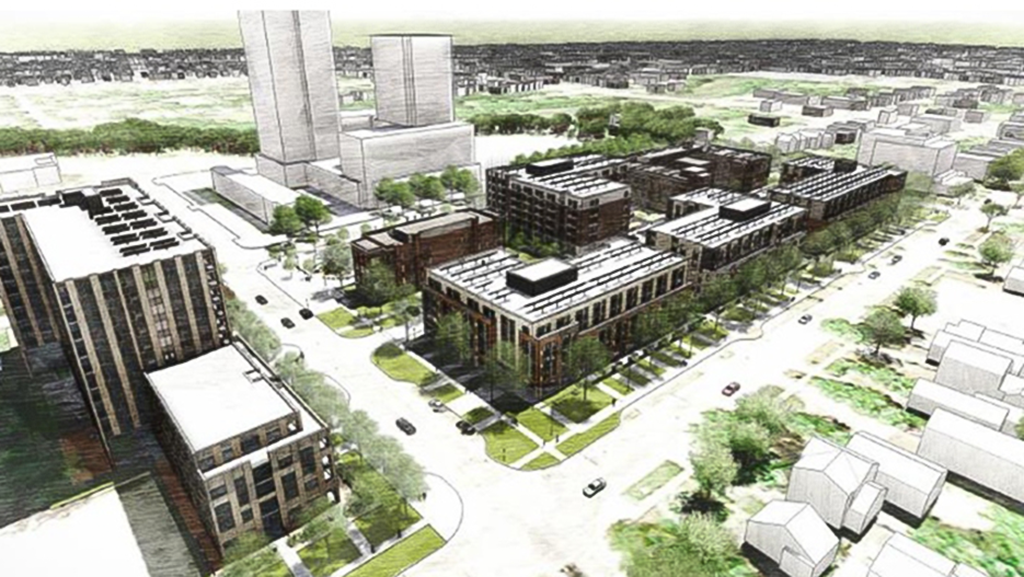
The most ambitious proposal so far comes from local developer Foundation Capital, which is planning two residential towers of almost 30 storeys each along the Wellington Gateway route, just southeast of downtown in London’s Old South neighbourhood.
The project would deliver a combined 1,004 units and is being designed with limited vehicle parking and extensive long-term bicycle parking.
“We are proposing these towers right along the BRT with minimal parking because we want the Canadians who are going to rent from us to save money, take the bus and have money left over to invest, not have it all go to the landlord. It’s also going to be environmentally friendly,” Foundation Capital principal Jeff Wybo told local media.
London’s BRT network includes the Wellington Gateway and East London Link, along with a Downtown Loop connection. The routes are supported by zoning intended to encourage transit-oriented development, including reduced parking requirements.
For Foundation Capital, limiting parking could also significantly reduce construction costs. The company estimates that each parking space represents approximately $60,000 in costs, potentially allowing savings to be reflected in apartment prices.
The proposal is expected to go before the city’s planning committee in September, with construction planned to begin next summer.
High land costs slow development
Despite projects such as Foundation Capital’s proposal, the City of London says there has not been a major rush of development applications along the BRT corridors.
Mike Macaulay, the city’s manager of community improvement and urban regeneration, said a consultant’s study identified a straightforward obstacle: development is simply “very expensive.”
A major issue is the cost and availability of land, particularly around the city centre.
“To get feasible development these days it requires land amalgamation,” Macaulay said, particularly in areas containing older or historical properties.
Many properties have limited frontage, meaning developers seeking to build larger projects may have to assemble several adjacent parcels controlled by multiple owners.
For projects involving towers of more than 20 storeys, acquiring enough land can therefore become a significant obstacle.
“We found that land amalgamation is one of the challenges, actually probably preventing a lot of development along these routes,” Macaulay said.
Suburban development remains more attractive
London’s development market is also being shaped by rapid growth in the city’s northwest, southeast and southwest.
According to Macaulay, developers already have substantial projects planned in those areas, where land is less expensive and larger parcels are easier to assemble.
“Our development community they’re pretty satisfied, they’re pretty busy,” he said. “They’ve got the next 10 years of projects queued up – a lot of big towers out on the edge of London where land is cheap and they can get their big parcels and they can hit the density that they want.”
Foundation Capital’s project illustrates how developers can overcome some of those challenges by assembling multiple parcels.
The company has brought together five parcels for its proposed development. Macaulay said the location, relatively close to downtown, is well suited to walkable neighbourhoods and could attract residents who do not need or want to own a vehicle.
The limited parking therefore becomes both a development strategy and a potential cost-saving measure, although residents choosing the project would likely need to rely more heavily on transit and other forms of transportation.
City funding helping smaller projects
Macaulay expects transit-oriented development in London to emerge gradually rather than through a sudden wave of major projects.
He described the likely pace as a “steady drip”, reflecting the reality of developing TOD in a midsize Ontario city with a population of approximately 625,000.
Some TOD projects are already moving forward, but municipal financial support has played an important role.
Through the city’s Community Improvement Plan (CIP), developers can receive a forgivable loan of $15,000 per unit, up to a maximum of $1.5 million per project.
The programme is funded through London’s Housing Accelerator Fund, with a total of $13 million allocated to support approximately 700 units.
“It’s still very expensive but we’re trying to close the gap,” Macaulay said.
The CIP has attracted more than a dozen applicants for smaller and medium-sized developments, generally ranging from six to 12 storeys.
However, the funding available through the programme is limited.
Macaulay said London city council will ultimately have to decide whether to introduce additional programmes or increase funding to support further transit-oriented development along the BRT network.