Logistic Nov 4, 2026
Maersk seeks a permanent role in the management of Panama’s former Hutchison port
After taking over interim operations at the Port of Balboa, APM Terminals signals its interest in securing a long-term concession, as Panama faces growing pressure to expand port capacity and resolve the future of its two strategic terminals.
Maersk seeks a permanent role in the management of Panama’s former Hutchison port
After taking over interim operations at the Port of Balboa, APM Terminals signals its interest in securing a long-term concession, as Panama faces growing pressure to expand port capacity and resolve the future of its two strategic terminals.
Categories: Logistic, Maritime, Business, World
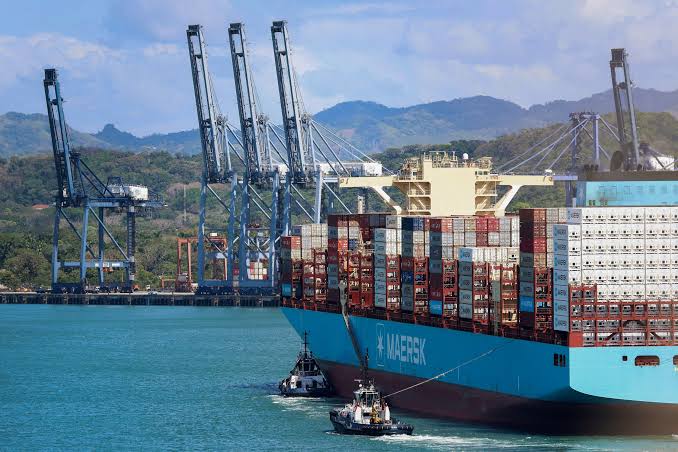
Maersk is positioning itself for a long-term presence in Panama’s port sector. Through its subsidiary APM Terminals, the Danish shipping group wants to continue managing the Port of Balboa on a permanent basis, following the termination of the concession previously held by CK Hutchison’s Panama Ports Company.
The company has now publicly expressed its intentions through statements to local Panamanian media, breaking its silence on the future of the port facilities it has been operating since February.
APM Terminals took over the management of the Port of Balboa after the Panamanian government terminated Panama Ports Company’s concession. The decision followed a court ruling declaring the contractual arrangement unconstitutional. Panama Ports Company had previously operated both Balboa, on the Pacific coast, and the Port of Cristobal, on the Atlantic side.
Following the termination, management of Cristobal was transferred to Terminal Investment Limited (TiL), MSC’s terminal operating subsidiary, while APM Terminals assumed responsibility for Balboa.
Both operators are currently working under transitional agreements approved by Panama’s Cabinet in February. These arrangements allow them to manage the terminals for a period of up to 18 months, extending to July 2027.
However, the temporary agreements are not intended to establish permanent operators. The Panamanian government previously indicated that any long-term concession would have to be awarded through a competitive tender. Despite this announcement, authorities have yet to provide a clear timetable for launching the process, leaving the future of both terminals uncertain and generating considerable debate.
Maersk wants to be a long-term partner of Panama
Panama continues to be a strategic node in Maersk’s regional network. Antonio Domínguez, president of the group for Latin America and the Caribbean, called on the government to clarify when the tender process for the port concessions will be launched.
He reiterated that Maersk has not lost confidence in the country and that Panama continues to be an important operational centre for APM Terminals.
Domínguez said the company wants to be part of it when the time comes and made it clear it is not only interested in the temporary management arrangement that is now in place.
The executive also highlighted that the group's immediate priority has been to ensure operational continuity and safeguard the stability of the logistics infrastructure in Panama.
He said the current arrangement was not a concession, but an operational assignment of 18 months made at the request of the government. Dominguez said: “So far the experience has been positive and operations have been maintained during the transition.”
He added that the foremost responsibility of APM Terminals was to secure Panama’s position as a logistics hub, something the company believes it has achieved successfully.
Port infrastructure capacity still a big worry
Maersk is also emphasising the need for more port infrastructure in Panama, no matter who eventually operates Balboa and Cristobal.
“We are lagging behind in terms of available port capacity,” Domínguez acknowledged. He believes that Panamanian authorities should continue on their roadmap for development and accelerate the expansion of the country’s infrastructure.
He says there is a need for more capacity, existing facilities won’t be able to meet the future needs.
He cited a number of possible development opportunities including the Corozal project tied to the Panama Canal, the Telfers project and other potential infrastructure investments.
Domínguez also mentioned the long relationship of Maersk with Panama, saying that the company has been around for about 100 years in the country.
The group intends to build on that relationship for another 100 years, underscoring its desire to remain involved in the country’s logistics and port development.
Uncertainty of future investment by temporary management
The transition has enabled Panama to maintain port operations without major disruption, but the absence of long-term agreements is becoming a worry for the sector.
Panama had done a great job keeping the terminals running, a port consultant told Seatrade Maritime News, praising the country’s management of the operational transition.
But the consultant warned that operational performance has to be watched all the time. "An operator is only as good as its last ship," he said. He said: “We want to get away from the short-term and get into longer-term contracts.
He also asked whether Maersk and TiL would be willing to make large hiring commitments without knowing whether they will still be in charge of the terminals after July 2027.
The uncertainty is especially significant as port operations require considerable investment in equipment and other infrastructure. Such commitments are difficult to justify when operators cannot be assured of control beyond a temporary contract.
The consultant also found productivity levels to be low, adding another concern to the debate on the future management of the facilities.
CK Hutchison continues its legal battle against Panama
The dispute over the two terminals remains far from resolved. Hong Kong-based CK Hutchison has been engaged in a prolonged confrontation with Panama since US President Donald Trump raised objections to Chinese ownership of the ports located along the Panama Canal.
The conglomerate is challenging the cancellation of its port concession through international legal proceedings.
In August, CK Hutchison filed an additional $1.5 billion in investment treaty claims against Panama over the cancelled agreement. This action adds to a separate $2 billion case before the International Chamber of Commerce (ICC), pursued by its subsidiary, Panama Ports Company, over the same dispute.
The legal confrontation has continued to develop. Panama has recently instructed Hogan Lovells and Cadwalader, US LLP, to represent the country in the $2 billion ICC claim brought by CK Hutchison's subsidiary.
The case concerns the concession covering the operation of Balboa and Cristobal, which was cancelled in February.
As Panama prepares to determine the long-term future of its two strategically important ports, the government faces several interconnected challenges: resolving the legal dispute, launching a transparent concession process, securing investment and expanding port capacity.
For Maersk and APM Terminals, the coming months could therefore prove decisive in determining whether their current interim responsibility at Balboa develops into a permanent role in Panama's maritime infrastructure.
END OF REPORT