



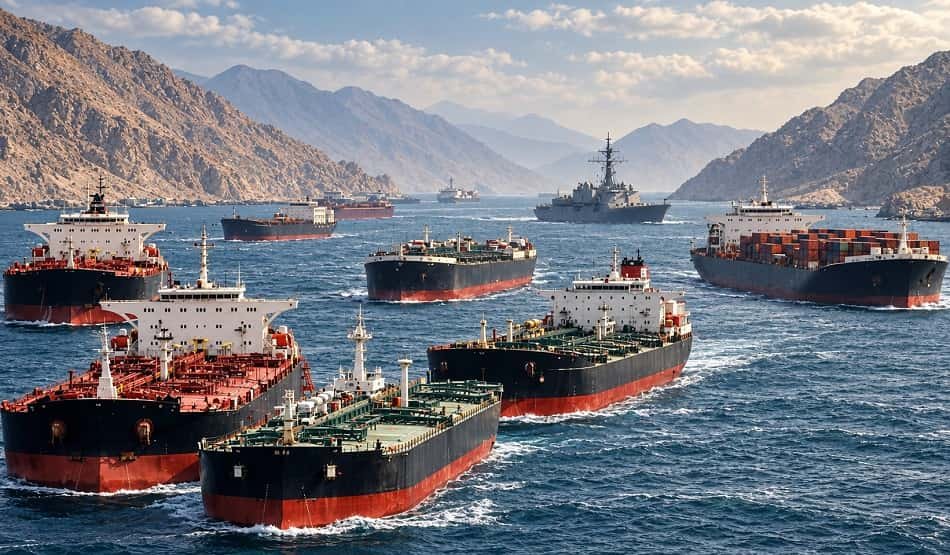
A military confrontation in the Middle East could again put significant pressure on global shipping and energy supply chains. Diplomatic efforts to prevent another flare-up continue, but fears are rising about the prospect of new hostilities involving Iran, the United States and Israel in the coming weeks.
A fresh wave of powerful strikes is approaching at a crucial time for energy markets in the region. Some maritime traffic has slowly picked up and exporters have developed alternative trade mechanisms and logistical workarounds to operate despite continuing security threats.
Commercial shipping and energy infrastructure have been key targets during the eight months of conflict. Iran has used pressure on these sectors repeatedly to influence regional developments and to keep international markets in uncertainty.
The biggest signs of recovery have been in crude oil exports. Middle Eastern countries exported at least 16.5 million barrels per day (bpd) of crude oil in September, according to Kpler data. The commodities analytics firm said it was broadly in line with the pre-war average, excluding Iranian exports.
But the recovery does not mean that Maritime Transportation will return to normal. More and more oil shipments are taking alternative routes to the traditional outbound shipping lane through the middle of the Strait of Hormuz.
Some of these volumes are now transported through Saudi and Emirati pipelines, yet these infrastructures are still vulnerable to possible attacks. The East-West pipeline incidents in Saudi Arabia demonstrated that such alternatives are not without their vulnerabilities.
Other shipments are dependent on ship-to-ship (STS) transfers in the Gulf of Oman. These operations have been limited by infrastructure, creating congestion and delays as tankers are routed further away from the Strait of Hormuz.
The recovery is frail too as crude prices and freight rates are impacted by geopolitical uncertainty through higher risk premiums. Attacks this month attributed to Iran suggest Tehran is trying to hamper the normalization of oil exports and keep pressure on energy flows in the region.
One of the main goals of Iran’s maritime strategy is to keep the security risks at a high level and to prevent a stable recovery. But regional governments are still creating alternative arrangements to safeguard energy supplies despite the threats.
However, the picture is far more complicated beyond crude oil. Refined petroleum products and liquefied natural gas (LNG) are much slower to recover, leaving these markets particularly vulnerable should hostilities restart.
Ship attacks in recovery may affect crude exports
Much will depend on Iranian infrastructure that any potential US and Israeli strikes could hit and how Tehran responds to the crude oil exports.
Crude shipments have been driving the region’s sluggish energy recovery and any disruption to maritime flows could easily impact export volumes. Some of these interruptions could come from attacks inside Iran, leading vessels to pause or delay transit while assessing the security situation. Others could be direct Iranian attacks against commercial vessels.
The threat to shipping is expected to persist along the Omani maritime corridor and perhaps further into the Persian Gulf, especially near terminals which have seen an increase in loading activity.
In October alone there were at least 30 reported and confirmed attacks on commercial vessels in the Strait of Hormuz and surrounding waters. It’s the highest monthly number since the conflict started.
If attacks reach the scale seen in March, a temporary halt to oil loading operations cannot be ruled out. Two tankers, Zefyros (IMO 9515917) and Safesea Vishnu (IMO 9327009), were attacked in Iraqi waters and Iraq was forced to halt oil loadings during that period.
The author also directs readers to a maritime incident map maintained by the Washington Institute that tracks previous attacks on vessels in the region.
Iraq, Saudi Arabia and the United Arab Emirates have been major contributors to the recent rise in Middle East crude exports. Southern export loadings from Iraqi terminals in the Gulf were approaching 3 million bpd on October 28, Kpler said. In February, before the war started, the number was about 3.5 million bpd.
Iraq is more vulnerable than Saudi Arabia and the UAE. The southern crude exports of the country depend on tanker traffic and free passage through the Strait of Hormuz, as there is no alternative pipeline infrastructure to replace the sea lanes.
Exports of liquefied natural gas are still a long way from pre-war levels.
Less commented on than the rebound in crude oil exports have been the challenges facing LNG transport, particularly from Qatar.
Before the conflict, Qatar was one of the world’s biggest exporters of liquefied natural gas. Bloomberg and Kpler data show that more than 80 LNG carriers with Qatari and non-Qatari cargoes sailed outbound through the Strait of Hormuz in February.
Things got a lot worse in March when LNG shipments took a nosedive after Iran hit Qatar’s Ras Laffan complex, the world’s largest LNG export terminal. QatarEnergy later said the damage would cut Qatar’s LNG production capacity by 17% for three to five years.
Maritime movements were in single digits in April and May. June showed some improvement, consistent with a short-lived ceasefire, but monthly transits remained below 20 vessels.
Since September, the number of LNG tankers leaving the US has jumped to 20 to 30 a month. But these numbers are still a long way from pre-war levels.
The disruption is especially acute for international energy markets as some 20% of global LNG supplies passed through the Strait of Hormuz prior to the conflict.
Qatar has had to revise its sourcing strategy to be able to continue to fulfilll long-term customer contracts. The conflict has continued to affect its traditional export activities, with QatarEnergy increasingly looking to other producing regions, such as the United States, for LNG supplies.
The country also has a large fleet of LNG carriers. Before the war, Qatar was working on an expansion program that would have seen the fleet grow as high as 200 vessels to cope with higher LNG production and export volumes.
That maritime capability is now being used in a different way, with QatarEnergy turning to its fleet to source LNG cargoes from markets outside the Middle East.
Qatar has also changed its trading arrangements to deal with the worsening security environment, like other regional producers. These include alternative LNG trading structures and logistical workarounds to keep some tanker flows through the Strait of Hormuz going, notably via shuttle operations.
But such arrangements cannot deliver a sustainable recovery. Fighting could quickly undo the progress made so far, particularly with the continuing security threats against the region’s maritime infrastructure.
Another hard recovery for refined petroleum products
In the recovery, refined petroleum product exports have also been trailing crude oil shipments.
Part of the problem is greater logistical complexity for ship-to-ship transfers and lower refinery run rates following attacks during the conflict.
Kuwait’s Mina al-Zour refinery, which is an important supplier of very low sulfur fuel oil (VLSFO), is a good example.
VLSFO exports from the facility resumed from late August to early September after several months of interruptions, Kpler and Argus market reports said.
Mina al-Zour is a major supplier of this marine fuel, including to Asian markets. Its gradual return to export activity is thus an important development for international fuel supply chains.
But another major escalation could undo that progress. Disruptions to refined product exports would have implications beyond the Middle East and could reduce the availability of bunker fuel at major international shipping hubs.
In the first months of the war, supply of marine fuel was already a major problem for shipowners and vessel managers. A new disruption could bring these challenges back to the fore in the global shipping industry.
Iran increases maritime disinformation campaigns
In parallel with its military activities, Iran has also stepped up its information campaign targeted at the commercial shipping sector.
In October, Tehran increased attacks on commercial vessels and also stepped up efforts to shape perceptions of maritime security incidents in the Strait of Hormuz.
One apparent aim has been to give the impression that tankers are being hit by naval mines in the strategic waterway.
For example, the Islamic Revolutionary Guard Corps (IRGC) Navy said two supertankers hit mines in the Strait of Hormuz. But the Joint Maritime Information Center (JMIC) rejected the allegations in an advisory of October 18, saying there was no substantiation of the claims.
The spread of fake images of ships on fire and videos falsely claimed by pro-Iranian media as evidence of attacks in the region have only further complicated the situation.
Once such material circulates rapidly through social media platforms, it becomes increasingly difficult to determine which incidents are verified and which are misleading.
This poses an additional challenge for the organizations responsible for informing the maritime and energy sectors. It is particularly difficult to maintain confidence among shipping companies, energy producers and other market participants when disinformation has already spread widely.
Therefore, it is probable that Iran will continue to use this media strategy as another tool to maintain a high perception of war-related risks.
A broader regional threat: Iranian strikes, pressure from the Houthis and Iraq
In recent days, diplomatic efforts have sought to prevent a wider escalation across the Middle East.
A key development was the meeting of senior officials from Iran, Saudi Arabia, Turkey and Pakistan in Tehran. The last three are parties to the Mecca Joint Defense Agreement signed in August.
Separately, U.S. officials told The Wall Street Journal on October 28 that Vise President JD Vance had reached out to Iranian officials to try to restart negotiations.
Still, the possibility of a resumption of military confrontation is a serious concern if diplomacy fails.
Tehran’s retaliation could coincide with the Houthi-led attacks against Saudi infrastructure, including energy facilities, that are already underway as part of the larger Houthi-Saudi conflict should intensive strikes against Iran restart.
“Further pressure from Iran-aligned armed groups in Iraq could also expand the range of potential threats to regional energy and maritime operations.”
Such developments would bolster the strategy Iran has adopted since the outset of the war: to sustain constant risks in regional oil and gas supply routes, make recovery efforts more complicated and maintain pressure on international energy markets.
The implications for the global shipping industry would extend far beyond the immediate theater of war. Even if crude exports continue to recover, renewed attacks, disruptions to LNG and refined fuel shipments and the growing influence of maritime disinformation could erode confidence in the region’s commercial routes.
The question is therefore not if energy exports can return to pre-war levels, but if those flows can be sustained reliably in an increasingly uncertain security environment.