



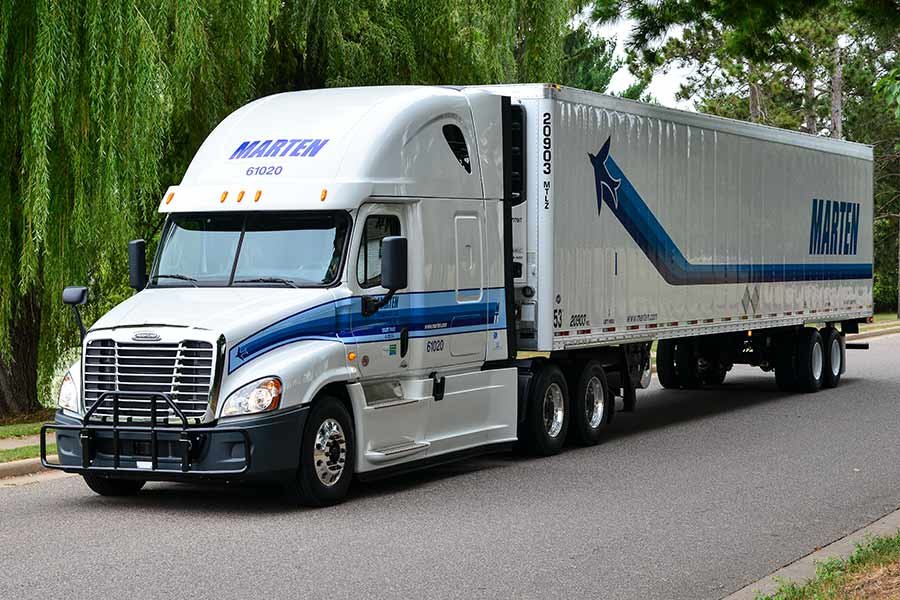
Investors did not like what they saw from Marten Transport on Friday. The refrigerated carrier’s stock (NASDAQ: MRTN) was down 7% by midday after a third-quarter report that fell short of expectations. This happened even as supply and demand in the freight market are moving in the right direction. Climbing fuel and health insurance costs, along with other expenses, ate into the quarter’s results.
The Mondovi, Wisconsin-based company earned $2.9 million, or $0.04 per share. That is one cent better than the same quarter last year, but two cents below the consensus estimate.
Marten pointed to higher fuel and payroll expenses, including raises for drivers, as the main culprits. Bigger gains from equipment sales offset only a portion of the damage. Taken together, these items cut net income by $3.7 million, or 4.5 cents per share.
On the top line, consolidated revenue reached $223 million, 1% above the prior-year period. The comparison is skewed by the 2025 sale of Marten’s intermodal business to Hub Group (NASDAQ: HUBG), which removed $9.9 million in revenue from this quarter.
| Consolidated: | Q3/26 | Q3/25 | Y/Y Gross Change | Y/Y % Change |
| Revenue | $223.2 | $220.5 | $2.8 | 1.3% |
| Revenue (ex fuel) | $184.2 | $185.5 | -1.4 | -0.7% |
| OR % (ex-fuel) | 98.3% | 98.6% | -30 bps | -0.3% |
| EPS | $0.04 | $0.03 | $0.01 | 33.3% |
Because Marten does not hold a quarterly earnings call, its view of the market came only through a news release. Chairman and CEO Randy Marten argued that the truckload market has tightened sharply since earlier this year, because “renewed and enhanced enforcement of federal and state law is removing a meaningful amount of noncompliant and unqualified driver capacity from the marketplace.” According to him, the company is now winning higher prices from customers for its premium services while also improving freight quality across its network, and he described this as the early stages of an upcycle.
The one-way truckload unit shows that logic at work. Revenue rose 12% year over year to $117 million, or 4% when fuel surcharges are stripped out. Marten has been cutting its truck count to get more out of each asset, and the fleet is now 9% smaller. Even so, revenue per tractor per week (ex-fuel) jumped 15%. Deadhead slipped 30 basis points to 10.7%, and revenue per loaded mile (ex-fuel) gained 14% to $3.02.
Profitability has not caught up yet. The unit ran at a 100.2% operating ratio (ex-fuel), which means it lost money. That is 200 bps better than a year earlier, but 280 bps worse than in the previous quarter.
The dedicated segment went the other way. Revenue (ex-fuel) fell 9% year over year, as an 11% drop in trucks was only partly cushioned by a 2% gain in revenue per tractor (ex-fuel). Revenue per loaded mile (ex-fuel) declined 2% to $2.41. The operating ratio (ex-fuel) came in at 97.6%, 360 bps worse than a year ago and 220 bps worse than in the prior quarter.
| Marten Transport | Q3/26 | Q3/25 | Y/Y Gross Change | Y/Y % Change |
| TL: | ||||
| Revenue | $117.3 | $104.8 | $12.5 | 11.9% |
| Revenue (ex-fuel) | $94.1 | $90.1 | $3.9 | 4.3% |
| Average Tractors | 1,507 | 1,661 | -154 | -9.3% |
| Revenue/Tractor/Week (ex-fuel) | $4,749 | $4,129 | $620 | 15.0% |
| Total Miles | 34,825,000 | 38,081,000 | -3,256,000 | -8.6% |
| Deadhead % | 10.7% | 11.0% | -30 bps | -2.7% |
| Loaded Miles | 31,098,725 | 33,892,090 | -2,793,365 | -8.2% |
| Revenue per Loaded Mile (ex-fuel) | $3.02 | $2.66 | $0.36 | 13.7% |
| Average Length of Haul | 506 | 508 | -2 | -0.4% |
| OR % (ex-fuel) | 100.2% | 102.2% | -200 bps | -2.0% |
| Dedicated: | ||||
| Revenue | $67.2 | $67.0 | $0.2 | 0.3% |
| Revenue (ex-fuel) | $51.4 | $56.7 | -$5.2 | -9.2% |
| Average Tractors | 1,013 | 1,142 | -129 | -11.3% |
| Revenue/Tractor/Week (ex-fuel) | $3,862 | $3,776 | $86 | 2.3% |
| Total Miles | 21,559,000 | 23,206,000 | -1,647,000 | -7.1% |
| Deadhead % | 1.1% | 1.1% | 0 bps | 0.0% |
| Loaded Miles | 21,321,851 | 22,950,734 | -1,628,883 | -7.1% |
| Revenue per Loaded Mile (ex-fuel) | $2.41 | $2.47 | -$0.06 | -2.3% |
| Average Length of Haul | 292 | 292 | 0 | 0.0% |
| OR % (ex-fuel) | 97.6% | 94.0% | 360 bps | 3.8% |
Brokerage was the steadiest of the three. Revenue held flat at $39 million. A 15% drop in shipment volume was offset by a 17% increase in revenue per load. The segment’s operating ratio improved by 110 bps to 94.8%, the same level as in the second quarter of 2026.
| Brokerage: | Q3/26 | Q3/25 | Y/Y Gross Change | Y/Y % Change |
| Revenue | $38.7 | $38.8 | $0.0 | -0.1% |
| Load Count | 22,141 | 25,940 | -3,799 | -14.6% |
| Revenue/Load | $1,750 | $1,495 | $255 | 17.0% |
| OR % | 94.8% | 95.9% | -110 bps | -1.1% |
Elsewhere on the financial front, operating cash flow totaled $83 million for the first nine months of 2026, down 5% from a year earlier. Marten remained free of debt. Its tractor fleet is also getting a bit older, at an average of 2.5 years versus 2.2 years in the same quarter last year.
The shares have lost 37% since peaking in mid-June. Investors watch Marten closely because it is the pure play on refrigerated trucking and the only public carrier in the reefer market, which makes its quarterly numbers a bellwether for the industry.