Business Nov 13, 2026
Mexico’s Heavy-Duty Truck Exports Surge 159% as October Production Rebounds
A strong bounce back in manufacturing and overseas shipments signals new momentum for Mexico’s truck industry, but declining domestic retail sales, aging fleets and rising used-vehicle imports remain drags on the market.
Data from the National Institute of Statistics and Geography (INEGI) showed that heavy-duty vehicle manufacturing in Mexico had a strong rebound in October 2026, with production skyrocketing almost 130% year-on-year and exports surging nearly 159%.
In the month, Mexican manufacturers produced 16,375 heavy-duty vehicles, up 129.6% from the 7,131 units produced in October 2025.
Exports too sustained the upward swing, reaching 13,518 vehicles, up 158.9% from 5,221 units shipped during the same period last year.
The figures show a robust bounce back in Mexico’s export-led truck manufacturing sector, which is still highly dependent on demand from the United States, its biggest overseas market.
But the recovery in production and overseas shipments is compared with ongoing difficulties in the domestic market. The National Association of Bus, Truck and Tractor-Trailer Producers (ANPACT) continues to point to weak demand, an aging vehicle fleet and increasing competition from imported second-hand trucks as key obstacles to a wider recovery.
Rogelio Arzate, executive president of ANPACT, said: “The October performance is a mixed picture for the industry.” The month's retail sales were better but the cumulative total was still around 16% down on the year before.
Mexico’s manufacturing recovery is gaining strength on the back of export performance
Strong October results contributed to boosting Mexico’s cumulative production of heavy-duty vehicles.
Between January and October 2026, manufacturers assembled 133,496 vehicles, up 17.8% from the 113,299 units produced in the same period in 2025.
Exports also remained on a positive trend. International shipments in the first 10 months of the year totaled 111,912 vehicles, a 20.3% increase from 93,037 units a year earlier.
The main destination for Mexico’s exports was still the United States, which imported 104,064 heavy-duty vehicles from January to October. This accounted for approximately 93% of the nation’s total exports, according to INEGI.
Arzate said shipments to the US alone soared 173.5% year over year in October to 13,097 vehicles. Exports to the American market increased 18.6% from January to October.
Canada was Mexico’s second-largest export destination, with 4,493 vehicles sent during the first 10 months of 2026. Third place was for Colombia with 2,138 units.
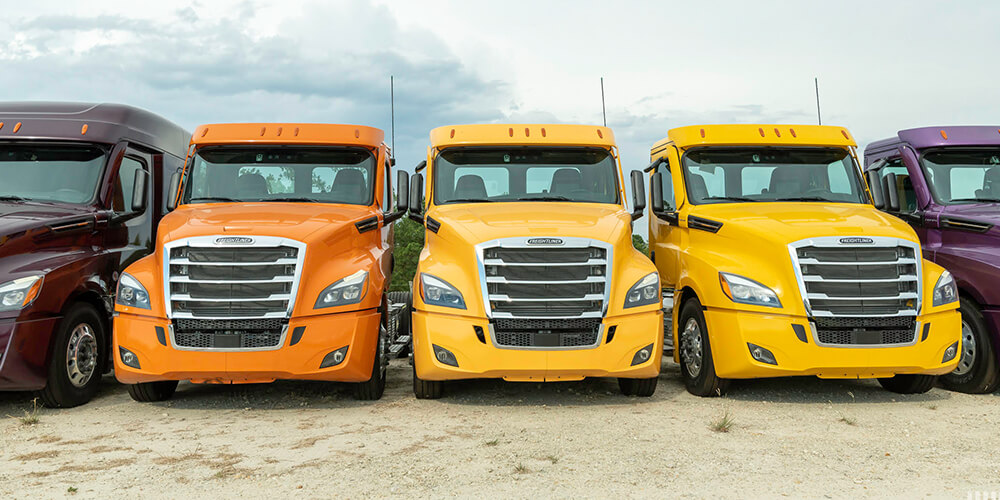
Freightliner also remained the top manufacturer, making up nearly 64% of Mexico’s heavy-duty vehicle production and 71% of its exports in October.
Significant contributions to the industry performance also came from International and Kenworth. The three manufacturers, along with Freightliner, accounted for roughly 97% of total production and almost all of the exports registered in the month.
October 2026: Production and export performance by manufacturer
Manufacturer | Production | Exports | Production YoY | Exports YoY |
|---|---|---|---|---|
Freightliner | 10,457 | 9,568 | +160.3% | +164.1% |
International | 4,208 | 3,583 | +189.6% | +205.2% |
Kenworth | 1,145 | 366 | +5.8% | -13.7% |
Combined total | 15,810 | 13,517 | — | — |
Mexico industry total | 16,375 | 13,518 | +129.6% | +158.9% |
Source: INEGI, Administrative Registry of the Heavy Vehicle Automotive Industry (RAIAVP), November 11, 2026. Year-over-year comparisons are against October 2025.
Domestic demand still trails industrial growth
Despite a significant improvement in manufacturing and exports, Mexico’s domestic heavy-duty vehicle market continues to be under pressure.
Retail sales ticked slightly higher in October as well, rising 5.1% to 3,162 vehicles, from 3,009 units in the same month in 2025.
But the overall performance is still much worse. Retail sales of 28,479 vehicles were recorded in the January-October 2026 period, down 15.4% on the 33,653 units recorded in the same period last year.
The picture was brighter in the wholesale sector. Sales in October rose 26.8% from a year ago to 3,301 vehicles.
Wholesale sales for the first 10 months of 2026 were 26,912 units, an increase of 10.5%.
The tractor-trailer segment was one of the strongest contributors to this improvement. Wholesale sales of fifth-wheel tractor units were up 48.1% in October to 1,438 units, from 971 units in October 2025.
At the industry’s news conference, Cristina Vázquez, coordinator of economic studies at the Mexican Automotive Distributors Association (AMDA), said October was only the second month this year to post positive year-over-year growth in retail sales.
She also noted uncertainty about economic conditions and North American trade policies as factors that impact buying decisions in the transport sector.
Vázquez said some companies are holding back on buying vehicles, hoping for more clarity about future operating conditions and investment prospects.
This reluctance still hampers domestic demand recovery, despite the better performance of Mexico’s manufacturing and export activities.
Imports of used trucks add to fleet renewal pressure
Another big challenge for the Mexican commercial vehicle market is the increasing arrival of imported used heavy duty trucks.
ANPACT has repeatedly voiced concern about the impact of used-truck imports from the United States, saying they undercut demand for newly manufactured vehicles and make it harder to modernize the country's transport fleet.
Arzate presented data that indicated that for every 100 new heavy-duty vehicles sold in Mexico between January and September 2026, around 51.4 used heavy-duty vehicles were imported from the United States.
The association believes this imbalance is a source of market distortion. Older vehicles can exert downward price pressure, deter new equipment investment and delay the renewal of aging commercial fleets.
ANPACT also expressed concern about the rise of imports of busses manufactured in countries without free trade agreements with Mexico.
To deal with these challenges the organization is calling for stronger vehicle scrappage programs, more accessible financing solutions and targeted policies to help smaller transport operators replace older vehicles.
The financing terms and incentives to refresh fleets are especially important to many smaller trucking firms, for whom the sticker price on new equipment is still a major obstacle.
Why is it important
The heavy-duty vehicle manufacturing industry in Mexico occupies a strategic position within the North American automotive and logistics supply chains. The figures for October show how closely the industrial performance of the country is still tied to US demand.
But the divergent path of surging exports and lagging domestic retail sales underscores the uneven recovery.
While manufacturers are enjoying a surge in international orders, Mexican transport operators still suffer from financial uncertainty, aging equipment and competition from imported used vehicles.
So the longer-term prospects for the industry will depend not only on maintaining export momentum but also on restoring domestic purchasing power and accelerating the modernization of Mexico’s commercial vehicle fleet.
END OF REPORT