Maritime Nov 18, 2026
NYK presents Japan’s first ammonia-powered vessel equipped with dual-fuel main and auxiliary engines
The 40,000 m³ medium gas carrier Izanami features Japanese-built ammonia dual-fuel engines and will undergo operational demonstrations under a charter agreement with Yara Clean Ammonia.
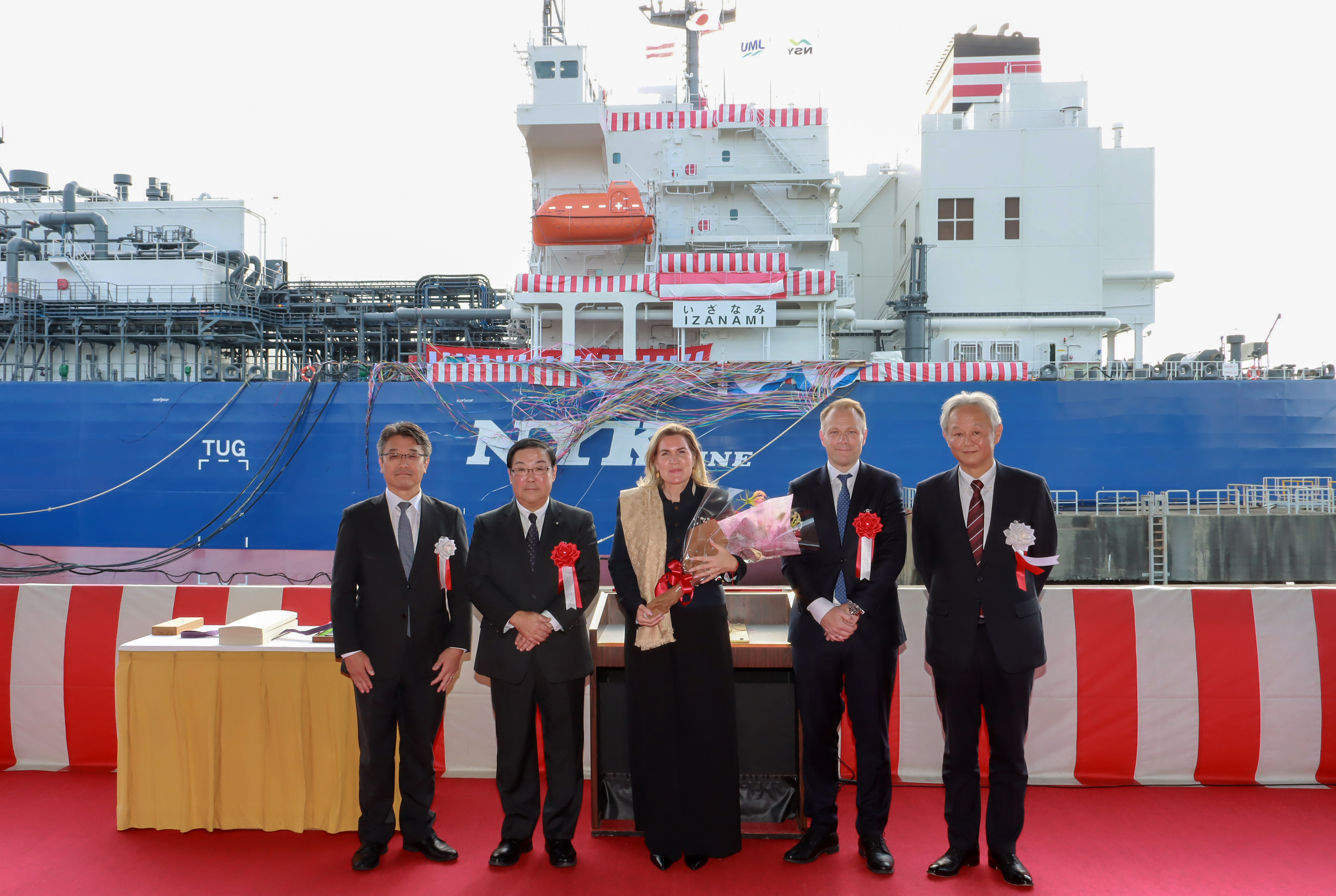
Japanese shipping group NYK formally launched its newly-built ammonia-fuel medium gas carrier Izanami at a ceremony at Japan Marine United Corporation’s Ariake Shipyard. The ship is a big step in Japan's push to promote the use of ammonia as a fuel for ships.
Izanami has a capacity of 40,000 cubic meters and is notable for the ammonia-fuelled configuration of its main and auxiliary engines. Both the propulsion and auxiliary power system technologies are of Japanese origin.
The vessel's two-stroke ammonia dual-fuel main engine was developed by Japan Engine Corporation, and its four-stroke ammonia dual-fuel auxiliary engines were manufactured by IHI Power Systems.
The project was carried out under a public-private partnership under the initiative “Development of Ships Equipped with Domestically Produced Ammonia-Fueled Engines”, which is supported by Japan’s Green Innovation Fund Project. This program has already supported NYK’s development of ammonia-fuelled tugboat Sakigake.
After delivery, Izanami will commence service on a time-charter contract with Yara Clean Ammonia. The setup will allow the assessment of the vessel performance in real operating conditions.
NYK says that during the charter period, demonstration voyages will be conducted to assess operational performance, safety and the potential reduction of greenhouse gas emissions. The experience and technical data collected will be applied to the design and future operation of ammonia-fuelled vessels.
The unveiling ceremony on 17 November was attended by about 100 people. Among the guests were Kentaro Asahi, Japan’s Vice-Minister of Land, Infrastructure, Transport and Tourism, and Yasushi Kaneko, member of the Japanese House of Representatives.
The Izanami represents another step in the development of alternative marine fuels and also shows Japan’s progress in developing domestically engineered technologies for the decarbonization of shipping.
END OF REPORT