



Fiber and metals are not the only packaging materials being drawn into the ongoing United States-Canada trade war. Plastic products are increasingly becoming part of the tariff debate as companies work through tariff classifications and discover that a wide range of items are covered by the new measures.
According to Rabobank, tariffs have become one of the most pressing challenges facing plastic packaging producers, alongside the continuing impact of the war involving Iran.
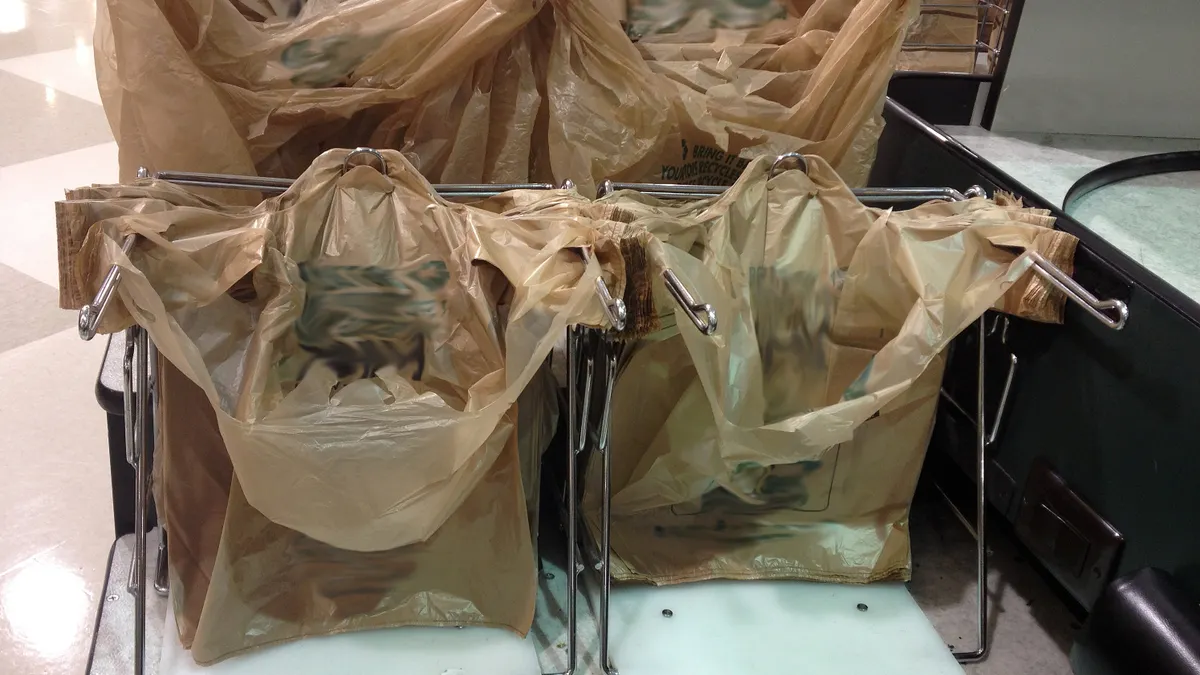
Polyethylene bags are included in Canada’s reciprocal tariff order at a 50% tariff rate. The same rate applies to stoppers, lids, caps, other closures and tableware. In addition, a 15% tariff applies to various molds used to manufacture plastic, metal and rubber products.
The rapidly changing trade environment is creating uncertainty over exactly which products fall within specific Harmonized Tariff Schedule codes. Plastics are not unique in facing this problem.
During an August earnings call, Hugues Simon, CEO of Canada-based fiber packaging company Cascades, noted that products made from the same fiber grade are not necessarily treated the same way under the two countries’ tariff regimes. A similar situation was highlighted last week by Montreal news outlet The Gazette, which reported on the difficulties faced by a manufacturer of plastic air pillows.
“It’s up to the exporters and importers to identify what the correct codes are,” said Jim Owen, senior packaging and logistics analyst at Rabobank. “Depending on the size of the converter and your influence over the supply chain, there’s probably a lot of confusion.”
In a recent report, Owen estimated that around 20% of the approximately $15 billion in annual U.S.-Canada plastics trade is exposed to the 50% tariffs imposed by the United States on $20 billion worth of Canadian goods in July. He stressed, however, that the situation remains fluid and that the share of trade affected could increase.
“I wouldn’t be surprised, until we come to a resolution, that there would be continued fluctuation in what’s hit and how hard,” Owen said.
For converters, rapidly changing tariffs and the lack of clarity are creating volatility and increasing short-term margin risks. Companies can also find it difficult to commit to fixed-price purchase orders when costs may shift substantially between the time a bid is submitted and the order is ultimately fulfilled.
Owen also explained that Section 338 duties are added on top of existing base duties and can apply even to products that would otherwise qualify for free-trade treatment under the United States-Mexico-Canada Agreement.
“We spent 30 years making this a well-oiled machine with free trade on plastic and molds and resins and additives,” Owen said. “It’s a pretty big shift to add some friction into that equation.”
At the same time, the continuing effects of the war involving Iran are adding another layer of pressure to the plastics sector.
The conflict reached the six-month mark in late August, while polyolefins have absorbed a significant share of its impact this year. Expectations for a resolution emerged in June, but those hopes faded after fighting resumed in July, bringing back supply chain disruptions and renewed price spikes.
Producers of polyethylene and polypropylene have reported sharply higher profits, but packaging converters have found themselves under growing financial pressure as the cost of materials, energy and transportation climbs.
North American polyethylene and polypropylene producers generally rely on ethane as a feedstock, giving them a cost advantage over petroleum-derived naphtha, which is widely used in Asia and Europe. As the war and the closure of the Strait of Hormuz have disrupted oil supply chains and pushed prices higher, demand has increased globally for lower-cost North American polyolefins, which are increasingly being exported to overseas markets.
That trend is creating a different problem for some U.S. converters. As domestic producers send more material abroad and/or raise prices, converters can no longer rely on the same cost advantage associated with domestically produced resins.
“There’s people eating margin right now that make it very challenging to deliver on yearly or quarterly results,” Owen said.
Taken together, the tariff dispute, geopolitical tensions, energy and transportation costs, supply chain disruptions and weaker consumer demand could leave a lasting mark on plastics markets and the businesses operating within them.
“With the Strait of Hormuz doing what it’s done to plastics, as well as the consumer rut that we’re in where demand is low, it’s quite a challenge,” Owen said. “And I don’t see a huge change coming in the next several years.”