



The Blue Sky Maritime Coalition (BSMC), now operating under new management and with a new Board, returned to the spotlight with its latest Maritime Action: Accelerated Innovation and Efficiency in North American Shipping conference and networking event. The gathering took place on World Maritime Day, September 23, during New York City Climate Week.
Rich Byrnes, the coalition’s new President and CEO, opened the session by outlining the BSMC’s renewed focus on “moving from declarations to delivery.” Rather than concentrating on broad decarbonisation concepts, the organisation is placing greater emphasis on the practical implementation of measures capable of reducing emissions from vessel operators serving North America.
At the centre of the event was a panel discussion moderated by Alan Ginsberg, Chief Financial Officer of McAllister Towing. Joining him were BSMC Board members Ted Tregurtha, Board Chair and a representative of rival operator Moran Transportation, Julie Ferland, Shell’s Vice President for Shipping and Maritime America, and Wells Fargo banker Brett Hewitt. The discussion focused specifically on alternative fuels and technologies for tugboats.
Ginsberg underlined the broader responsibility attached to emissions reductions, stating: “In my opinion, reducing emissions is everyone’s responsibility…” His comments followed a discussion of the fact that tugboat emissions are considered Scope 3 emissions, meaning downstream emissions, under certain international frameworks.
Renewable diesel gains traction
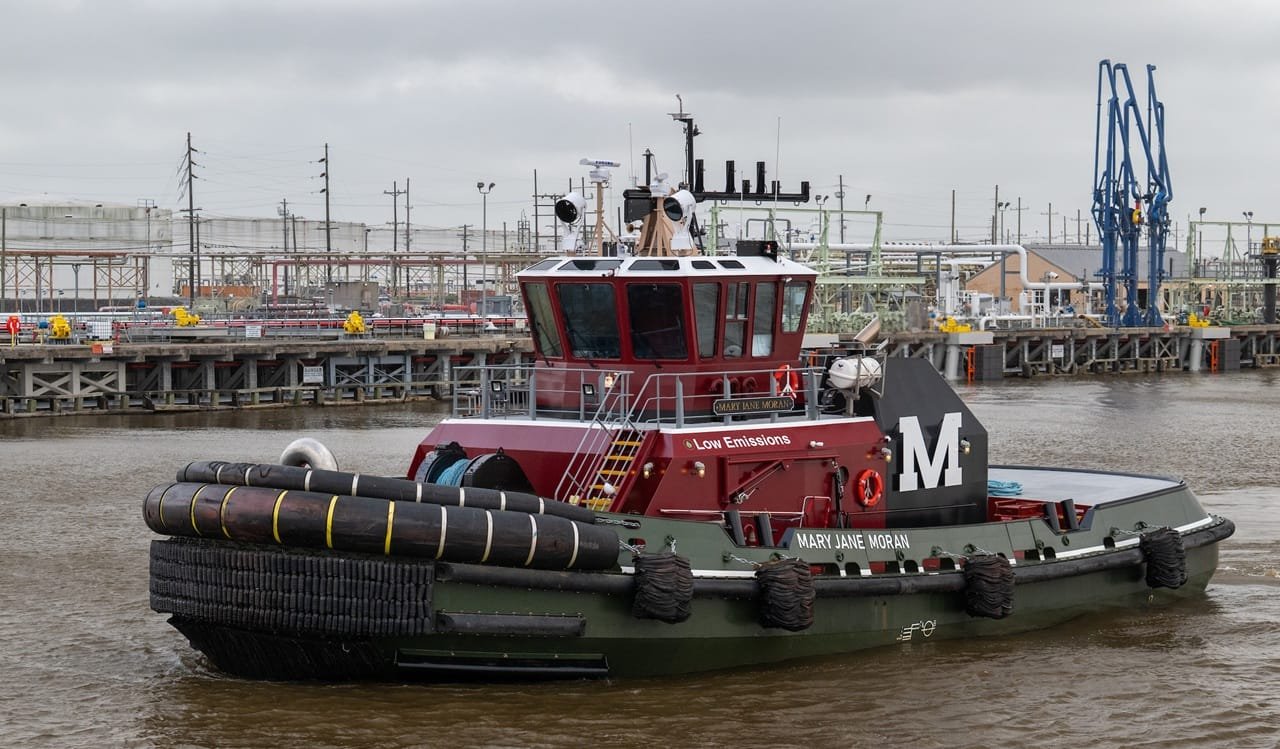
Ted Tregurtha outlined Moran’s decades-long efforts to identify viable alternatives to conventional marine fuels. The company’s challenge, he explained, has consistently been finding a solution capable of meeting three requirements at once: keeping mariners safe, maintaining reliable service for customers and remaining economically viable.
Moran’s recent experience with renewable diesel has nevertheless been increasingly encouraging. Tregurtha pointed to positive results from the use of renewable diesel on vessels operating in several ports.
The company has also been able to monetise reductions of approximately 5,600 tons of carbon through “carbon insets”, a financial mechanism arranged with ClimeCo, another BSMC member.
“That’s a pathway that we can get behind,” Tregurtha said.
Another advantage of renewable diesel is that it can be used without retrofitting existing tugboats, unlike several other alternative-fuel technologies.
Availability, however, remains a significant concern. Tregurtha noted that renewable diesel is costly in the New York area and said that much of the available supply is directed toward California.
“Most of the renewable diesel finds its way to California,” he said.
He also pointed to the importance of government incentives and regional credit systems in shaping the renewable fuel market, saying that “the whole renewable market is heavily driven by credits” and that availability is “complicated by government policy.”
Price remains a challenge
Renewable diesel generally remains more expensive than conventional diesel, although the cost difference can be reduced through carbon-inset mechanisms.
Tregurtha also highlighted a notable development in Europe, referring to recent reports from the Port of Rotterdam indicating that renewable diesel was selling for less than regular diesel.
The price gap therefore remains closely linked not only to fuel production and availability, but also to regional policy frameworks and incentive structures.
Electrification enters the discussion
The panel also examined the potential for tugboat electrification, generally through rechargeable battery systems combined with diesel engines or other alternative-fuel propulsion systems.
Peter Wallace, Principal Engineer for Risk and Regulatory Advisory at Lloyd’s Register, brought extensive naval architectural experience to the discussion. His assessment of properly engineered electric vessels was unequivocal:
“Anyone who has ever used a properly designed and built electric boat – they never go back.”
Responding to a question from Ginsberg during the earlier panel session, Tregurtha said advances in battery technology would make electrification increasingly important for the tugboat sector.
“With advances in battery technology, electrification is going to be one of the key pillars of efficiency, resiliency and decarbonisation,” he said.
At the same time, he pointed to a major obstacle: the lack of adequate electrical charging infrastructure at the ports served by Moran.
Tugboats remain underrepresented in federal programmes
Ginsberg also addressed the role of tugboats in recent US federal efforts aimed at reducing emissions in and around seaports.
According to the McAllister executive, tugboats have received very limited attention in federal programmes designed to support port decarbonisation.
“The website of the Environmental Protection Agency, [the administrator for numerous environmental grant programs] does not contain the word ‘tugboat’,” he said.
The comments highlighted a broader issue facing operators seeking to deploy lower-emission tugboat technologies: available solutions are expanding, but their wider adoption depends not only on technology and economics, but also on fuel availability, charging infrastructure and the design of government support programmes.