



The United States has sharply raised the pressure at the International Maritime Organization by calling for the body’s proposed Net Zero Framework to be abandoned altogether, deepening an already visible divide over the future direction of shipping decarbonisation.
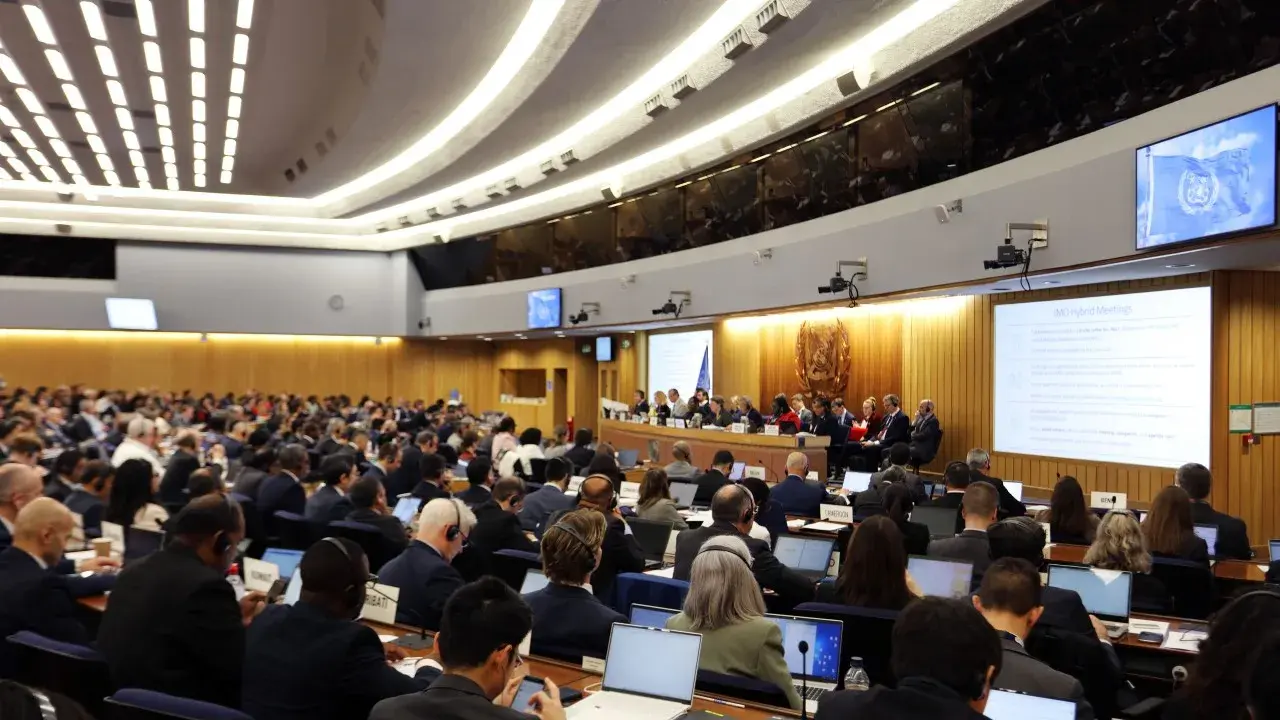
In its submission to the 84th session of the Marine Environment Protection Committee, known as MEPC84, the US delegation said the current IMO Net Zero Framework suffers from serious shortcomings and does not command the consensus needed to move forward effectively.
Washington also argued that the IMO should not resume the Extraordinary Session 2 of the Marine Environment Protection Committee, which had been adjourned last year for 12 months. According to the US position, the most appropriate course is to end consideration of the Net Zero Framework entirely rather than revive discussions in their current form when the session is due to remain adjourned until November 2026.
The US intervention aligns with a separate submission led by Algeria and supported by Bahrain, Iraq, Kuwait, the Russian Federation, Saudi Arabia, Somalia and the United Arab Emirates. That group maintains that the framework presented in October 2025 cannot secure the level of agreement required for implementation.
Backing that view, the US said the proposal in its current form would suppress ongoing debate and distract from what it described as more constructive, member-state-led discussions. In other words, Washington is not simply asking for revisions; it is questioning whether the framework should continue to exist at all.
Opposition has also been articulated through another submission, this time from Argentina, Liberia and Panama. That filing suggests that resistance to the framework stems from a mix of geopolitical, economic and procedural concerns. It also warns that the proposed greenhouse gas fuel intensity measure is too restrictive and that related emissions penalties could reach as much as US$300 billion by 2035, with disproportionate consequences for small and medium-sized businesses as well as tramp operators.
According to that submission, the concerns go beyond cost alone. It argues that the system risks functioning more as a penalty mechanism than as an incentive for innovation. It also highlights reduced flexibility linked to expiring surplus units, as well as uncertainty surrounding several undefined elements, including the reward mechanism, default life cycle assessment values and the governance of the proposed IMO Fund.
For critics, these unresolved issues create real implementation challenges and leave too many strategic and financial questions unanswered. For supporters of stronger climate measures, however, the debate risks delaying badly needed progress on maritime decarbonisation.
What is increasingly clear is that the battle lines at the IMO are no longer just technical. They are geopolitical, commercial and structural, and the fight over the Net Zero Framework is becoming a defining test of how far the industry is willing — and able — to go in aligning climate ambition with global shipping realities.