

• Latest
  • Trending
Autonomous Trucks Could Save Consumers $9 Billion a Year by 2035, Study Says

Autonomous Trucks Could Save Consumers $9 Billion a Year by 2035, Study Says

March 21, 2026
What the Iran war means for Asia Pacific air corridors

What the Iran war means for Asia Pacific air corridors

May 18, 2026
Saudia Cargo, Tibah partner to boost Madinah logistics development

Saudia Cargo, Tibah partner to boost Madinah logistics development

May 18, 2026
ADVERTISEMENT
GEODIS selects Rotate to strengthen global air cargo market intelligence

GEODIS selects Rotate to strengthen global air cargo market intelligence

May 18, 2026
Port of Los Angeles sees April volume jump despite Iran war shadow

Port of Los Angeles sees April volume jump despite Iran war shadow

May 18, 2026

UP, NS merger: What other railroads are saying

May 18, 2026
NAM calls for making the USMCA even more manufacturing friendly

NAM calls for making the USMCA even more manufacturing friendly

May 18, 2026
USPS to align dimensional pricing closer to FedEx, UPS

USPS to align dimensional pricing closer to FedEx, UPS

May 18, 2026
Labor Dept. jumps in on the push for driver English language proficiency

Labor Dept. jumps in on the push for driver English language proficiency

May 18, 2026
This autonomous ship mooring system really sucks – and that’s a good thing

This autonomous ship mooring system really sucks – and that’s a good thing

May 18, 2026
Velesto lands Hibiscus drilling deal in first asset-light rig move

Velesto lands Hibiscus drilling deal in first asset-light rig move

May 18, 2026
ADES secures fresh rig deals worth $270m

ADES secures fresh rig deals worth $270m

May 18, 2026
New global alliance formed to fast-track liquid hydrogen shipping ecosystem

New global alliance formed to fast-track liquid hydrogen shipping ecosystem

May 18, 2026
  • Home
  • About Us
  • Press Room
  • Podcasts
  • Media Kit
  • Contact Us
  • Careers
Tuesday, May 19, 2026
  • Login
  • Register
The Logistic News
  • Logistic
  • Air
  • Maritime
  • Land
  • World
  • Business
  • Tech
  • Events
  • Advertise
No Result
View All Result
  • Logistic
  • Air
  • Maritime
  • Land
  • World
  • Business
  • Tech
  • Events
  • Advertise
No Result
View All Result
The Logistic News
No Result
View All Result
Home Logistic

Autonomous Trucks Could Save Consumers $9 Billion a Year by 2035, Study Says

A new report backed by Aurora projects major economic, safety and productivity gains from self-driving trucks, including a $70 billion contribution to GDP and nearly 500 lives saved annually.

The Logistic News by The Logistic News
March 21, 2026
in Logistic, Tech
Reading Time: 3 mins read
0
Autonomous Trucks Could Save Consumers $9 Billion a Year by 2035, Study Says
ADVERTISEMENT

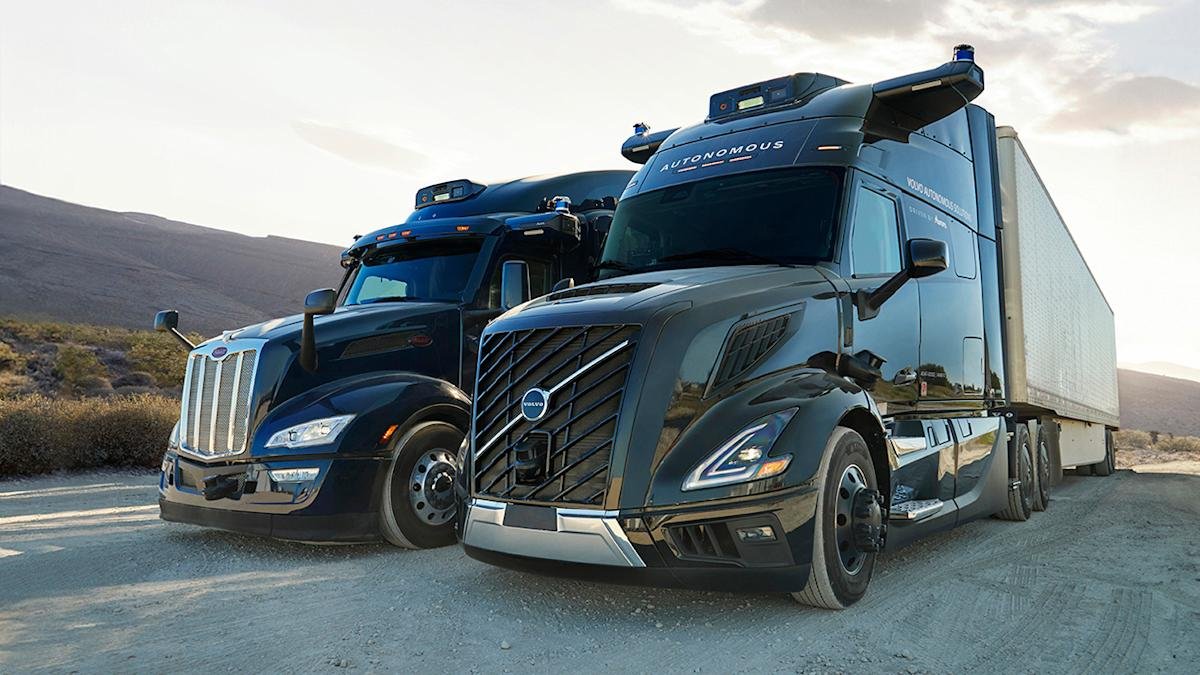
Self-driving trucks could deliver sweeping benefits across the US freight economy over the next decade, according to a new report commissioned by Aurora Innovation and carried out by the Steer Group.

The study argues that, under an accelerated deployment scenario, autonomous trucking could generate $9 billion in annual consumer savings, contribute $70 billion to gross domestic product and prevent nearly 500 road deaths every year by 2035.

Even at today’s early stage of development, the report says the autonomous trucking sector already supports 17,000 jobs and $3.3 billion in total economic output. By 2035, it projects that around 170,000 self-driving trucks could be operating on US highways — equivalent to roughly 15% of the market — collectively driving 33 billion miles per year.

ADVERTISEMENT

Aurora chief executive Chris Urmson said autonomous trucking has the potential to strengthen the US economy, improve road safety and make supply chains more resilient and efficient.

One of the report’s strongest claims relates to safety. Large trucks are involved in one out of every eight fatal crashes on US roads, contributing to around 5,300 deaths annually. The Federal Motor Carrier Safety Administration attributes 87% of at-fault truck crashes to driver error, including inattention, poor decision-making, fatigue and physical impairment.

In that context, the report estimates that self-driving technology could prevent 490 fatalities, 8,800 injuries and 23,000 crashes per year by 2035. Measured against US Department of Transportation standards, those reductions would represent $9.4 billion in annual socioeconomic safety benefits.

The financial benefits for carriers could also be substantial. The analysis forecasts a 40% reduction in insurance premiums, equivalent to $1.4 billion in annual savings. Aurora says its trucks can detect hazards more than 450 meters ahead and identify pedestrians 11 seconds faster than human drivers at highway speed at night.

Supporters of autonomy also point to evidence from adjacent sectors. Waymo, for example, has reported a 90% reduction in serious and fatal crashes compared with human drivers over 125 million miles in San Francisco, Los Angeles, Phoenix and Austin.

The productivity case may be just as compelling. Human drivers in the US are limited by hours-of-service rules to 11 hours of driving within a 14-hour work window, followed by 10 consecutive hours off duty. Autonomous trucks do not face those restrictions.

That difference could transform equipment utilization. On a 1,000-mile lane such as Fort Worth to Phoenix, a conventional truck may cover between 500 and 750 miles before a required break, depending on available driver hours. A self-driving vehicle could complete the route in a single day and begin the return leg immediately, effectively more than doubling productivity.

The report also projects 32% fuel savings through smoother acceleration, optimized speed control and better route management. Across the industry, that could translate into $5.7 billion in annual fuel savings and 1.6 billion gallons conserved. Lower emissions would add another $730 million in public health benefits.

Because trucking underpins the movement of most goods consumed in the US, the study argues that lower transport costs would eventually flow through to households in the form of $9 billion in increased purchasing power each year.

On employment, the report presents autonomy not as a pure replacement story, but as a shift in job types. It argues that while trucking continues to struggle with driver turnover and a shortage of qualified labor, self-driving technology could create demand for higher-skilled roles in software engineering, advanced manufacturing and specialized operations. It adds that 82% of autonomous vehicle workers already earn above the national median wage, and many of those jobs do not require a college degree.

Aurora also announced a $1 million commitment through its Aurora Works program to help ensure workforce opportunities scale alongside the technology.

The rollout is expected to begin in Sun Belt states including Texas, Arizona, Florida and Georgia, with a broader national network targeted by 2030. The biggest obstacle, the report says, remains regulation. States that establish supportive legal frameworks are expected to attract more investment, while others may fall behind.

The study concludes that Level 4 autonomous trucking could represent one of the most significant productivity gains in an industry responsible for moving more than 60% of domestic freight tonnage in the United States.


Previous Post

MSC Makes Major Bet on Tankers with Sinokor Stake

Next Post

The True Cost of Engine Maintenance: Why the Biggest Expense Goes Far Beyond the Shop Visit

Next Post
The True Cost of Engine Maintenance: Why the Biggest Expense Goes Far Beyond the Shop Visit

The True Cost of Engine Maintenance: Why the Biggest Expense Goes Far Beyond the Shop Visit

Leave a Reply Cancel reply

Your email address will not be published. Required fields are marked *

A D V E R T I S E M E N T

Popular News

  • Drone Delivery Takes Flight: Amazon Partners with UPS for Trial Program

    Drone Delivery Takes Flight: Amazon Partners with UPS for Trial Program

    0 shares
    Share 0 Tweet 0
  • Rail Cargo Group Strengthens European Network with Captrain Netherlands Acquisition

    0 shares
    Share 0 Tweet 0
  • Automotive Inbound Logistics Market: Navigating Future Challenges

    0 shares
    Share 0 Tweet 0
  • Global Inflation Cools to Target After Three Years, Central Banks Face Policy Dilemma

    0 shares
    Share 0 Tweet 0
  • Dubai Mercantile Exchange Rebrands as Gulf Mercantile Exchange Following Saudi Tadawul Group Acquisition

    0 shares
    Share 0 Tweet 0

Recent News

What the Iran war means for Asia Pacific air corridors

What the Iran war means for Asia Pacific air corridors

May 18, 2026
Saudia Cargo, Tibah partner to boost Madinah logistics development

Saudia Cargo, Tibah partner to boost Madinah logistics development

May 18, 2026
GEODIS selects Rotate to strengthen global air cargo market intelligence

GEODIS selects Rotate to strengthen global air cargo market intelligence

May 18, 2026

Discover a new era of logistics reporting with The Logistic News, your go-to platform for breaking news, insightful features, and exclusive interviews shaping the global logistics and freight landscape. Trust us to deliver accurate, timely, and relevant information that empowers professionals and enthusiasts alike in navigating the intricacies of this vital sector.

Navigation

  • Home
  • About Us
  • Press Room
  • Podcasts
  • Media Kit
  • Contact Us
  • Careers
  • Privacy Policy
  • Terms of Use

© 2024 - thelogisticnews.com

Welcome Back!

Login to your account below

Forgotten Password? Sign Up

Create New Account!

Fill the forms below to register

All fields are required. Log In

Retrieve your password

Please enter your username or email address to reset your password.

Log In

SIgn Up Newsletter

This will close in 20 seconds

Manage Cookie Consent
We use technologies like cookies to store and/or access device information. We do this to improve browsing experience and to show (non-) personalized ads. Consenting to these technologies will allow us to process data such as browsing behavior or unique IDs on this site. Not consenting or withdrawing consent, may adversely affect certain features and functions.
Functional Always active
The technical storage or access is strictly necessary for the legitimate purpose of enabling the use of a specific service explicitly requested by the subscriber or user, or for the sole purpose of carrying out the transmission of a communication over an electronic communications network.
Preferences
The technical storage or access is necessary for the legitimate purpose of storing preferences that are not requested by the subscriber or user.
Statistics
The technical storage or access that is used exclusively for statistical purposes. The technical storage or access that is used exclusively for anonymous statistical purposes. Without a subpoena, voluntary compliance on the part of your Internet Service Provider, or additional records from a third party, information stored or retrieved for this purpose alone cannot usually be used to identify you.
Marketing
The technical storage or access is required to create user profiles to send advertising, or to track the user on a website or across several websites for similar marketing purposes.
Manage options Manage services Manage {vendor_count} vendors Read more about these purposes
View preferences
{title} {title} {title}
No Result
View All Result
  • Logistic
  • Air
  • Maritime
  • Land
  • World
  • Business
  • Tech
  • Events
  • Advertise

© 2024 - thelogisticnews.com