Land Nov 13, 2026
What B-1 Visa Holders Can Legally Do as Foreign Truck Drivers in the United States
As US authorities intensify enforcement of cross-border trucking regulations, Mexican and Canadian drivers face tighter scrutiny over domestic freight movements, putting carriers and brokers at greater risk of visa violations, disrupted deliveries and financial losses.
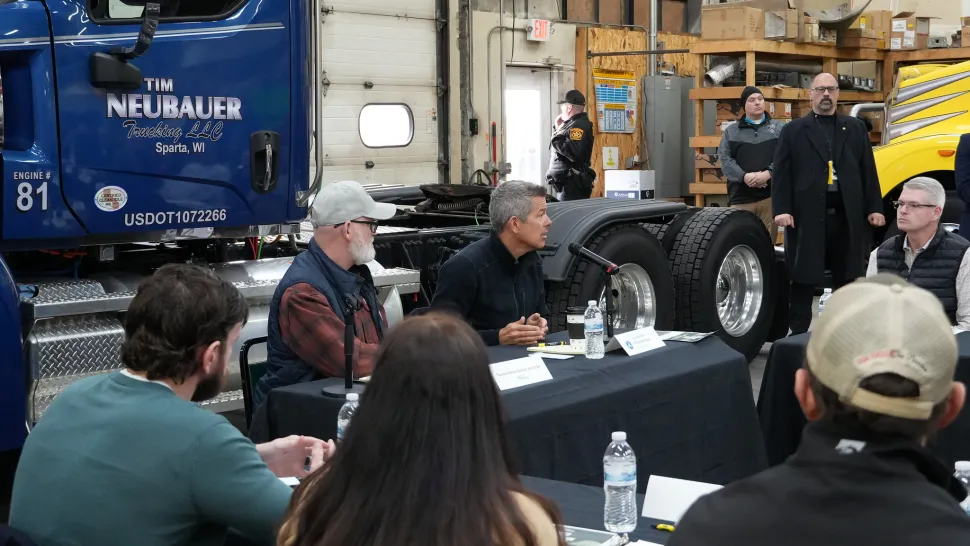
There have been rules for foreign truck drivers operating in the U.S. for decades. But their use has come back into focus in 2026, as federal agencies ramp up enforcement of laws governing violations of cross-border transport. A firm grasp of the specific parameters of B-1 visa privileges is now a necessity for international freight carriers, in an effort to avoid expensive compliance failures.
This is becoming a hot issue for the American trucking industry." Much of the argument comes from a misunderstanding of what Mexican and Canadian drivers can do when working on US soil. The B-1 visa does allow some business activity related to international transportation, but it does not allow free reign on the domestic freight market.
That is the difference that counts. If the foreign driver later participates in transportation activities that are not permitted under the visa, the cargo that legally entered the United States with that driver may be subject to an immigration or customs violation. The consequences can go beyond the individual driver and can hit the carrier that sent the load.
Cross-border trucking is regulated by two Federal Frameworks of Regulation
There are two different regulatory systems that apply to foreign truck operations in the United States. meeting one does not automatically mean that the other will be met.
Under cabotage rules in 19 CFR 123.14, CBP controls the movement of cargo and equipment. These rules control what foreign-registered trucks and trailers are legally allowed to do in the United States.
Immigration officials, however, regulate the actions of the people driving those vehicles. The relevant legal authority is 8 USC 1101 and the business-visitor provisions in 8 CFR 214.2(b).
The difference is simple. Customs rules determine if the freight and equipment are legal to participate in a given movement. Immigration rules determine if the driver is legally authorized to do the activity.
This enables a trailer to be cleared for a specific transportation operation while the driver assigned to the trailer is still in violation of his/her immigration status. This means carriers must check regulatory requirements at each stage of a shipment.
What transportation activities are allowed with a B-1 visa?
The B-1 classification is for business visitors. It allows Mexican and Canadian based drivers to operate in the trucking sector within transportation activities which are directly related to international commerce.
The fundamental requirement is that the freight must be a genuine cross-border movement either into or out of the United States.
Permitted activities are:
Ship cargo loaded in Mexico or Canada to one or more locations in the United States.
Entering the United States without a load to pick up American cargo for Mexico or Canada.
Dropping in the inbound trailer and running empty on that same trailer before loading it for an outbound international trip.
Delivering a loaded inbound trailer, traveling without a trailer to another US location and picking up a different loaded trailer for export.
Performing loading and unloading operations necessary to complete the international transport movement.
CBP covers these situations in its published guidance for land carriers. The guidance says that a U.S. carrier can use a foreign driver to move goods internationally to or from the driver’s home country, but not for domestic transportation without proper U.S. work authorization.
The central idea is that the driver's activity is connected to the international movement of goods. This includes delivery of imports to their American recipients or movement of exports toward the border, as long as the operation retains its international character.
Cabotage: The Border Line Foreign Drivers Can’t Cross
For B-1 truck drivers, the main limitation is cabotage, which is the carriage of domestic freight between two points within a country by a foreign operator.
What this means for foreign drivers coming to the United States is that generally, you cannot commercially move cargo between two locations within the United States on B-1 status.
For instance, a Mexican driver delivering an import shipment to Dallas cannot accept a paid load traveling from Dallas to Houston. Since the origin and destination are both in the United States, the movement is domestic transportation.
Other prohibited activities include:
Topping up – Adding a domestic shipment to an existing international load to utilize available trailer capacity.
Requesting household freight while in the United States.
Hauling an empty trailer in the US from one location to another, where it is not the same trailer the driver arrived in or will depart with.
The regulatory distinction depends on the nature of the transportation service. The B-1 classification does not allow for domestic operations that are in direct competition with US-based trucking companies.
Another important principle is the international status of freight on reaching its destination.
CBP guidance is that freight that has come to rest loses its international character upon importation. Once the shipment is in the domestic supply chain, after being unloaded, it cannot be collected and moved elsewhere under the original B-1 authorization.
This means that the driver is only allowed to drive the international part of the transportation and not the domestic distribution afterward.
But practical interpretation at border crossings is not always uniform. Canacar’s Tijuana delegate has reported disagreements among officers on how to treat empty trailers, with some officers considering the trailer itself to be cargo. This inconsistency has led to protests by drivers seeking more clarity on enforcement.
Why You Can’t Work in the U.S. Trucking Industry on a B-1 Visa
The restrictions on cabotage are inherent in the nature of the B-1 visa. This classification is not a U.S. employment authorization.
The State Department's Foreign Affairs Manual states that commercial activities not gainful employment in the United States are permitted under B-1 status. It also distinguishes travel for business from taking a domestic job.
An example in the manual concerns crews of foreign airlines. A person in B-1 status cannot use that status to conduct flight operations solely within the United States.
The same logic applies to trucking. International freight transport is considered to be part of cross-border business activity. However, accepting paid domestic loads is a US trucking job and requires the proper work authorization.
This differentiation has been a sore point in the freight market for ages.
Previous reports have pointed out the growth of fleets of outsourced B-1 drivers around Nuevo Laredo, some of whom are reported to pay their drivers in cash or cheque and not withhold taxes. Some of those drivers also were given domestic freight at rates far below prevailing market levels.
The financial reward was enormous. If drivers were paid Mexican wages but hauling American freight at American market prices, they could drive US-domiciled carriers out of the market.
For years, lax enforcement has allowed this business model to continue, despite existing restrictions under federal law.
New Enforcement Strategy Is Changing the Industry
Things started to change in April 2025 when the US government released an executive order titled Enforcing Commonsense Rules of the Road for America’s Truck Drivers.
The order directed the Department of Transportation (DOT) to shore up existing driver qualification requirements.
One of the first major changes was the proficiency in the English language. The requirement was a longtime inclusion in 49 CFR 391.11, but enforcement had been effectively frozen since 2016 guidance blocked inspectors from taking action against drivers who did not meet the standard.
That changed on June 25, 2025, when roadside inspectors were again given the authority to remove drivers from service for failing to adequately communicate in English.
At the same time there started to be an increase in visa cancelations, but not every case was directly linked to cabotage violations.
According to figures quoted by Mexico’s national freight chamber, Canacar, and attributed by its president to the American Trucking Associations, some 20,000 Mexican drivers lost their US work visas between April 2025 and April 2026. The wider enforcement drive included new driver qualification requirements, especially English-language proficiency, as well as cabotage-related scrutiny.
By September 2026, Canacar reps had estimated the total at over 25,000. The figure was based on reports from members and social media, rather than official US government statistics, the organization stressed.
The number specifically tied to cabotage is considerably smaller.
Transportation Secretary Sean Duffy said about 3,200 drivers have lost their visas for cabotage violations since January. The figure was initially relayed by a Canacar official and the DOT has not formally confirmed it as an exact total.
What the department has confirmed is the enforcement mechanism: Driver information is being shared with CBP, which allows authorities to target individuals suspected of cabotage violations. In some cases visas are canceled right at the border.
This has transformed regulations that had been largely dormant into an immediate operational risk for cross-border carriers.
The developments have also prompted protests at the border, as well as formal requests from Mexican industry groups asking CBP to clarify exactly what activities are violations.
Enforcement Is Spilling Beyond the U.S. Border
While the majority of enforcement activity still takes place on the US-Mexico border, Canadian drivers are no longer entirely off the radar.
In fact, throughout much of the spring, the Private Motor Truck Council of Canada reported that no Canadian drivers had been stopped for cabotage or had lost B-1 status.
This changed in August 2026 when US Border Patrol arrested a Canadian driver allegedly hauling freight between Deming and Los Lunas, both New Mexico locations.
Authorities said the domestic transportation movement was a violation of his nonimmigrant status. The driver could be prosecuted and deported.
Enforcement activity is still much heavier on the southern border, but the incident proves the same legal restrictions apply to operators in Mexico and Canada.
What U.S. Carriers and Freight Brokers Should Consider
The stepped-up enforcement campaign targets concerns that have been around for years for U.S. trucking companies, especially smaller ones that operate on border corridors and Sun Belt routes.
Domestic carriers have repeatedly complained that certain foreign operators, who use B-1 drivers, had the ability to offer artificially low prices because they could use cheaper labor and undertake domestic transportation activities that are not legal.
A South Texas carrier owner, who spoke anonymously out of fear of retaliation, described how more companies had adopted these practices over the previous years.
The latest in the enforcement saga has thus produced a cocktail of relief and uncertainty for compliant operators.
The process has unfolded as follows: The April 2025 executive order. The June 2025 reestablishment of English-proficiency enforcement. Border-level visa actions over cabotage by late 2025. The broader wave of revocations associated with DOT and CBP data sharing during 2026.
The implications are also economic for the larger trucking companies.
Nick Hobbs, COO of J.B. Hunt, and then-Schneider CEO Mark Rourke pointed to the availability of this kind of capacity as one of the reasons for the unusual low rates and the long-lasting downturn at a June 2025 Wells Fargo conference.
They said tighter enforcement of cabotage and English-language requirements could help bring a better balance to freight supply and demand. The Southwest and the Southeast were the regions most identified as needing attention.
The logic is simple: removing some of the underpriced trucking capacity from border routes would improve the pricing conditions for the operators that adhere to U.S. regulations.
Legal exposure and operational reliability
While criminal prosecution is still relatively rare, the potential ramifications for carriers are great.
A common example is the case in 2019 of two trucking operators in the Nogales area who pled guilty to illegally employing workers who were not authorized to work in the United States. Each operator lost two trucks and was fined $20,000.
The problem for most carriers, however, is the competitive pressure from the operators offering lower rates.
The enforcement campaign creates a new operational vulnerability. If a driver is detained at a border crossing or if their visa is canceled, the shipment may not arrive at its destination. A lane of transportation reliant on that driver can be made effectively unavailable overnight.
Why freight brokers should look beyond the quoted rate
Freight brokers also need to reconsider how they evaluate cross-border capacity.
The lowest-priced truck on an international route may be relying on transportation arrangements that carry a growing risk of enforcement action. A driver could be refused entry, lose their visa during an existing contract or undertake a domestic movement that should never have been assigned.
For brokers, the issue is not simply regulatory compliance. It is also service reliability.
A seemingly attractive rate can quickly become expensive when freight is stranded, delivery commitments are missed and shippers demand explanations.
Verifying who is actually operating a shipment and whether the assigned driver is authorized to perform every leg of the journey is becoming an increasingly important part of carrier selection.
END OF REPORT