



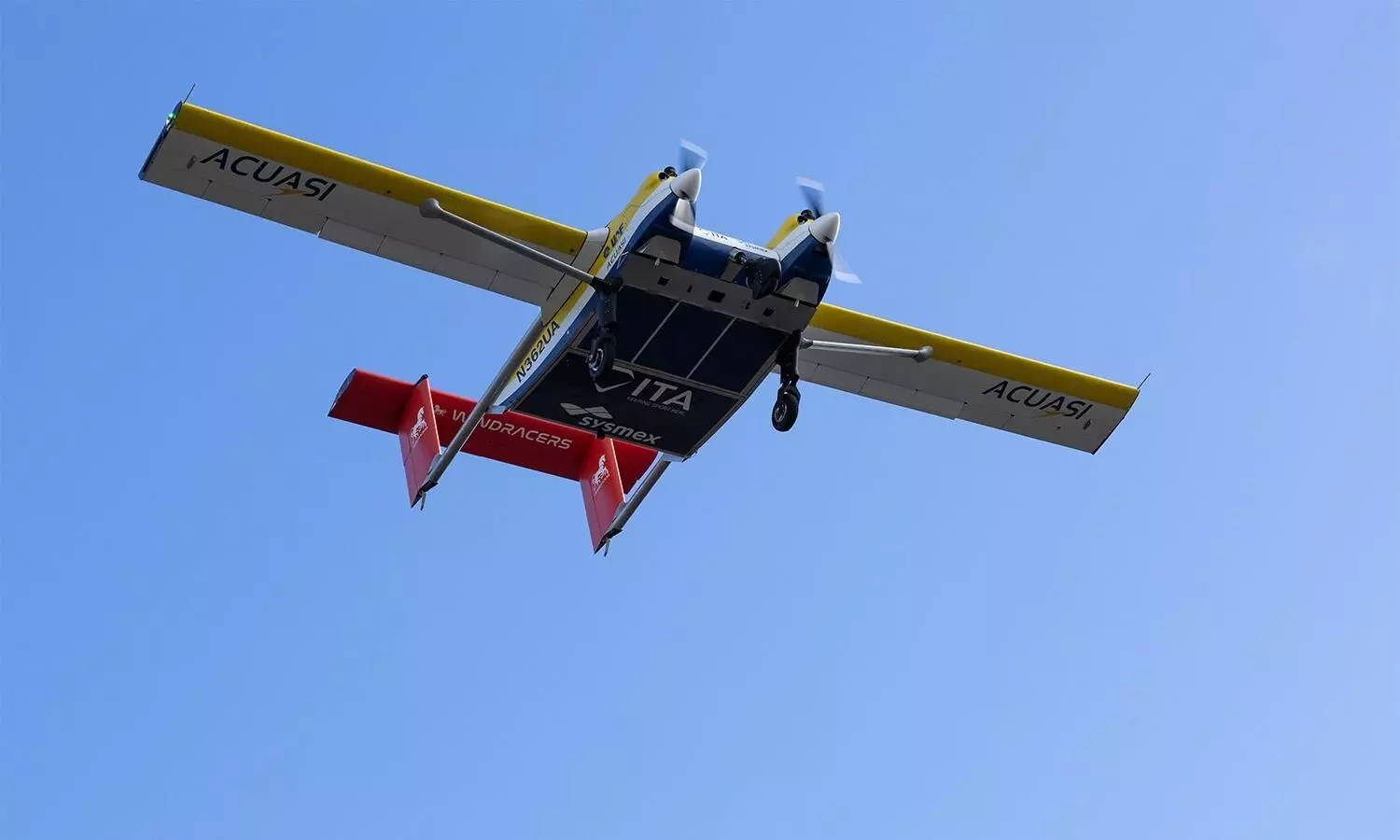
Windracers has completed a 1,000-km flight of its ULTRA autonomous heavy-lift aircraft in North America as part of a multi-party project investigating the use of autonomous air cargo to transport anti-doping blood samples over long distances.
The Alaska Center for Unmanned Aircraft Systems Integration (ACUASI) at the University of Alaska Fairbanks flew the mission. The aim was to test whether blood samples could be safely and reliably transported and remain intact all the way through.
The flight, which lasted several hours, also represented the first Beyond Visual Line of Sight (BVLOS) operation with a Windracers ULTRA in North America.
The International Testing Agency (ITA), an independent anti-doping program manager, led the project, with support from Sysmex, a provider of clinical laboratory diagnostic and hematology systems.
The initiative is testing whether long-range autonomous aircraft can offer an alternative means of moving things when normal logistics are slower, less certain or harder to put in place.
“The ITA has been looking into the potential for autonomous air cargo to transport anti-doping samples for some years. The technology is of particular interest for large-scale sporting events such as the Olympic Games, where timely transport of samples is an important component of anti-doping operations.
The most recent flight was August 19, 2026 from Nenana Municipal Airport near Fairbanks, Alaska.
ACUASI provided operational and technical support such as flight planning and execution while providing the Windracers ULTRA, a 10 meter fixed wing autonomous aircraft made from aluminum.
Windracers Operations people also worked with ACUASI, the ITA and Sysmex in support of the mission. “Larger study is intended to determine the potential for long-range autonomous aircraft for time-sensitive sample transport across remote and difficult routes.”
“Windracers’ mission is to push the limits of autonomous aviation in support of customer operations,” said the company’s CEO Simon Muderack.
The Alaska mission, led by Cathy Cahill and the ACUASI team, was successful in that regard while establishing a new standard for ULTRA performance and providing a significant result for ITA and Sysmex, he said. Muderack added he hopes Windracers ULTRA will eventually become a standard option for sample deliveries at major international events such as the Olympic Games.
Cathy Cahill, director of the ACUASI at the University of Alaska Fairbanks, said autonomous air cargo is particularly important in Alaska, where 82% of the communities are not connected to the road system.
Cahill said UAVs could also allow nurses to collect medical samples from isolated communities and bring them to laboratories for analysis. Then healthcare providers would know what medications are needed and send them back by UAV before medical teams leave the area. The system could improve access to timely medical care and supplies for those in remote communities.
“Innovation has a place in tackling practical challenges in anti-doping, but only where it is based on strong science and with strict requirements that govern sample integrity and chain of custody,” said Benjamin Cohen, Director General of ITA.
The study is designed to determine whether drone technology can provide a reliable method of transporting samples over long distances and difficult terrain, he said. The technology could also help speed access to laboratory and medical services in remote communities.
Andy Hay, Chairman of the Board of Directors at Sysmex America, hinted at possible uses that extend well beyond sport.
He said the ability to transport blood samples over more than 1,000 kilometers of remote Alaskan terrain could ultimately help provide timely diagnostic services to patients in some of the world’s most isolated communities.
The next stage of the study will be to compare data gathered before and after the flight. ITA will consider whether the journey impacted on red and white blood cell populations or any other indices relevant to the Athlete Biological Passport.
If the findings show that blood samples can be kept preserved during long-distance drone flights, the results could unlock new transport options for anti-doping agencies and organizers of major sporting events and also point to the wider potential for autonomous aircraft in remote healthcare logistics.