



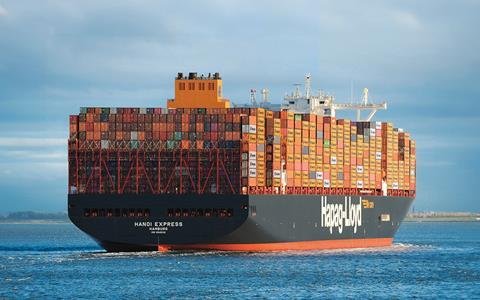
Hapag-Lloyd and Kuehne+Nagel have launched their first joint sustainable ocean freight initiative, using waste-based marine biofuels to reduce emissions on container shipments between Asia and Europe.
Under the agreement, Kuehne+Nagel will use Hapag-Lloyd’s Ship Green program for cargo moving between East Asia and North Europe from April to December 2026.
Around 3,300 teu of cargo will be covered by the pilot project, with the partners expecting to reduce emissions by approximately 2,979 tons of CO₂ equivalent on a well-to-wake basis.
The program will use around 1,000 tons of sustainable marine fuel compliant with RED III and produced from waste and residue-based feedstocks.
The agreement marks the first direct collaboration between the two companies on lower-emission ocean freight solutions.
Hapag-Lloyd said the partnership shows how collaboration can help scale practical emissions reduction measures in shipping. Kuehne+Nagel said the project gives customers access to verified emissions reductions through commercially available solutions.
The agreement uses a book-and-claim model, allowing customers to account for emissions savings from biofuel use even if the fuel is not physically consumed on the exact vessel carrying their cargo.
Only verified emissions reductions generated within Hapag-Lloyd’s operated fleet are allocated to Kuehne+Nagel.
Hapag-Lloyd aims to achieve net-zero fleet operations by 2045, while Kuehne+Nagel targets net zero across its value chain by 2050.