




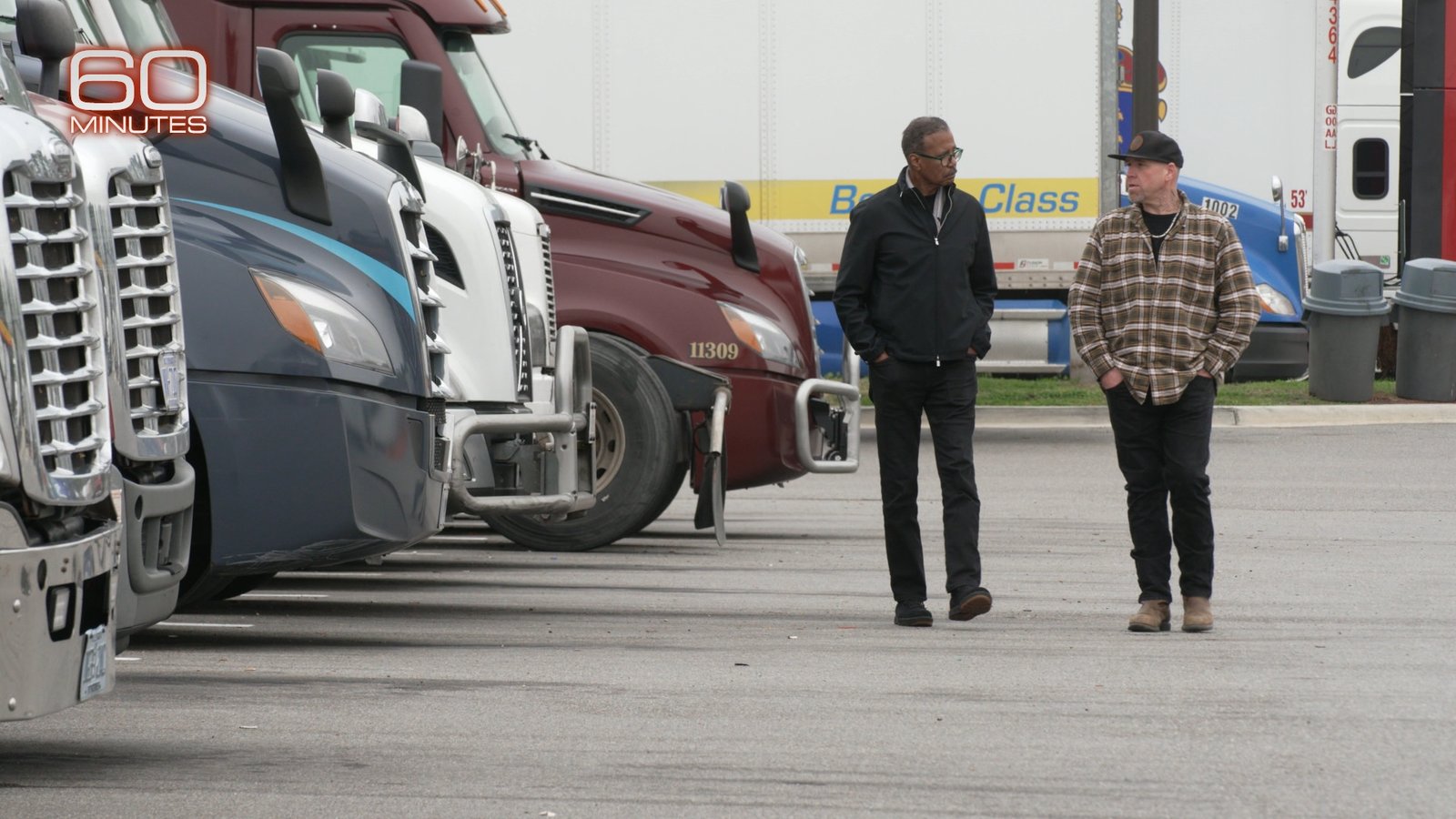
A major CBS “60 Minutes” investigation has thrust the issue of chameleon carriers into the national spotlight in the United States, exposing how some trucking fleets repeatedly shed one corporate identity for another after accumulating serious safety violations.
At the centre of the report is Super Ego Holding, a Serbia- and US-linked network of trucking and leasing companies that federal regulators have described as one of the most notorious chameleon carrier schemes currently operating on American highways.
The 15-minute segment followed an eight-month investigation led by correspondent Bill Whitaker and producers Ashley Velie and Eliza Costas. Their work included travel to Europe, interviews with drivers across the United States, surveillance of Super Ego facilities and the review of legal depositions and other documentary evidence.
Rob Carpenter, a trucking safety consultant, FreightWaves contributor and long-time industry observer who has tracked the network for years, said he was struck by the depth and care of the CBS team’s reporting. He said the journalists prioritised accuracy over speed and reviewed a vast volume of evidence before broadcasting the story.
Carpenter alone provided six hours of footage, including a four-hour sit-down interview and two hours of filming on the road. Federal Motor Carrier Safety Administration administrator Derek Barrs also reportedly sat for a three-hour interview. Carpenter estimated that the wider investigation involved the review of tens of thousands of documents, and possibly hundreds of thousands when civil case depositions linked to Super Ego were included.
The report explained how easy it remains for operators based anywhere in the world to establish a trucking company in the US. Carpenter said that, for around $1,000 paid online, anyone can obtain operating authority from the FMCSA within 21 days, with no requirement for American ownership.
That loophole lies at the heart of the chameleon carrier model. Companies accumulate violations, crashes or other compliance problems, then shut down and reopen under a new name with a fresh DOT number and a clean-looking record.
Carpenter described the approach as a revenue-first strategy in which operators run one company into the ground, abandon its history, then restart under a new identity to continue operating without the burden of their previous safety performance.
The result, he said, is that brokers and shippers often see what appears to be a clean carrier with no violations or crashes, making it difficult to identify the underlying risk.
Carpenter estimates that between 10% and 20% of the 700,000 trucking companies operating in the US could fall somewhere on the chameleon carrier spectrum. Data cited from risk assessment firm Fusable suggests such operators are four times more likely to be involved in crashes.
The “60 Minutes” report highlighted Super Ego as a case study. According to Department of Transportation data referenced in the programme, Super Ego-linked carriers recorded nearly 15,000 safety violations and 500 accidents over the past two years. The network stretches from Serbia to the US, with hubs in Elmhurst, Illinois, and Jacksonville, Florida, and customers including Amazon, Walmart, Costco and the United States Postal Service.
The report also featured the testimony of driver Daniel Sanchez, who said he was recruited by Super Ego in 2025 with promises of earning between $8,000 and $12,000 a week. He said the reality was the opposite, with some pay cheques ending in negative amounts despite driving 600 to 800 miles a day.
Sanchez said drivers were instructed to physically alter trucks by taping over old names and replacing them with new company markings and DOT numbers, allowing the same operation to continue under multiple identities.
He also alleged serious hours-of-service violations, claiming dispatchers in Serbia remotely reset drivers’ electronic logs after they had already reached the legal driving limit. In one case, he said he drove for 18 hours before being told the company did not care whether he rested.
A whistleblower from a Serbia-based affiliate reportedly confirmed that cutting driver pay had become a form of internal competition, with one dispatcher reducing nearly $24,000, or 32%, from drivers’ pay during a single period.
Not all of the material gathered made it into the broadcast. Carpenter said one omitted section involved GenLog analysis of Sanchez’s employment history, which allegedly showed the same driver, truck and logging system appearing under six different company door markings over the course of a year without any real operational change behind the scenes.
Carpenter has since channelled his work into the TEA Highway Intelligence & Risk Platform, which combines around 100 datasets and 35 integrations, including FBI data, census records, corporate filings and UCC records, to identify red flags in new applications for trucking authority.
The FMCSA is currently evaluating new systems of this kind as it tries to tackle what Barrs has called the “front door problem” — stopping bad actors before they enter the system.
The regulatory landscape is now shifting. A new registration platform is expected to replace 40-year-old technology this year, and the FMCSA is adding 40 investigators to its existing team of 350 overseeing roughly 700,000 carriers.
Carpenter said the challenge goes beyond the FMCSA alone and requires cooperation with the Department of Homeland Security, the Department of Justice and the FBI. He noted that, while many in the industry want immediate action, structural reform will take time.
Even so, he believes momentum is finally building and that the system is now moving more decisively than at any point in the past.