For global consumer health company Kenvue, innovation doesn’t only come from executive strategy sessions or research labs. Instead, some of the most impactful ideas originate directly from employees across the organization.
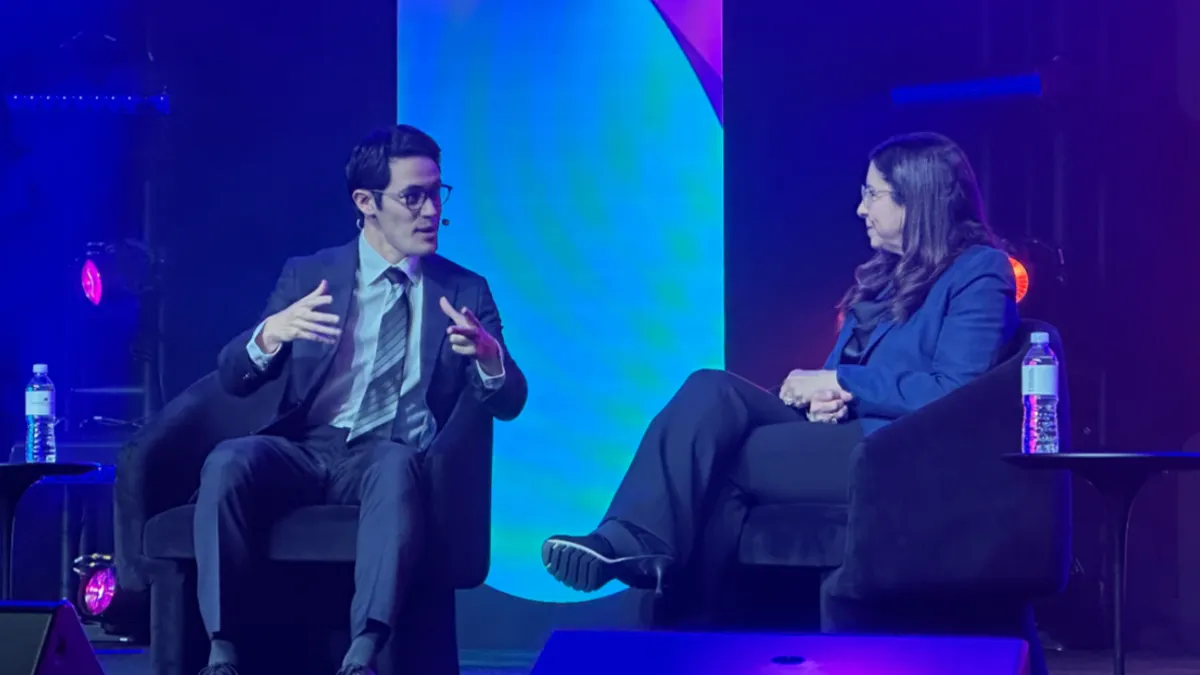
Speaking at the Manifest 2026 conference in Las Vegas, Chief Operating Officer Meri Stevens explained how the company encourages internal innovation through a program known as the “Shark Tank.”
The initiative allows employees from any department to present operational ideas that could improve efficiency, reduce costs or accelerate processes across Kenvue’s global supply chain.
To remain competitive, Stevens emphasized that companies must not only generate ideas but also move quickly in testing and implementing them.
“We have to be able to kill things off almost as fast as we test them,” Stevens said. “We’re constantly scanning, experimenting and evaluating. When something works, we double down and scale it globally.”
Kenvue — the owner of consumer health brands such as Tylenol, Band-Aid and Neutrogena — became an independent company in 2023 following its spin-off from Johnson & Johnson. Stevens, who assumed the COO role that same year, saw an opportunity to reshape the organization’s innovation culture.
Initially, she noticed that teams across the company were tackling similar operational problems independently, resulting in hundreds of disconnected projects.
The Shark Tank model was designed to change that.
The monthly meetings create a centralized forum where employees can present ideas capable of delivering measurable benefits within 30 to 90 days. Participation across the organization is encouraged, helping ensure that employees feel their perspectives are heard.
“It allows us to constantly disrupt ourselves,” Stevens said. “But it also reinforces the idea that great innovations can come from anywhere within the organization.”
Not every proposal receives funding. Those that demonstrate clear operational value must pass through a “digital council,” which evaluates the projects and determines how investment funds should be allocated.
Successful ideas are then deployed across Kenvue’s global operations.
Many of the winning initiatives focus on increasing automation and introducing touchless operational processes. Some involve the use of intelligent software agents capable of handling repetitive tasks, freeing employees to focus on more strategic work.
“Resources are finite,” Stevens explained. “But with agents, we can create an almost infinite source of operational capability.”
Interestingly, smaller production facilities often serve as testing grounds for these innovations. Because they are less complex than major plants, they can experiment more rapidly and refine solutions before scaling them across larger operations.
The results have been significant.
According to Stevens, the company is now generating savings equal to ten times the investment made in the Shark Tank innovation initiatives.
One example involves predictive maintenance technologies that analyze factory equipment data to anticipate mechanical issues before they occur. By predicting failures earlier, Kenvue can reduce downtime while optimizing spare-parts inventories.
The approach has delivered both operational efficiency and cost reductions.
“Imagine the savings from being able to predict maintenance needs, reduce unnecessary spare parts and ensure technicians have the tools they need at the right moment,” Stevens said.
For Kenvue, the program represents more than just a new innovation tool. It reflects a broader cultural shift toward faster experimentation and collaborative problem solving across the organization.
⸻