• Latest
  • Trending
Strait of Hormuz remains vital to Gulf trade — and its greatest structural weakness

Strait of Hormuz remains vital to Gulf trade — and its greatest structural weakness

March 13, 2026
Gebrüder Weiss weathers difficult economic conditions

Gebrüder Weiss weathers difficult economic conditions

March 13, 2026
BIFA meets European policymakers to discuss Windsor Framework

BIFA meets European policymakers to discuss Windsor Framework

March 13, 2026
ADVERTISEMENT
IATA confirms Singapore as host of World Data Symposium 2026

IATA confirms Singapore as host of World Data Symposium 2026

March 13, 2026
Amerijet founder David Bassett dies

Amerijet founder David Bassett dies

March 13, 2026
LATAM Cargo strengthens leadership after moving more than 1 million tons in 2025

LATAM Cargo strengthens leadership after moving more than 1 million tons in 2025

March 13, 2026
LA port chief says reported Iran drone threat to California lacks credibility

LA port chief says reported Iran drone threat to California lacks credibility

March 13, 2026
Flexport unveils new tools as tariffs and geopolitical disruption reshape freight markets

Flexport unveils new tools as tariffs and geopolitical disruption reshape freight markets

March 13, 2026
Flexible ‘physical AI’ could unlock the next wave of warehouse automation

Flexible ‘physical AI’ could unlock the next wave of warehouse automation

March 13, 2026
OOCL hit by weaker earnings as market volatility weighs on 2025 performance

OOCL hit by weaker earnings as market volatility weighs on 2025 performance

March 13, 2026
Canada’s ‘Driver Inc.’ crackdown could tighten capacity and push trucking rates higher

Canada’s ‘Driver Inc.’ crackdown could tighten capacity and push trucking rates higher

March 13, 2026
Middle East shipping disruption strengthens U.S. position in LNG exports

Middle East shipping disruption strengthens U.S. position in LNG exports

March 13, 2026
USITC launches investigation into USMCA automotive rules and competitiveness

USITC launches investigation into USMCA automotive rules and competitiveness

March 13, 2026
  • Home
  • About Us
  • Press Room
  • Podcasts
  • Media Kit
  • Contact Us
  • Careers
Friday, March 13, 2026
  • Login
  • Register
The Logistic News
  • Logistic
  • Air
  • Maritime
  • Land
  • World
  • Business
  • Tech
  • Events
  • Advertise
No Result
View All Result
  • Logistic
  • Air
  • Maritime
  • Land
  • World
  • Business
  • Tech
  • Events
  • Advertise
No Result
View All Result
The Logistic News
No Result
View All Result
Home Logistic

Strait of Hormuz remains vital to Gulf trade — and its greatest structural weakness

A new Drewry analysis shows that the region has no credible short-term logistics alternative if Hormuz remains blocked, despite spare port capacity elsewhere.

The Logistic News by The Logistic News
March 13, 2026
in Logistic, Maritime, World
Reading Time: 3 mins read
0
Strait of Hormuz remains vital to Gulf trade — and its greatest structural weakness
ADVERTISEMENT

The Strait of Hormuz is not only one of the world’s most strategic maritime chokepoints — it is also the single greatest structural vulnerability in Gulf logistics.

That is the conclusion of a new analysis by Drewry, which argues that decades of underinvestment in bypass infrastructure mean no realistic short-term alternative exists if access through the strait remains severely disrupted.

The narrow waterway connecting the Persian Gulf to the Gulf of Oman and the Indian Ocean carries up to 30% of global crude oil tanker shipments, along with critical flows of LNG, propane gas, petrochemicals and fertilizer. The consequences of the current disruption are already being felt in the United States, where diesel prices have risen and gasoline prices have reportedly increased by 70 cents per gallon.

ADVERTISEMENT

Container shipping is also exposed. Liner operators have already introduced emergency surcharges and rate increases to account for diversions away from the region.

While Persian Gulf ports represent only 3.5% of global container trade, a prolonged disruption would create severe congestion and supply chain spillovers from Gulf ports into Asia and onward to U.S.-bound services. The strait is the only maritime gateway for the economies of Qatar, Kuwait, Bahrain and Iraq.

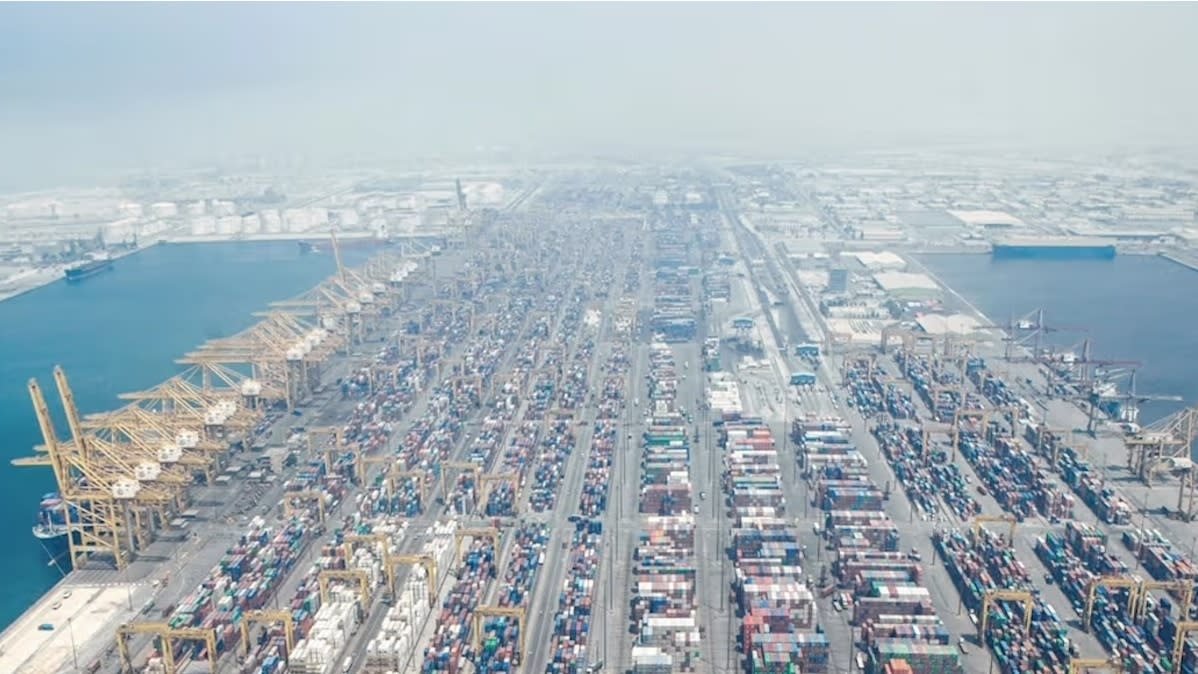
According to Drewry, about 33 million TEUs move through Gulf terminals each year, including traffic for the UAE, Saudi Arabia, Kuwait, Qatar and Bahrain. Jebel Ali alone handles around 15.5 million TEUs annually.

The region’s strength has always been its connectivity. Drewry’s Port Connectivity Index for the first quarter of 2026 gave Jebel Ali a score of 16.0 and Khalifa Port 9.4, making them highly connected regional hubs. But Drewry notes that a full closure of Hormuz would remove more than three-quarters of that connectivity.

The study found that Gulf bypass ports collectively have more than 20 million TEUs of latent capacity, but much of that potential is limited by geography and inland logistics.

Among the alternatives, Khorfakkan in the UAE is seen as the only genuinely high-utility bypass port because it sits just 80 miles from Dubai by road. UAE authorities have already introduced emergency customs clearance for cargo moving by truck from Khorfakkan to Jebel Ali and Abu Dhabi free zones. Still, road capacity is likely only a fraction of what the port itself could absorb.

Salalah in Oman offers around 3 million TEUs of spare capacity, but Drewry says it is effectively disconnected from Gulf inland supply chains because it lies more than 1,700 kilometers from Dubai and lacks rail connectivity. Trucking a 40-foot container from Salalah to Dubai costs an estimated $3,000 to $5,000, compared with only $200 to $400 from Jebel Ali.

Saudi Red Sea ports such as Jeddah and King Abdullah Port also have meaningful capacity, but still lack a direct freight rail connection to Riyadh. A planned 600-mile inland freight railway has not yet entered construction.

Qatar, Bahrain, Kuwait and Iraq are considered even more exposed, with no viable overland bypass routes that avoid either Hormuz or Saudi territory.

The problem is even greater for transshipment. Jebel Ali’s 65% transshipment ratio means disruption there affects not only UAE cargo but also feeder services into Kuwait, Qatar and Bahrain. Khalifa Port faces similar structural exposure. Even Abu Dhabi’s investments, including projects involving COSCO and CMA CGM, become vulnerable if relay cargo can no longer move efficiently through the strait. The only alternative link, Etihad Rail to Fujairah, offers just 50,000 TEUs of annual relief, far too little to replace Hormuz-dependent flows.

Drewry sees the crisis unfolding in three stages. In the short term, the next six months would bring severe disruption, with only partial rerouting options. Over six to 24 months, adaptation would be possible, but at a far higher cost, with logistics expenses across the Gulf potentially rising by three to five times. Beyond two years, governments may finally be forced to invest in long-delayed strategic projects such as the GCC Railway or the Jeddah-Dammam-Kuwait corridor, though these would still take years to deliver.

The report’s conclusion is blunt: collective underinvestment in Hormuz bypass infrastructure means the region’s greatest strength — its liner connectivity — becomes its greatest point of failure in a closure scenario.


Previous Post

OOCL hit by weaker earnings as market volatility weighs on 2025 performance

Next Post

Flexible ‘physical AI’ could unlock the next wave of warehouse automation

Next Post
Flexible ‘physical AI’ could unlock the next wave of warehouse automation

Flexible ‘physical AI’ could unlock the next wave of warehouse automation

Leave a Reply Cancel reply

Your email address will not be published. Required fields are marked *

A D V E R T I S E M E N T

Popular News

  • Drone Delivery Takes Flight: Amazon Partners with UPS for Trial Program

    Drone Delivery Takes Flight: Amazon Partners with UPS for Trial Program

    0 shares
    Share 0 Tweet 0
  • Rail Cargo Group Strengthens European Network with Captrain Netherlands Acquisition

    0 shares
    Share 0 Tweet 0
  • Automotive Inbound Logistics Market: Navigating Future Challenges

    0 shares
    Share 0 Tweet 0
  • Global Inflation Cools to Target After Three Years, Central Banks Face Policy Dilemma

    0 shares
    Share 0 Tweet 0
  • Dubai Mercantile Exchange Rebrands as Gulf Mercantile Exchange Following Saudi Tadawul Group Acquisition

    0 shares
    Share 0 Tweet 0

Recent News

Gebrüder Weiss weathers difficult economic conditions

Gebrüder Weiss weathers difficult economic conditions

March 13, 2026
BIFA meets European policymakers to discuss Windsor Framework

BIFA meets European policymakers to discuss Windsor Framework

March 13, 2026
IATA confirms Singapore as host of World Data Symposium 2026

IATA confirms Singapore as host of World Data Symposium 2026

March 13, 2026

Discover a new era of logistics reporting with The Logistic News, your go-to platform for breaking news, insightful features, and exclusive interviews shaping the global logistics and freight landscape. Trust us to deliver accurate, timely, and relevant information that empowers professionals and enthusiasts alike in navigating the intricacies of this vital sector.

Navigation

  • Home
  • About Us
  • Press Room
  • Podcasts
  • Media Kit
  • Contact Us
  • Careers
  • Privacy Policy
  • Terms of Use

© 2024 - thelogisticnews.com

Welcome Back!

Login to your account below

Forgotten Password? Sign Up

Create New Account!

Fill the forms below to register

All fields are required. Log In

Retrieve your password

Please enter your username or email address to reset your password.

Log In

SIgn Up Newsletter

This will close in 20 seconds

Manage Cookie Consent
We use technologies like cookies to store and/or access device information. We do this to improve browsing experience and to show (non-) personalized ads. Consenting to these technologies will allow us to process data such as browsing behavior or unique IDs on this site. Not consenting or withdrawing consent, may adversely affect certain features and functions.
Functional Always active
The technical storage or access is strictly necessary for the legitimate purpose of enabling the use of a specific service explicitly requested by the subscriber or user, or for the sole purpose of carrying out the transmission of a communication over an electronic communications network.
Preferences
The technical storage or access is necessary for the legitimate purpose of storing preferences that are not requested by the subscriber or user.
Statistics
The technical storage or access that is used exclusively for statistical purposes. The technical storage or access that is used exclusively for anonymous statistical purposes. Without a subpoena, voluntary compliance on the part of your Internet Service Provider, or additional records from a third party, information stored or retrieved for this purpose alone cannot usually be used to identify you.
Marketing
The technical storage or access is required to create user profiles to send advertising, or to track the user on a website or across several websites for similar marketing purposes.
Manage options Manage services Manage {vendor_count} vendors Read more about these purposes
View preferences
{title} {title} {title}
No Result
View All Result
  • Logistic
  • Air
  • Maritime
  • Land
  • World
  • Business
  • Tech
  • Events
  • Advertise

© 2024 - thelogisticnews.com