




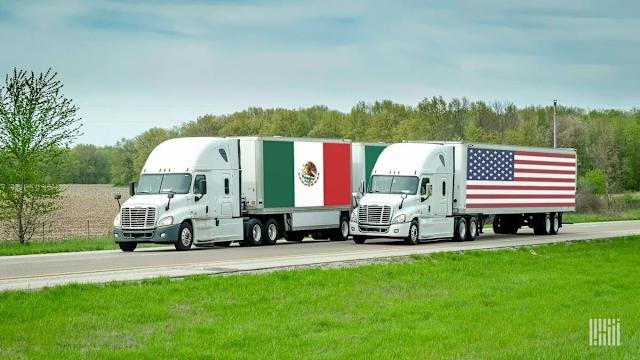
As the 2026 review of the United States-Mexico-Canada Agreement approaches, the growing presence of Chinese manufacturing and investment in Mexico is drawing renewed attention from policymakers and supply chain leaders across North America.
The debate centres on whether Chinese companies are using Mexico as a back door into the US market — a characterisation that industry executives say contains some truth, but oversimplifies what is happening on the ground.
Jorge Gonzalez Henrichsen, co-chief executive of The Nearshore Co., said the answer is both yes and no. He acknowledged that the trend is real and visible in the data, but argued that the term back door carries a negative implication that does not fully reflect the complexity of the situation.
Chinese companies have expanded their footprint in Mexico in recent years, particularly since the Covid-19 pandemic disrupted global supply chains. Henrichsen said much of that shift has been driven by US companies trying to reduce tariff exposure and geopolitical risk associated with direct sourcing from China.
He pointed to a clear increase in manufacturing facilities since the pandemic, with the electric vehicle segment standing out as one of the most visible examples.
Rather than giving up on the US market, many Chinese suppliers have adapted by relocating operations to Mexico, establishing local entities and hiring Mexican workers in order to qualify for preferential treatment under USMCA rules.
Henrichsen described a recurring scenario in which a US buyer cuts ties with a China-based supplier, only to see that same supplier reappear later through a Mexican manufacturing presence.
While critics argue that some firms may rely on minimal processing or relabelling to bypass tariffs, Henrichsen said much of the activity falls within legal grey areas or is fully compliant, as companies work to meet rules-of-origin requirements.
Chinese foreign direct investment into Mexico has accelerated since 2017, particularly after the US-China trade war and the implementation of USMCA in 2020. According to the Federal Reserve Bank of Dallas, official figures show Mexico received around $2.3 billion in net Chinese FDI between 2017 and 2024, although private estimates suggest the true number may be several times higher because some investments are routed through offshore entities or take the form of greenfield projects.
One of the largest examples was a $5 billion factory announced in October 2023 by China-based Lingong Machinery Group in Monterrey.
Even with that growth, Chinese investment still represents only a small portion of Mexico’s total inward FDI compared with flows from the United States and other G7 countries. But Chinese companies are becoming increasingly visible within nearshoring-driven supply chains.
The trend has brought benefits to Mexico, particularly in the north of the country, where Chinese-linked projects have supported job creation, industrial expansion and supplier development.
Henrichsen said such arrangements can be positive for the Mexican ecosystem because they bring manufacturing know-how and strengthen industrial capacity.
At the same time, the shift is creating tension. Mexican companies face rising competition, while officials in both Mexico and the United States are under increasing pressure to respond to concerns over Chinese overcapacity and supply chain dependence.
Recent talks between US Trade Representative Jamieson Greer and Mexican officials have focused on stricter rules of origin, stronger economic security provisions and better tariff alignment ahead of the USMCA review.
US officials have also signalled that tariffs, particularly those affecting autos and steel, are likely to remain in place even after the agreement is revisited.
Henrichsen expects USMCA to survive the 2026 review, but not unchanged. In his view, the agreement is likely to remain in place while undergoing meaningful adjustments, especially in areas such as rules of origin and enforcement.
Analysts say likely outcomes could include tougher content thresholds, stronger compliance mechanisms and closer coordination on tariffs and investment screening related to China-linked activity.
For now, the uncertainty is already affecting investment decisions. Henrichsen said many companies are choosing to wait a few months before committing major capital because of the unresolved questions surrounding the review.
Even so, he believes the long-term logic of Mexico remains intact for many manufacturers serving the US market. For some companies, he said, the right move is still to go ahead with nearshoring, because the structural case for Mexico is unlikely to disappear.