



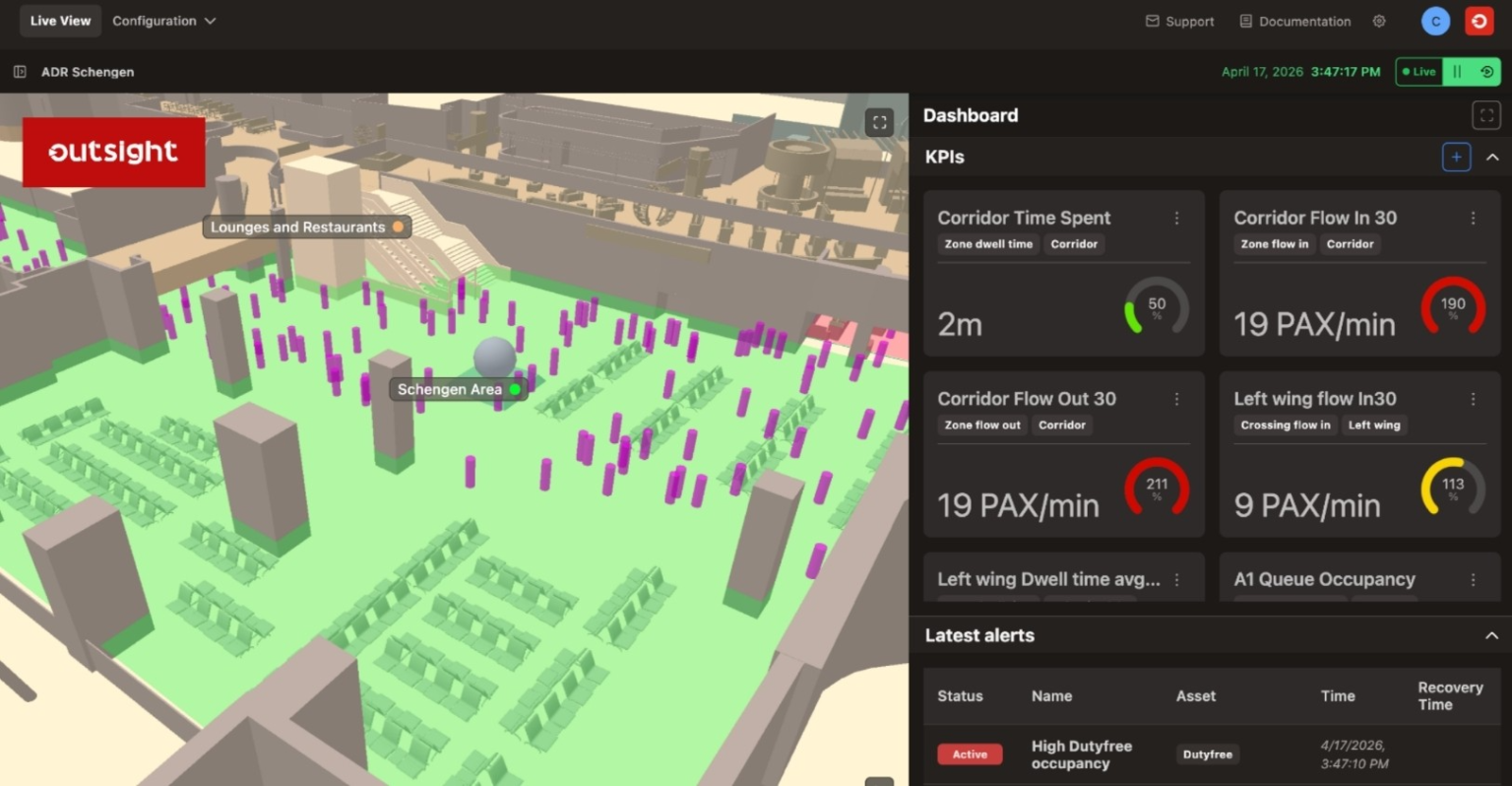
Rome Fiumicino Airport is taking another major step in its digital transformation strategy, as Aeroporti di Roma (ADR) and Outsight expand their collaboration to deploy AI-powered flow management technology across nearly all common-use areas within the Schengen zone.
The project marks a significant extension of a partnership that began under ADR’s “Runway to the Future” innovation programme. After an initial implementation in the arrivals immigration area, which delivered measurable operational benefits, the technology is now being rolled out on a much larger scale.
Outsight’s solution uses Physical AI and 3D LiDAR data to generate real-time insights into passenger flows, queue formation and congestion points. The aim is to give ADR an end-to-end view of the passenger journey, allowing teams to allocate resources more dynamically, redesign processes using data and prepare the ground for more predictive, agentic AI-based airport operations.
For ADR, the move reflects growing confidence not only in Outsight’s platform, but also in the wider value of combining LiDAR, advanced analytics and artificial intelligence in airport management. The project is also expected to further refine the technology in the complex environment of a major international hub such as Rome Fiumicino, which ranks among the world’s top ten airports according to Skytrax.
Emanuele Calà, senior vice president transformation and technology at Aeroporti di Roma, said the airport sees innovation as a practical tool to continuously improve operations, service quality and the overall passenger experience. He noted that having full visibility over traveller flows in a sensitive operating environment allows the airport to act more proactively and deliver a smoother, more predictable journey.
Raul Bravo, president and co-founder of Outsight, said the transition from pilot phase to full-scale deployment is a strong validation of the company’s Spatial Intelligence platform and demonstrates how major hubs can operate more efficiently and responsively through the use of Physical AI, LiDAR perception and real-time analytics.