



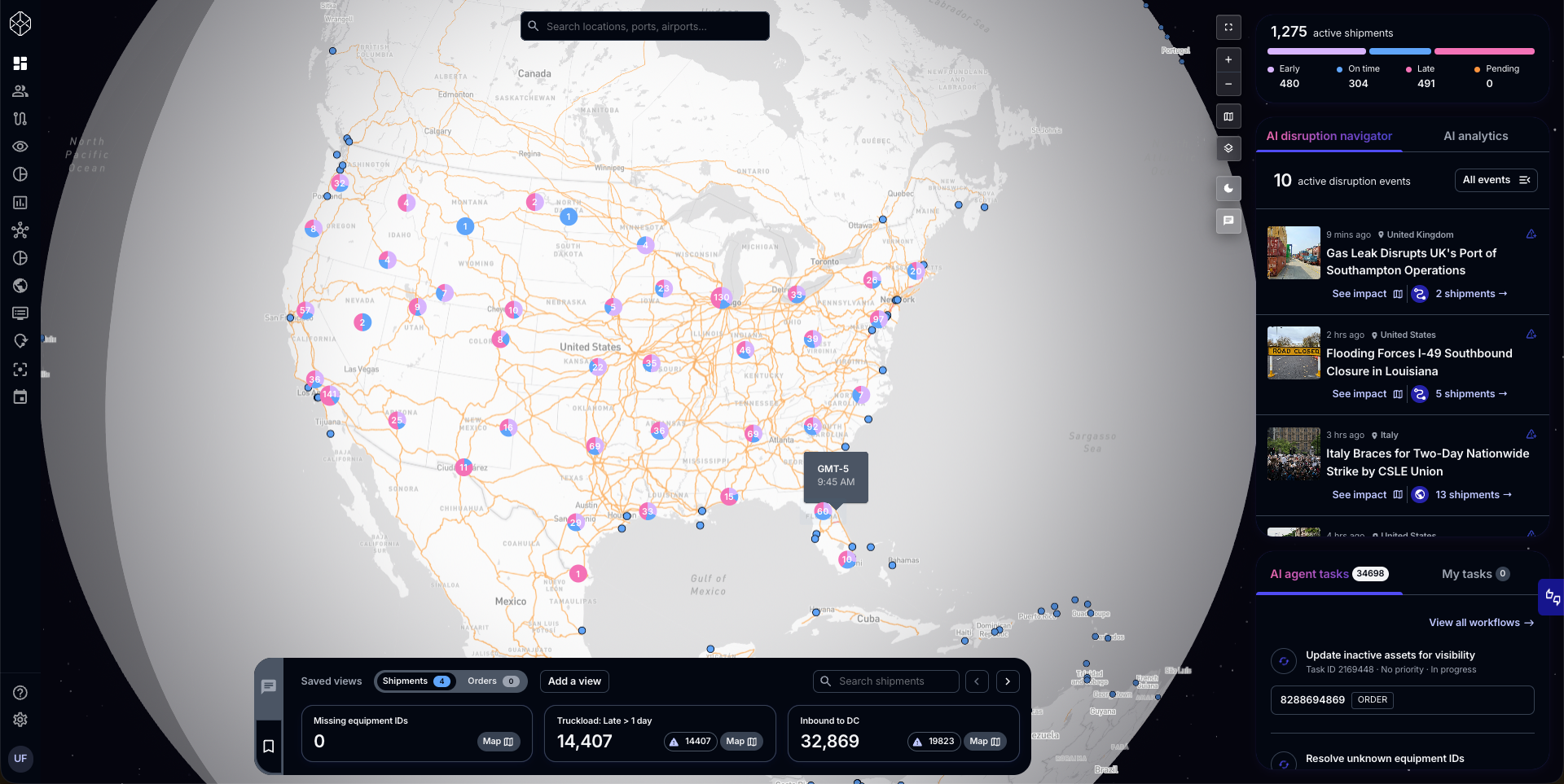
Project44 has officially launched Autopilot, a new AI-driven logistics operating platform designed to automate supply chain workflows without requiring coding expertise, complex integrations or dedicated engineering resources.
The platform represents more than 18 months of AI deployment across Project44’s global logistics network and is being presented as a major shift in the future of supply chain execution.
According to the company, the technology has already delivered measurable operational gains, including a 4% reduction in transportation spending, a 70% decrease in manual coordination tasks, supply cycle acceleration of up to 75%, and nearly 40% lower disruption-related costs.
More than a product update, Autopilot reflects Project44’s strategic move toward what CEO and founder Jett McCandless describes as an “intelligent operating system” for supply chains.
The platform enables shippers, brokers and logistics providers to deploy autonomous AI agents directly into operational workflows through a no-code interface. These agents can react in real time to logistics disruptions such as delayed shipments, missing PRO numbers or containers remaining idle at ports.
Users configure triggers, escalation procedures and follow-up actions, while AI agents autonomously manage operational tasks including notifications, carrier outreach and workflow coordination.
Project44 currently offers approximately 40 preconfigured workflow templates covering areas such as truck milestone collection, shipment delay management, missing PRO tracking and ETA confirmation requests. The company says two to three additional workflows are being introduced every week.
One of the early users, Eastman Chemical Co., stated that the platform enabled its supply chain teams to expand operations in the Asia-Pacific region while integrating less technologically advanced carriers without increasing operational complexity.
“The right tasks are routed to the right people automatically,” said Josh Moss, global supply chain process leader at Eastman.
McCandless described Autopilot as the final layer in what he calls the “signal-trigger-action” evolution of supply chain visibility.
The first layer, “Signal,” refers to Project44’s massive logistics data network, built over more than a decade. The company says the network now connects 259,000 carriers, processes 1.5 billion shipments annually across 186 countries and territories, and handles more than 700 million logistics events every day.
“The construction of this layer cost me a billion dollars,” McCandless said. “Maybe even more, but that context is what we need for everything.”
The second layer, “Trigger,” emerged during the COVID-19 pandemic as Project44 developed an exception management engine capable of prioritizing operational disruptions. The final layer, “Action,” is Autopilot itself, designed to execute tasks autonomously rather than simply identifying problems.
McCandless argues that traditional supply chain visibility platforms exposed operational chaos without truly solving it.
“When we turned the lights on, it was chaos,” he explained. “You can see everything happening. But how do you distinguish noise from signal? How do you know which exceptions actually matter?”
According to him, human teams alone cannot handle the growing volume of operational data flowing through modern supply chains.
“Humans simply cannot process this amount of information,” he said. “So companies would have to hire more people.”
Autopilot, he argues, changes that equation by allowing companies to scale operations through autonomous execution rather than additional staffing.
Project44 also used the launch to position itself against the rapidly growing wave of agentic AI startups entering the logistics sector. McCandless claimed many of those companies lack the logistics data infrastructure, integrations and network scale required to operate effectively at enterprise level.
Interestingly, Project44 itself leverages some external AI providers within Autopilot’s architecture. The system routes highly specific tasks, such as multilingual carrier calls or voice-agent interactions, to whichever AI provider performs best, while clients interact exclusively through the Project44 platform.
The launch arrives during an important financial phase for the company. McCandless stated that Project44 has reached profitability while continuing to grow its shipper management business by more than 20% annually.
The company’s workforce, which once peaked at approximately 1,200 employees, has now been reduced to 582. McCandless said the organization does not expect to exceed 600 employees in the future, largely because AI now generates around 85% of Project44’s software code.
Autopilot is currently being offered free of charge, with Project44 expected to monetize the platform through shared efficiency gains and operational savings rather than traditional per-user licensing models.
The launch signals a broader shift within logistics technology, where the next competitive battleground may no longer be visibility itself, but autonomous execution at scale.