



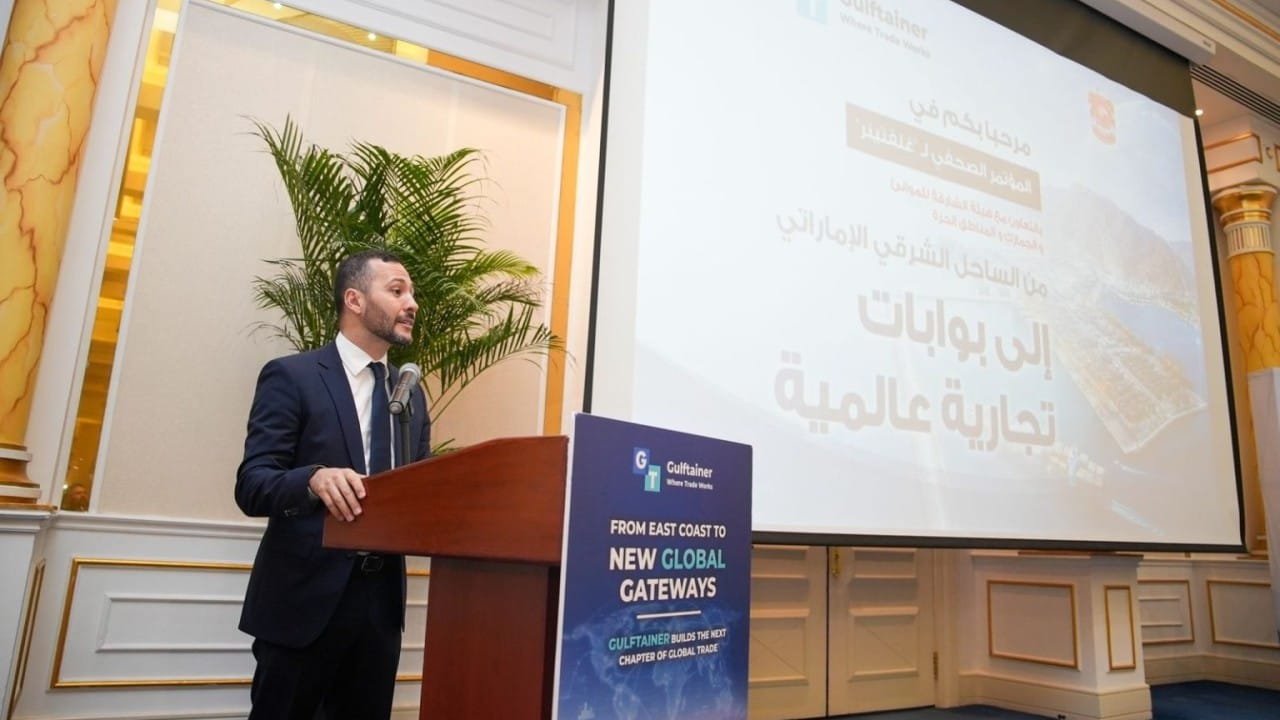
Gulftainer has unveiled an ambitious new growth strategy that will see the company expand well beyond its traditional port operations, with major investments planned across terminals, logistics parks, maritime services and digital supply chain solutions.
At the centre of the strategy is the continued development of Khorfakkan Commercial Terminal (KCT), one of the UAE’s busiest container terminals. Gulftainer plans to increase the terminal’s annual handling capacity from 3.5 million TEUs to 5 million TEUs, with a long-term objective of exceeding 10 million TEUs.
The expansion is part of a broader vision to create a fully integrated logistics network that connects ports, inland transport, warehousing and digital services across some of the world’s fastest-growing trade corridors.
Group CEO Farid Belbouab said the company is entering a new chapter after nearly five decades of operating in the port sector.
“For almost 50 years, we have focused on connecting ports. Our goal now is to connect economies,” he said, explaining that Gulftainer wants to become a global trade infrastructure company capable of supporting customers throughout the entire supply chain.
Supporting the expansion of Khorfakkan will be Al Dhaid Logistics Park and Sajaa Logistics Park, which together will provide 2.3 million TEUs of annual inland logistics capacity. The facilities are expected to boost cargo flows between the port and inland markets, and improve the overall supply chain efficiency.
The company is also investing in its maritime activities through GT Lines and developing new AI-powered digital platforms to simplify supply chain management, customer services, logistics operations and digital payments.
As part of the new strategy, Gulftainer will organise its business around four core divisions: GT Ports, GT Logistics, GT Parks and GT Maritime. Together, these businesses will focus on supporting trade between the UAE, China, the Indian subcontinent, East Africa and the Gulf region.
According to the company, global supply chains are becoming more complex, and customers increasingly expect logistics providers to offer complete, end-to-end solutions rather than standalone port services.
Once the planned developments are completed, the combined network of Khorfakkan Commercial Terminal, Al Dhaid Logistics Park and Sajaa Logistics Park will form one of the largest integrated logistics ecosystems in the Middle East.
The network will bring together container terminals, warehousing, bonded and non-bonded storage, cold chain facilities, contract logistics, container freight stations, distribution centres, e-commerce fulfilment, cross-docking services, value-added logistics, light industrial activities and multimodal transport within a single connected platform.
“This approach is how Gulftainer is preparing for the next generation of global trade, to offer customers an even more seamless logistics experience, underpinned by modern infrastructure and enhanced digital technology.”