



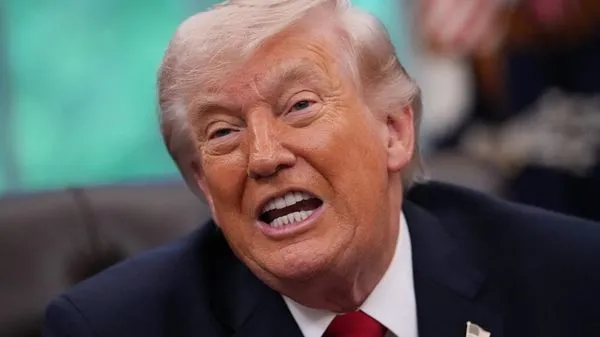
U.S. President Donald Trump has announced plans to reintroduce the blockade of Iranian ports and has proposed a new 20% charge on cargo moving through the Strait of Hormuz, arguing that it would help cover the cost of maintaining security in one of the world’s most strategic shipping routes.
In a post published on Truth Social, Trump said the United States would now be known as “The Guardian of the Hormuz Strait” and argued that countries using the waterway should contribute to the cost of keeping it secure.
According to the proposal, the United States would seek reimbursement equal to 20% of the value of all cargo transiting the Strait of Hormuz. Trump said the process to establish the system would begin immediately, although he did not provide details on how the fee would be implemented or enforced.
The proposal comes as tensions between the United States and Iran continue to escalate and appears to contrast with Washington’s longstanding position that the Strait of Hormuz should remain open to international navigation without interference.
In a security advisory issued on 12 July, the Joint Maritime Information Center (JMIC) reaffirmed that the Strait of Hormuz is an international waterway and that U.S. forces remain committed to protecting freedom of navigation and lawful commercial shipping in accordance with international law.
Iran has previously explored its own plans to introduce transit fees for vessels using the Strait, proposals that the United States has strongly opposed since the conflict began earlier this year.
Alongside the proposed cargo charge, Trump also announced that the United States would reinstate its blockade of Iranian ports, ending the suspension that followed the memorandum of understanding signed between Washington and Tehran in June.
According to Trump, the blockade is intended to target only Iranian vessels and ships trading with Iran, while allowing all other countries to continue using the Strait of Hormuz without restrictions.
The earlier U.S. blockade led to several military incidents involving commercial shipping. During those operations, multiple vessels trading with Iran were attacked as U.S. forces attempted to disrupt maritime traffic linked to the country. One of the most serious incidents occurred on 9 June, when the products tanker Settebello was struck, resulting in the deaths of three seafarers.
The latest announcements come amid renewed military exchanges in the region. Earlier this month, Iran launched attacks against several commercial vessels using the southern shipping route through the Strait of Hormuz. On 11 July, the container ship GFS Galaxy was also attacked off the coast of Oman, causing a fire that forced the crew to abandon the vessel. Reports indicate that all but one crew member were later rescued.
Trump’s proposed transit fee may or may not materialize, but the announcement underscores the growing risk of an incident in one of the world’s busiest maritime trade routes. Any additional disruption to the Strait of Hormuz could have dire consequences for global shipping, energy markets and international supply chains.