



Robotic arms are moving deeper into the daily operations of two of the world’s biggest logistics companies.
FedEx and Amazon are expanding their use of robotic systems as they look to improve productivity, increase efficiency and reduce some of the most physically demanding tasks carried out by employees across their networks.
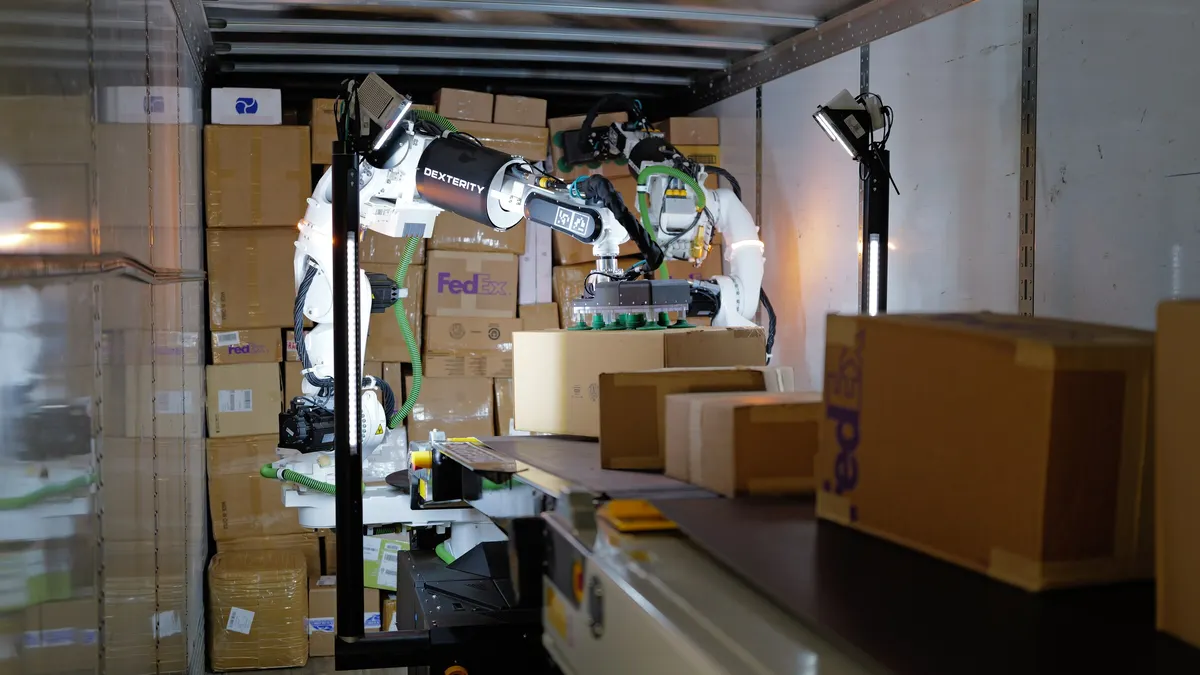
For FedEx, the latest step came on July 30, when the company announced the deployment of Dexterity’s dual-armed Mech trailer loading systems at its Hagerstown Hub in Maryland.
The systems use Foresight, Dexterity’s artificial intelligence model, to make real-time decisions about where packages should be positioned during the autonomous loading process.
Automating one of parcel logistics’ toughest tasks
Trailer loading remains a difficult operation to automate, particularly because packages arrive in different sizes and shapes and must be positioned efficiently inside a trailer.
FedEx loads tens of thousands of trailers every day across its US network. The company and Dexterity describe trailer loading as one of the most physically demanding and challenging workflows in parcel logistics, requiring workers to combine strength and endurance with constant decision-making.
The new robotic systems are designed to take on part of that workload while using AI to determine how packages should be arranged.
“Hagerstown represents an important milestone in demonstrating how physical AI can operate reliably in a high-volume logistics environment, creating a blueprint for network expansion,” said Samir Menon, founder and CEO of Dexterity.
FedEx has already been working with Dexterity on automated trailer loading for several years. The company now intends to take the technology considerably further.
Over the coming years, FedEx plans to introduce automated trailer loading and unloading operations across thousands of dock doors at more than 20 US hubs, according to Kawal Preet, EVP of planning, engineering and transformation, who discussed the strategy during the company’s 2026 Investor Day in February.
Amazon prepares for a major robotics expansion
Amazon is also accelerating its use of robotic arms.
During the company’s July 30 earnings call, Amazon SVP and CFO Brian Olsavsky said the company plans to more than double its fleet of robotic arms during 2026 as it expands automation throughout its fulfillment network.
The move comes on top of an already substantial robotics operation. Amazon says it has deployed more than 1 million robots across its network since 2012.
Among the robotic arms already used by the company are Cardinal, which lifts packages and places them into carts, and Sparrow, which moves products from containers into totes before they are packaged.
Both systems rely on artificial intelligence and computer vision to perform their tasks.
Logistics becomes a major driver of industrial robotics
Amazon’s planned expansion could have implications beyond the company’s own fulfillment centres.
Aaron Prather, director of market intelligence at the Association for Advancing Automation (A3), said a significant increase in Amazon’s robotics fleet could influence both the company’s operations and wider automation trends.
He pointed out that industries outside automotive manufacturing have recently overtaken automotive companies as the largest buyers of industrial robots.
“Companies such as Amazon and FedEx are helping fuel this shift through continued automation installs across their extensive logistics and fulfillment networks,” Prather said.
The growing use of robotic arms at both companies reflects a broader change in logistics. Rather than limiting automation to repetitive manufacturing processes, operators are increasingly applying AI-powered machines to environments where packages, volumes and operating conditions can change constantly.
For FedEx, that means teaching robots to load trailers more intelligently. For Amazon, it means expanding robotic handling across a fulfillment network that already includes more than a million machines.
The direction is increasingly clear: automation is moving from isolated warehouse projects into the core of large-scale logistics operations.