



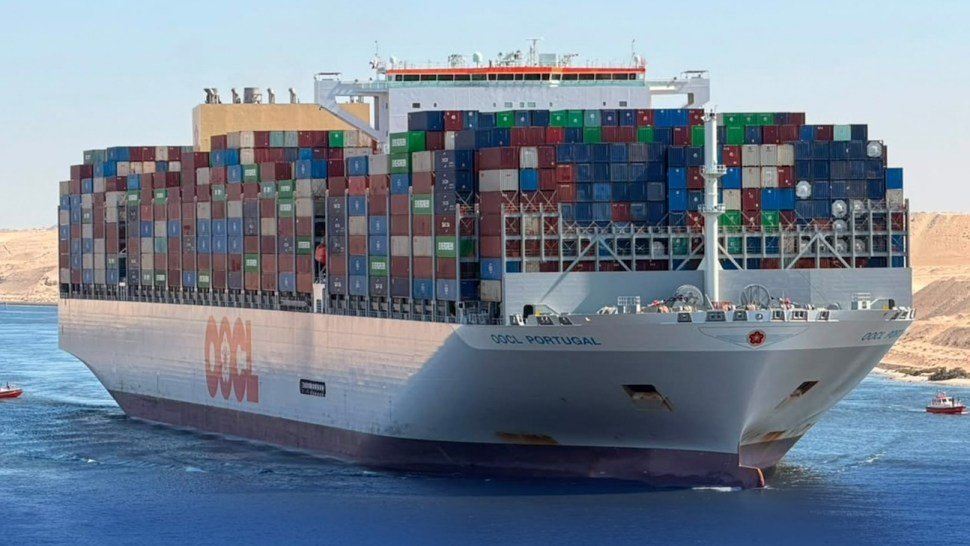
In August, traffic through the Suez Canal continued to recover, with vessel transits up 27% on the year as major shipping lines began to selectively restore services through the Red Sea corridor.
Suez Canal Authority Chairman Osama Rabie said a total of 1,358 vessels crossed the canal in August compared to 1,070 vessels in the same month of 2025. Meanwhile, canal revenue went up 56.7% to $567.1 million, while net tonnage rose 51.1% to 68.3 million tons from 45.2 million tons a year ago.
Figures show Suez traffic has recovered more strongly, but not fully, from the prolonged Red Sea disruption which had seen many Asia-Europe and Asia-North America services rerouted onto longer journeys around Africa.
The August numbers are an average of nearly 44 vessel passages a day, versus around 35 a day in August 2025. The increase in net tonnage was considerably more rapid than the increase in the number of vessels, suggesting that some of the returning traffic involved larger ships, or ships carrying heavier loads.
Rabie said navigation through the canal was functioning normally and the waterway was safe as the broader shipping environment improved.
But for North American shippers, the immediate impact remains indirect and mixed. The return to Suez will primarily impact Asia-Europe and Middle East networks, but the reinstatement of those routes can gradually free up vessel capacity and containers that could eventually impact trans-Pacific and U.S. East Coast markets.
That alone is unlikely to bring immediate rate relief on Asia-U.S. trades, where capacity and freight rates remain tight.
Create Carrier Returns
The August increase followed a slow and uneven return by container carriers to the Suez route.
Maersk and Hapag-Lloyd have resumed some of the Gemini Cooperation services through Suez, such as the AE15 and AE19 services, after assessing the security situation in the Red Sea.
The changes being targeted were a “measured step” in a phased return to the trans-Suez corridor, Maersk said, stressing that the move was not a full restoration of its East-West network through the waterway.
Even a small number of Asia-Europe loops can have a significant effect on canal traffic, given the size and frequency of the container vessels involved. Using Suez also cuts journeys between Asia and Europe dramatically compared to going round the Cape of Good Hope.
Hapag-Lloyd said its new AE15 service would cut passage time by as much as four weeks compared with the longer routing.
China’s Cosco has also started a cautious return to the Red Sea-Suez corridor, while France’s CMA CGM is already operating through the canal at a materially higher frequency.
The latest numbers give a good indication of the difference between the carriers’ approaches. Sixty vessels have passed through Suez for CMA CGM so far in September, with Cosco’s first return journey on September 16 and three more ships scheduled.
Partial recovery still
But the latest improvement is still well below pre-Red Sea crisis levels of Suez traffic.
Container traffic through the Red Sea was sharply reduced by a Houthi rebel attack in late 2023, but before the assaults the Suez Canal was moving about 80 container ships a week.
By mid-January 2026 that number had dropped to just 26 ships per week, underscoring just how much carriers were still running longer routes around Africa even as individual services began to revert to Suez.
The most recent monthly data suggest the pace of recovery is picking up.
The canal had 1,340 vessel transits in July, generating $505 million in revenue. Traffic in August rose to 1,358 vessels and revenue soared to $567.1 million.
Although the month-to-month growth in vessel numbers was modest, the increased revenue growth points to a changing vessel mix and a more robust toll base.
For the Suez Canal, the figures are another step toward restoring traffic volumes. But the return for carriers and cargo owners is selective, with security considerations still determining how fast more services return on the Red Sea route.