



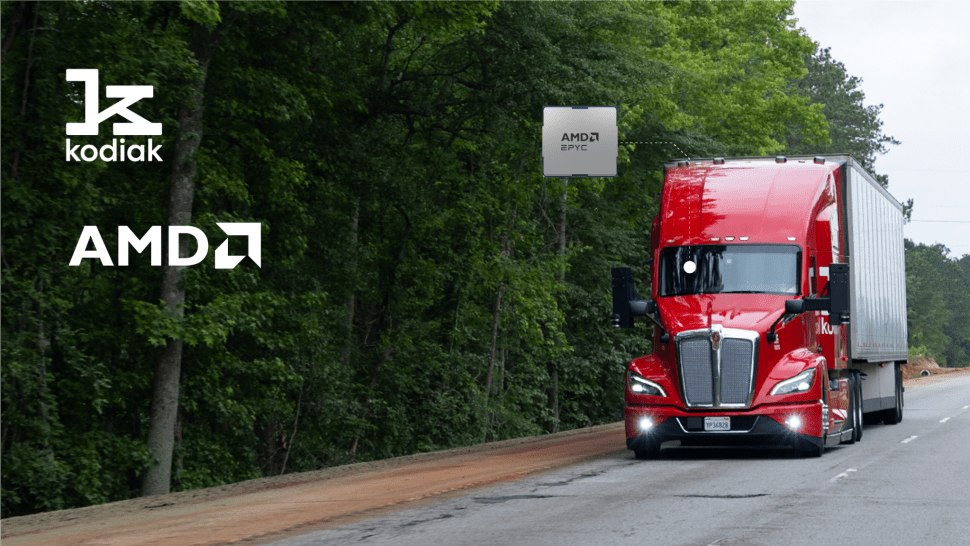
AMD is taking a new position in autonomous trucking as its EPYC processors are set to power Kodiak AI’s seventh-generation autonomous truck platform. The two companies announced the agreement Wednesday, making Kodiak the first autonomous trucking company to deploy AMD’s advanced EPYC chips in its hardware.
Unlike conventional automotive processors, EPYC chips belong to the server-processor class commonly used for cloud and data-center workloads. In Kodiak’s trucks, their role is focused on autonomous vehicle computing: processing the enormous flow of sensor information generated on the road and preparing it for the autonomous-driving software.
Kodiak’s SensorPods combine cameras, lidars and radars to produce that data stream every second. The EPYC processors aggregate and preprocess the incoming information before it is handled by the Kodiak Driver.
The move comes as Kodiak continues expanding its driverless operations in the Permian Basin, where its trucks are already operating without anyone in the cab. The company’s second-quarter 2026 results showed that seven additional driverless trucks were deployed during the quarter. At the end of Q2, 35 customer-owned vehicles were in operation, while cumulative paid driverless operation had surpassed 40,000 hours.
Kodiak is targeting driverless operations on public highways later this year, putting the new computing platform in place ahead of that planned expansion.
Compute speed is critical for autonomous trucking
Kodiak’s choice of AMD as its compute provider is closely tied to the demands of autonomous driving, particularly I/O performance and latency.
Tasks such as sensor processing, localization and path planning require rapid data handling and are not easily distributed across hundreds of processor cores. For these applications, clock speed and PCIe connectivity can be more important than simply maximizing core count.
AMD’s EPYC processors provide Kodiak’s platform with 80 PCIe lanes, allowing large volumes of data to move at high rates. The processors have a 3.15 GHz base frequency and can reach a maximum boost frequency of 4.4 GHz. AMD estimates that the new generation delivers a 25% improvement in clock speed compared with the previous generation while also consuming less power.
“Physical AI requires compute capabilities that can rapidly handle enormous amounts of sensor data while supporting increasingly sophisticated AI workloads,” said Don Burnette, founder and CEO of Kodiak.
“AMD delivers best-in-class CPU technology with the performance, scalability and efficiency required for advanced autonomous driving applications. AMD EPYC CPUs give us the compute capabilities we need to advance the Kodiak Driver and continue commercializing autonomous trucking.”
Commercially available hardware for the next phase
Kodiak is relying on commercially available AMD hardware rather than developing specialized silicon itself. The approach allows the company to focus its engineering resources on building trucks that can scale and reach production readiness, an increasingly important consideration as its driverless Permian Basin fleet continues to expand.
The Kodiak Driver is already deployed across long-haul trucking, industrial trucking and defense applications. Its commercial partners include Atlas Energy Solutions, IKEA, J.B. Hunt, Bridgestone, Werner Enterprises, C.R. England, General Dynamics Land Systems and Roehl Transport.
Kodiak commercializes the technology through a Driver-as-a-Service model as well as strategic partnerships.
“Physical AI is pushing computing into some of the most complex and data-intensive environments in the world,” said Wayne Lyons, senior director of the automotive market at AMD.
“Kodiak is demonstrating what’s possible when advanced autonomous driving software is paired with high-performance AMD compute. Together with Kodiak, AMD is providing the processing capabilities needed to move driverless trucking from innovation to significant scale.”