



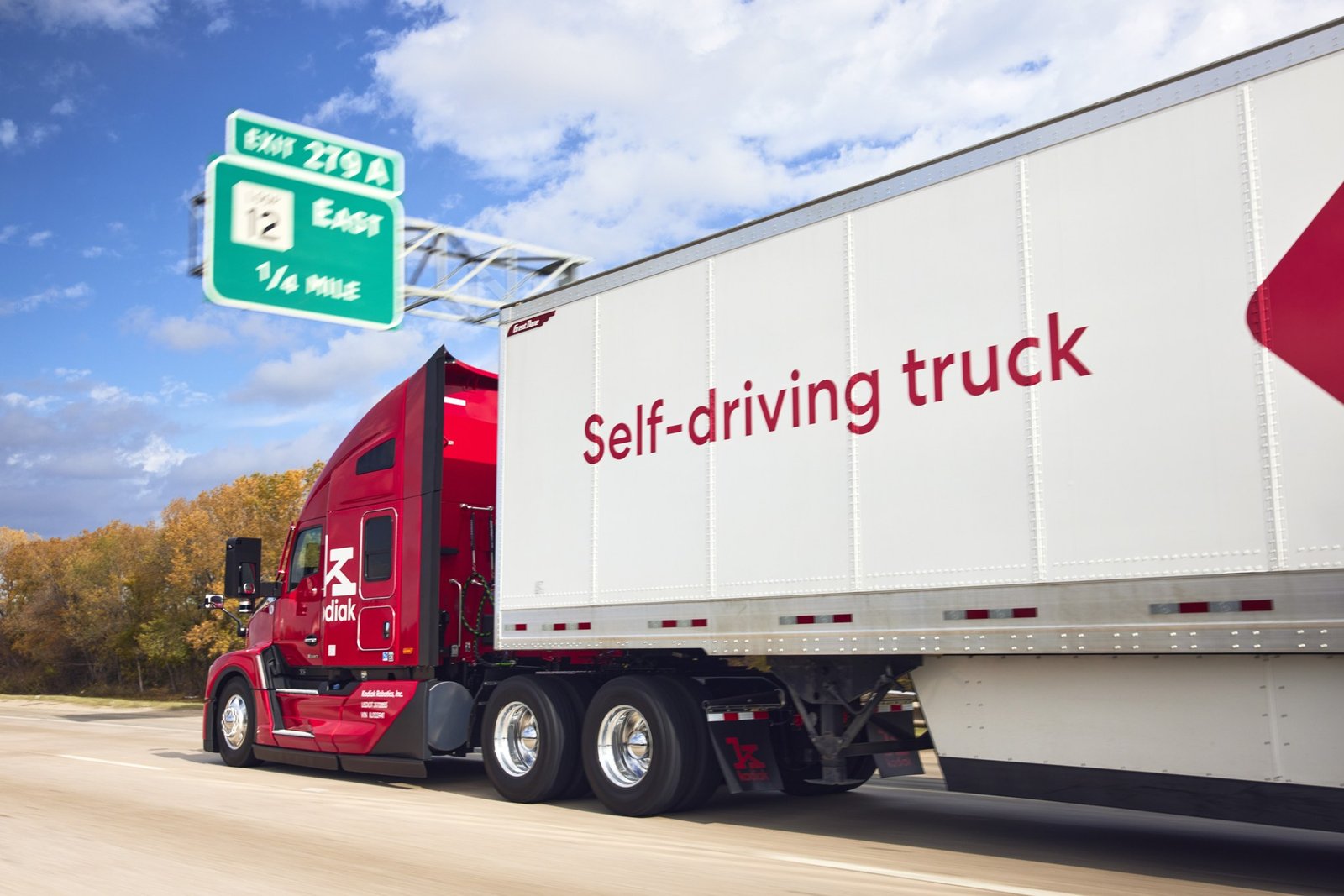
Kodiak AI and Charger Logistics have begun autonomous freight operations on a 435-mile route connecting the carrier’s terminals in Dallas and Laredo, Texas. Announced on Thursday, the new service transports refrigerated and dry van freight for customers in the consumer packaged goods and food and beverage sectors. The first delivery took place on September 8.
The trucks currently operate with a safety driver behind the wheel. The companies intend to transition to driverless operations once Kodiak completes the safety case required for the deployment.
Progress towards that milestone has accelerated in recent months. Kodiak’s long-haul Autonomy Readiness Measure, which tracks the proportion of claims and supporting evidence completed for its safety case, reached 96% at the end of September. This compares with 93% at the end of August and 84% in February.
Kodiak is targeting the launch of driverless long-haul freight operations by the end of 2026 on its Dallas–Houston route along Interstate 45. The company already operates driverless trucks in commercial service in the Permian Basin, where the deployment began in December 2024.
Laredo corridor targets high-volume freight flows
The new route gives Kodiak its first presence in Laredo, the highest-volume commercial land port of entry in the United States. According to Kodiak’s announcement, the Port of Laredo handled more than $350 billion in international trade in 2025, representing nearly 40% of all U.S. trade with Mexico.
The corridor is particularly suited to autonomous freight operations because consumer packaged goods and food and beverage shipments move in consistent, high-volume flows linked to retail replenishment schedules. Kodiak says predictable transit times and extended operating hours are especially valuable for these supply chains.
Charger Logistics is an asset-based carrier operating across the United States and Mexico, with temperature-controlled transportation among its core services. The company manages its network through a proprietary transportation management system (TMS) supported by internally developed applications.
Andy Khera, president of Charger Logistics, said autonomous technology would help the company build a network that benefits both customers and drivers.
“Autonomy lets us build a network that serves both our customers and our drivers,” Khera said in the announcement.
He added that combining Charger’s in-house TMS, managed transportation capabilities and the Kodiak Driver technology creates a nearly fully automated ecosystem. According to Khera, this approach is designed to provide customers with long-term continuity of freight capacity despite changing labour markets and fluctuations in freight demand, while also enabling drivers to return home every night.
Kodiak plans to expand autonomous operations across Charger’s network
The deployment operates under Kodiak’s Driver-as-a-Service model, through which the company installs and operates its Kodiak Driver autonomous technology on trucks owned and operated by its customers.
The two companies expect to introduce additional routes over time as Charger integrates the technology into its fleet. The Dallas–Laredo launch therefore represents an initial step towards a broader deployment of autonomous freight services across Charger’s network.
However, Charger is also pursuing a separate autonomous trucking partnership with Aurora Innovation on the same corridor.
In late July, Aurora announced that Charger would deploy its second-generation driverless trucks between Dallas and Laredo. The agreement, subsequently reported in August, follows a transportation-as-a-service model that differs from Kodiak’s approach.
Under Aurora’s arrangement, Aurora holds the U.S. Department of Transportation operating authority, controls the truck and provides the insurance coverage.
Kodiak, meanwhile, views the new corridor as an opportunity to extend its autonomous technology into another major freight market while establishing the operational foundations for future expansion.
Don Burnette, founder and CEO of Kodiak, said Charger had approached the company with a clear understanding of its objectives for autonomous transportation and the requirements that needed to be met before scaling the technology.
“Charger came to us knowing what they wanted from autonomy and what they need to see before scaling it,” Burnette said.
He added that the Dallas–Laredo route extends the Kodiak Driver into a new corridor and provides both companies with the operational foundation needed to expand driverless freight services.
Related articles about Kodiak AI

PrePass, Kodiak Bring Driverless Trucks Into Weigh Station Bypass SystemsSeptember 22, 2026

AMD powers Kodiak’s seventh-generation autonomous trucks in first for the sectorAugust 28, 2026

Kodiak taps IKEA to launch driverless freight on I-45September 30, 2026

Autonomous truck beacon waiver moves closer to October renewal amid legal challengeOctober 5, 2026