




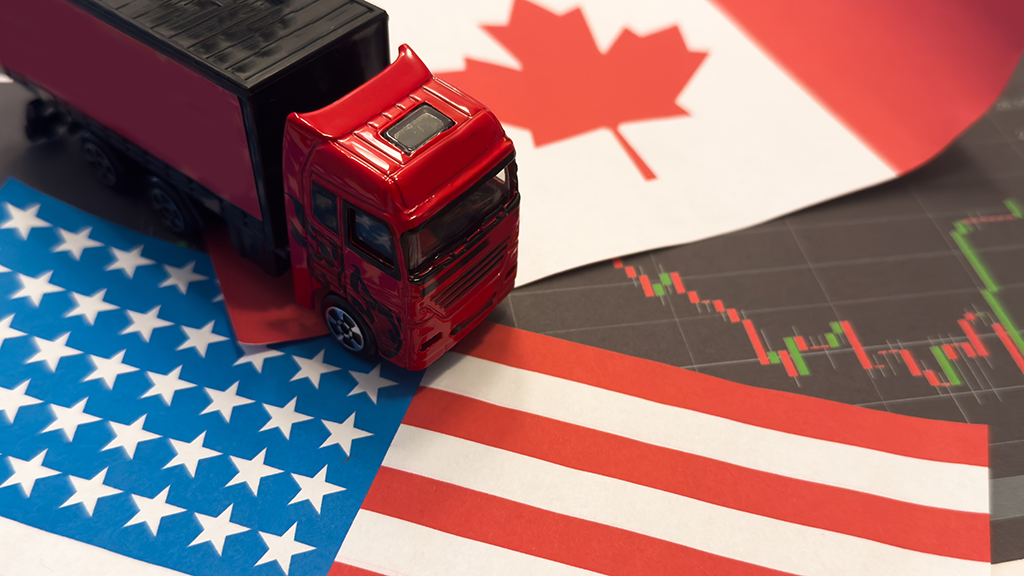
OTTAWA – The escalating tariff dispute between Canada and the United States could leave a lasting mark on cross-border commerce, with economists warning that years of increasingly integrated trade ties may be entering a fundamentally different era.
As new tariffs take effect and confidence in the United States as a reliable trading partner weakens, more Canadian companies are being encouraged to look beyond their traditional southern market. U.S. investment strategist Peter Schiff said the search for alternative markets and new trade relationships could ultimately become difficult to reverse.
Schiff, chief economist and global strategist at Euro Pacific Asset Management, said the longer Canadian businesses develop commercial links elsewhere, the more firmly those relationships could become established.
“To the extent that over the next few years other relationships are established, they may not be so easily unwound,” Schiff said in an interview. He added that the shift “could permanently impact the overall volume of trade.”
Companies will continue to pursue business opportunities across the border whenever doing so remains profitable, Schiff said. But as Canadian firms are compelled to identify alternative destinations, those markets could become increasingly attractive.
The process could also encourage companies to make long-term investments outside the United States.
“As Canadian companies end up having to invest more in logistics or infrastructure to service other markets, it may be more lucrative to pursue those relationships,” Schiff said.
A weaker U.S. dollar could further accelerate the trend by making the American market less appealing to Canadian exporters, he added.
The United States remains the most convenient destination for many Canadian products because of its geographic proximity, but Schiff stressed that Canadian businesses have other potential customers.
“Americans are not the only buyers,” he said. “We’re just the most convenient buyer because stuff doesn’t have to travel very far to get here.”
Canadian companies, he added, can increasingly seek customers elsewhere and establish trading relationships with other countries.
For decades, Canada has treated the United States as its most important trading ally. Successive trade agreements between the two countries steadily lowered barriers and helped deepen economic integration across the border.
That long period of expanding ties, however, may now have reached its peak.
Drew Fagan, a professor at the University of Toronto’s Munk School of Global Affairs and Public Policy, believes the current tensions could lead to a lasting structural transformation in the relationship.
“There’s going to be lasting change,” Fagan said.
In his view, the shift is about more than the tariffs themselves. The change also reflects a broader transformation in attitudes, as the United States becomes more protectionist and nationalist.
Canada’s historic dependence on the American market was built on more than economics, Fagan explained. Geography, market size and longstanding cultural connections all contributed to making the United States the natural destination for Canadian trade.
“There’s good reason why we were so dependent on the U.S. market,” he said. “The U.S. is close, it’s large and the cultural ties are deep.”
Although the American market remains highly competitive, it has traditionally offered Canadian companies significant opportunities. Some of those opportunities are now diminishing as trade tensions intensify.
Still, Fagan emphasized that the existing relationship will not disappear entirely.
“Although the U.S. is super competitive, there was opportunity there. Now some of that is going away. But there are also plenty of ties that will continue.”