



Green ammonia could become a cheaper fuel for shipping than very low sulphur fuel oil (VLSFO) by 2035, provided the International Maritime Organization’s (IMO) proposed Net Zero Framework progresses as envisaged. A new report from the UCL Energy Institute suggests that the fuel could also help unlock large-scale renewable energy investments in developing economies.
The study examines the potential of the Grand Inga hydropower project in the Democratic Republic of Congo (DRC) to supply renewable electricity to ports for shore-side power, also known as cold ironing, and to electrolysers producing green hydrogen for ammonia manufacturing.
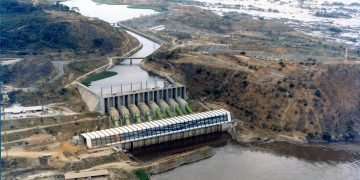
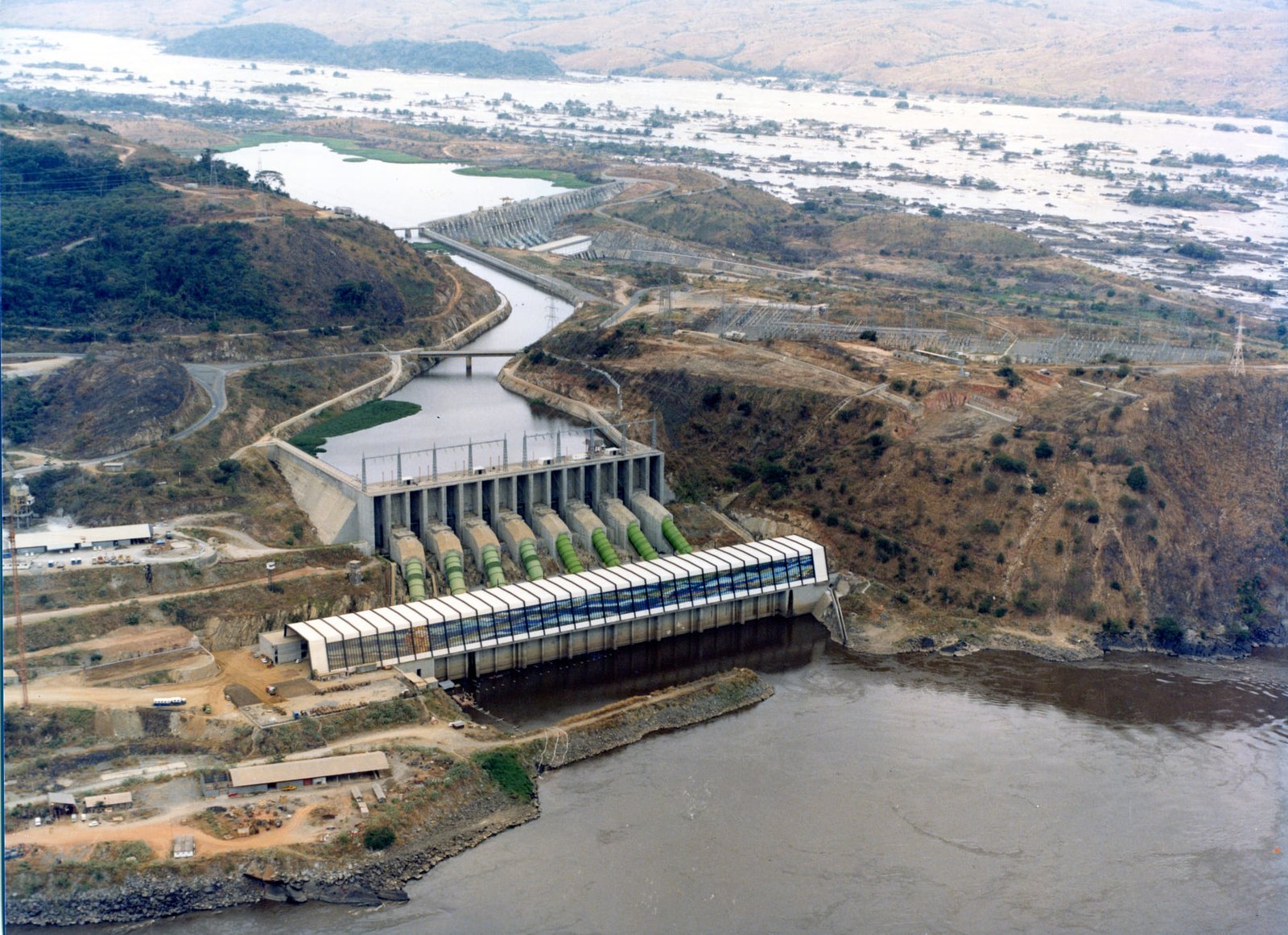
The DRC already operates two Inga hydropower stations, Inga 1 and Inga 2, with a combined installed capacity of 1,775 MW. A third phase, known as Inga 3, has been proposed with a capacity ranging from 2 GW to 11 GW. Last year, the World Bank agreed to a $1 billion, multi-phase financing project intended to prepare the country for the development of Inga 3.
According to the UCL Energy Institute, the IMO’s proposed Net Zero Framework could help create the electricity demand needed to strengthen the economic case for the dam. The report argues that similar mechanisms could support renewable energy projects in other developing countries.
Port electrification alone is generally insufficient to generate the scale of demand needed to influence major power investment decisions. However, combining shore-side electricity with the substantial requirements of electrolysers used to produce green hydrogen could provide a more compelling commercial rationale for large renewable energy projects.
Green ammonia production could change the economics of the project
The electricity demand for cold ironing of the DRC’s ports is estimated to be 21 GWh per year, or an average power demand of about 2.4 MW.
The report said a 580 MW electrolyzer running at 90% capacity could generate 500,000 tons of green ammonia annually. This production would consume 4,756 GWh of electricity per year, which means ammonia production is a much larger potential source of power demand than port electrification alone.
The report said that ammonia production facilities alone would not justify developing Grand Inga. However, they could provide a significant base level of electricity demand to back up later stages of the hydropower project.
The economics of green ammonia will also benefit from access to cheap hydro power. The levelised cost of hydrogen production is about two-thirds electricity and the delivered levelised cost of ammonia production is 92% hydrogen in the model used in the study.
The report said green ammonia could be produced for $515 per ton at the port using electricity from Grand Inga or an average levelised cost of $524 per ton at the coast. These figures are well below previous estimates for green ammonia of between $950 and more than $2,000 per ton.
A key competitive advantage of Grand Inga is its capability to provide low-cost and near-continuous hydropower with a capacity factor of 90%, according to the report. The conditions could enable the project to produce hydrogen and ammonia at significantly lower prices than those reported for many other parts of Africa.
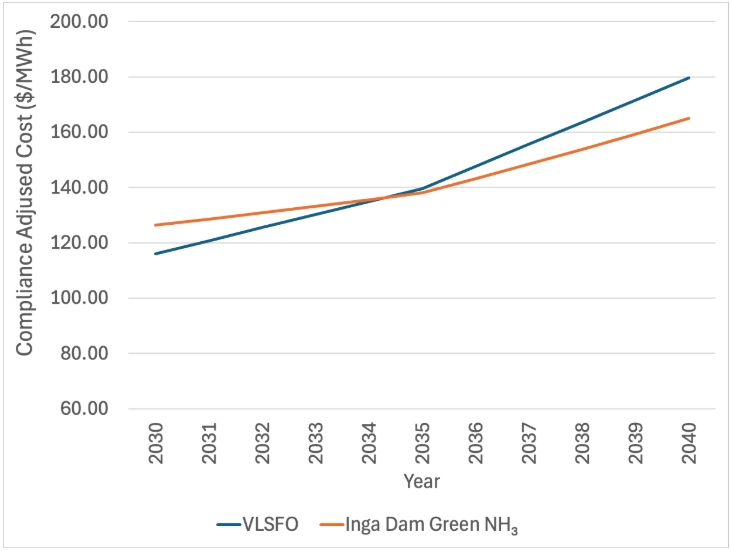
Chart: UCL Energy Institute, Electrification investment from IMO’s Net Zero Framework – a case study on Grand Inga Hydropower project.
IMO rules might alter the balance of fuel costs.
The report also assesses the possible implications of the proposed IMO Net Zero Framework on the relative competitiveness of marine fuels from 2030 onward. When the costs and benefits of remedial units and surplus units are taken into account under the proposed framework, green ammonia would initially be slightly more expensive than VLSFO on a compliance-adjusted basis.
The zero-carbon Inga hydropower project’s shore-side electricity is the most competitive compliance-adjusted alternative at -$36.6 per MWh. The negative number implies that there is a net economic benefit under the report’s compliance-adjusted estimate.
That result indicates there is significant economic headroom between the cost of providing shore power and what ship operators could be willing to pay to avoid future compliance penalties, the researchers said.
The study finds the compliance-adjusted cost of VLSFO is $116.1 per MWh in 2030. Green ammonia at Grand Inga is $126.3 per MWh and the central biofuel price estimate is $234.2 per MWh.
Such comparisons are expected to change as the policy framework of the IMO evolves. The report, using projections from the UCL Fleet Evolution Model, finds that the compliance-adjusted costs of all fuels considered increase over time. But the cost of running on VLSFO increases faster than green ammonia.
2035 Could Be a Turning Point for Shipping
2035 is identified as a milestone in the study. This is the first year where green ammonia is cheaper than VLSFO on a compliance-adjusted basis, per MWh for ship operations.
The expected change illustrates the possible impact of international maritime climate policy on the economics of alternative fuels. The IMO framework could also improve the commercial viability of green ammonia by changing the relative cost of conventional and low-carbon energy, while underpinning investment in renewable electricity infrastructure.
However, the UCL Energy Institute warns that diluting the proposed Net Zero Framework would undermine the business cases for both cold ironing and green ammonia production. It may also reduce their stake in the broader economic rationale for investment in renewable energy in developing countries.
It also notes that the commercial and environmental promise of Grand Inga may extend beyond shipping and power generation. This is beyond the scope of the analysis but the project might also allow for the production of energy intensive commodities like fertilizers with a lower carbon footprint.
The authors recognize that there are major uncertainties about future policy decisions, market adoption and project financing. But they find that green ammonia could play an important role in a broader strategy to unlock the economic value of Grand Inga’s hydropower resources while supporting global decarbonization objectives.