



As peak season approaches each year, the conversation across the air cargo industry tends to revolve around one familiar concern: capacity.
Airlines add flights. Freight forwarders compete for available space. Rates can rise almost overnight, while shippers wait anxiously to find out whether their cargo will actually make it onto an aircraft in time for the seasonal rush. Warehouses become busier, phones keep ringing, and for several hectic weeks, one question dominates the industry: is there enough space in the sky?
Yet beneath that highly visible pressure lies another challenge, quieter but arguably just as important. It receives far less attention, even though it has a significant influence on pricing, planning and network economics.
It is the backhaul problem.
And it begins with a straightforward question: what happens to the empty half of the aircraft?
A flight is rarely balanced in both directions
Consider an aircraft flying from Shanghai to Chicago with its cargo holds full. The aircraft still has to return to Asia.
The heavily demanded direction is known as the headhaul. The return journey is the backhaul. When there is little demand for cargo moving from Chicago back to Shanghai, the aircraft departs with unused capacity.
The costs, however, do not disappear.
Fuel, crew and airport charges still have to be paid for the return flight. Those costs must be recovered somewhere, and they are often reflected in the pricing of the stronger outbound direction.
The issue is far from new. Research published in the Journal of the Air Transport Research Society by Vincent Van Bockstaele, Sven Buyle and Wouter Dewulf illustrates the imbalance clearly. Load factors — essentially the percentage of available cargo capacity that is actually filled — are considerably higher on dedicated freighters, at around 65%, compared with approximately 36% on passenger aircraft carrying cargo in their belly, according to IATA figures cited in the study.
Passenger aircraft, after all, are scheduled primarily around passenger demand rather than freight flows. As a result, the difference between demand in one direction and demand in the other can become particularly pronounced.
It would be easy to imagine this as a simple global pattern: strong outbound demand and weak return flows.
The reality, however, is considerably more complicated.
The picture is not one imbalance. It is many.
Kathy Liu, VP, Global Sales & Marketing at Dimerco Express Group, summed up the situation clearly.
“The imbalance therefore varies by origin, destination and commodity rather than following the same headhaul-backhaul pattern across all routes,” she said.
That distinction matters.
Taiwan-US routes remain tight, supported by demand for semiconductors and AI-related hardware. South Korea is also reporting strong load factors in broadly the same direction. Selected routes from Malaysia, Thailand and Singapore are similarly experiencing relatively tight conditions.
China and Hong Kong, however, tell a different story. Exports from those markets to the United States have softened, easing pressure on that corridor even as neighbouring Asian markets remain stretched.
The traditional assumption becomes even more complicated in the opposite direction. Some routes from the United States into Asia are also tight, a situation that does not fit neatly into the classic headhaul-versus-backhaul narrative.
In practical terms, there is no single global setting marked “strong outbound, weak return.”
The imbalance changes from route to route and commodity to commodity. In some cases, markets within the same region can behave in entirely different ways. A forwarder planning capacity across Asia this season cannot simply apply one strategy everywhere. Taiwan does not behave like Hong Kong. Korea does not behave like Thailand.
Pricing data from TAC Index reinforces that fragmented picture.
Neil Wilson, Editor at TAC Index, described two very different developments occurring simultaneously. Rates from China to Europe are up by around 12% year-on-year, but that increase follows a slower period. Volumes and rates on the route fell after the European Union ended its de minimis exemption on 1 July, reducing the flow of low-value parcels. The market has only recently started to stabilise.
China-US rates, meanwhile, are up by around 30% year-on-year, representing a considerably sharper increase. Wilson linked the strength of the market to continuing demand from the AI sector, semiconductors and resilient e-commerce volumes.
Two routes originating in the same country. Two very different pricing stories. And both unfolding during the same season.
That is precisely the fragmented imbalance described by Liu, now visible directly in the rate data.
There is also another layer affecting the market: operating costs.
Rising jet fuel prices, driven by tensions in the Persian Gulf and disruption through the Strait of Hormuz, are increasing costs across air cargo networks, including on routes where demand has weakened.
Rates, therefore, are not determined solely by how much cargo wants to move. They are also shaped by what it costs to keep the aircraft flying in the first place.
What a real imbalance looks like on the ground
Statistics can illustrate what is happening on a particular route. Seeing the imbalance play out at an individual airport provides a much clearer picture of its operational consequences.
Velana International Airport (MLE) in the Maldives offers a particularly useful example because its imbalance is neither temporary nor primarily seasonal. It is structural, rooted in the shape of the country’s economy.
“MLE has a structural imbalance toward inbound cargo, reflecting the Maldives’ import-dependent economy and the role of tourism as the country’s primary economic driver,” said Hussain Shafiu, Manager, Cargo Development, Commercial at Velana.
The Maldives imports significantly more than it exports.
Food, consumer goods, e-commerce parcels and supplies connected to the tourism industry enter the country continuously. Outbound cargo volumes, by comparison, remain limited. A significant share of the cargo that does leave is transshipment freight, moving through the Maldives rather than originating there.
That makes the issue far more than an academic question.
An airport with a strong inbound bias still has to find ways to manage the emptier outbound side of its network. Shafiu explained that Velana has responded by developing its role as a transshipment gateway in the Indian Ocean, prioritising rapid connections rather than long-term storage for cargo moving through the airport.
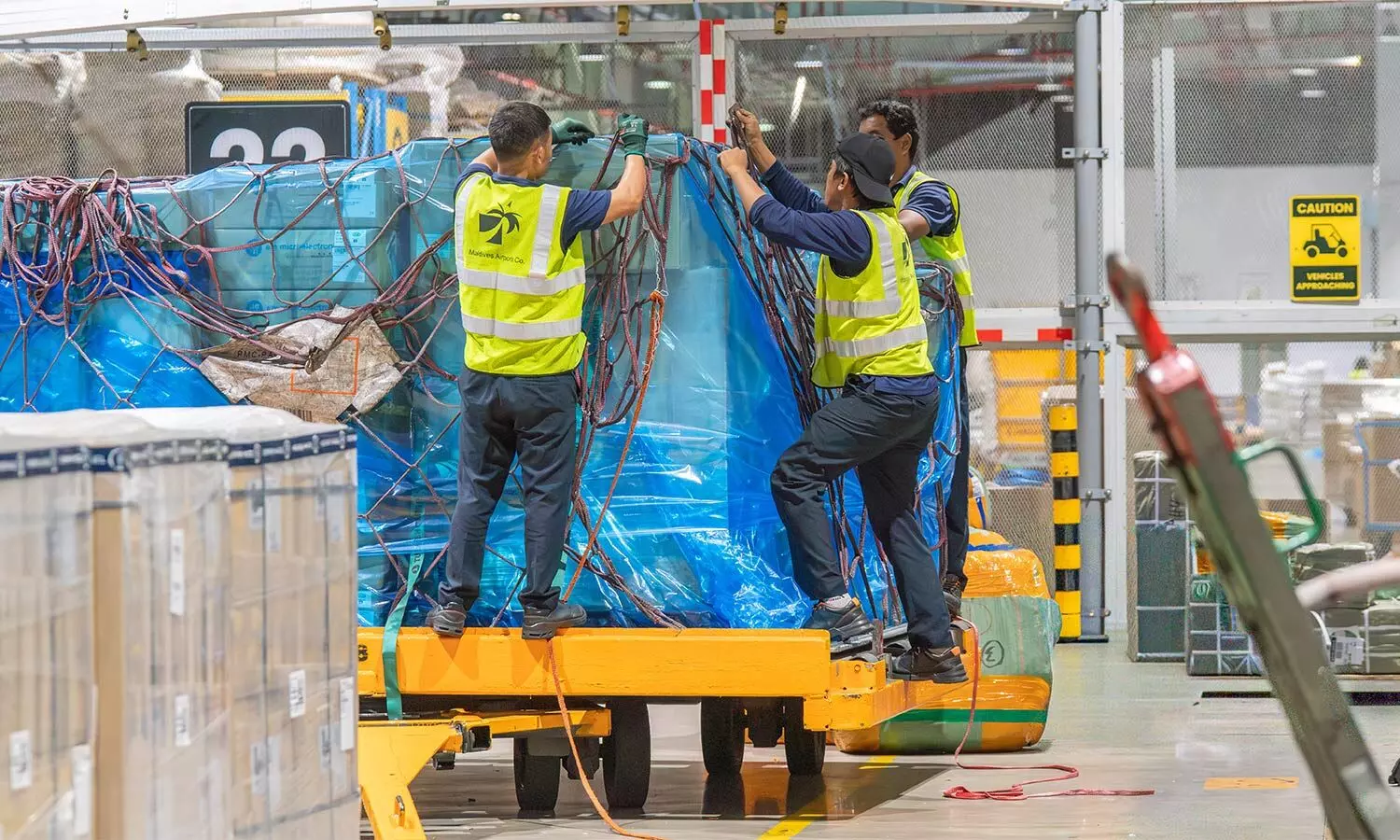
MLE opened a new cargo terminal in 2024, with the capacity to handle up to 120,000 tonnes annually.
The airport handled almost 89,000 tons of cargo in 2025. Peak day volumes were about 380 tons during the December holidays. We are now regularly processing in excess of 200 tons a day with peaks in excess of 300 tons.
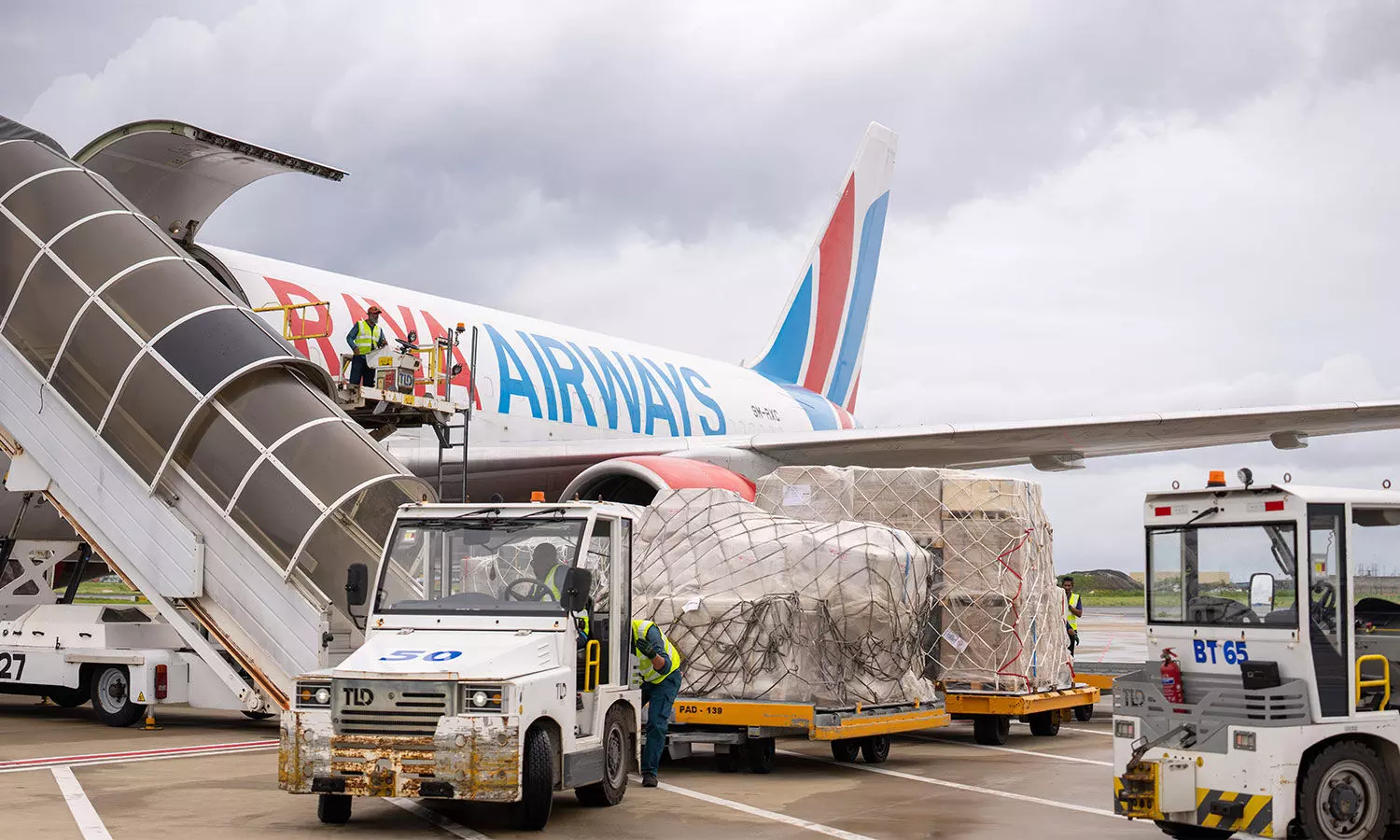
And it will see a 12% rise in flight movements in winter 2026/27, plus new freighter links, including Raya Airways’ weekly Penang-MLE service.
During the holiday season, Velana adds belly capacity — cargo space in the hold of passenger aircraft rather than dedicated freighter capacity — on flights to Europe. The goal is to give shippers more options on what may be a less crowded cargo route.
The bottleneck is rarely the aircraft itself
In the holiday rush, the biggest obstacle to getting cargo moving is often not the plane.
That’s what happens after the plane lands.
During peak holiday periods, capacity and manpower deployment has been the biggest constraints at Velana and not the number of arriving flights, he said.
Cargo may only be on board an aircraft for a few hours but it might spend a lot longer in a warehouse if there is not enough space and not enough staff to process it.
The new cargo terminal, designed specifically to meet that challenge, opened in 2024. The facility is to be designed to operate round the clock and to absorb seasonal surges and reduce the congestion previously experienced at the airport.
<

Physical infrastructure, however, is only part of the equation.
Coordination is equally important.
Velana works with airlines, freight forwarders and agents to forecast expected cargo volumes, flight schedules and cargo flows well before known peak periods. The objective is to align manpower and handling resources with expected demand rather than attempting to assemble capacity at the last minute.
The airport’s 24-hour operating model also provides additional flexibility.
Sea-to-air cargo, for example, can be processed during off-peak periods in coordination with the Maldives Ports and Customs, helping to keep that traffic away from the busiest operating windows.
Because many passenger airlines connect through Velana during the early morning, the airport also works with carriers to make better use of evening operating windows. This allows pressure to be distributed throughout the day instead of concentrating activity within a single narrow period.
These operational details rarely appear in headline capacity figures.
Yet they can determine whether cargo actually moves in time for the holiday season or remains stuck waiting for capacity that technically exists but cannot yet be accessed.
How forwarders route around the gap
Freight forwarders do not simply wait for network imbalances to correct themselves.
They adjust.
Liu described several patterns that Dimerco has observed this year. Earlier tariff-related front-loading brought some shipments forward ahead of their original schedules. Some cargo moving between China and Vietnam, as well as China and Thailand, has shifted from air freight to road transport.
China-Europe rail also remains an option for cargo that can tolerate a longer transit time.
On the tightest routes, booking space one to two weeks in advance is now considered the recommended minimum.
Korea-US shipments currently require around one week of advance notice, while some equipment cargo moving through Incheon requires closer to two weeks.

Capacity availability can differ considerably from one market to another.
When a major hub becomes fully loaded, as Taipei has recently, the cargo itself does not disappear.
Instead, it waits for a later flight, moves through an alternative routing or, in the case of urgent or larger shipments, travels via charter service.
For cargo that is less time-sensitive, changing transport mode altogether can become a practical solution.
A full hub, therefore, does not necessarily stop trade.
It makes trade slower, more expensive, or both.
And in most cases, it is the shipper who ultimately absorbs that cost, whether through higher freight rates, delayed deliveries or the need to identify an alternative gateway at very short notice.
Locking in space without overcommitting
That’s where Block Space Agreements, or BSAs, are becoming more and more relevant.
A BSA is a contract in which a freight forwarder pays an airline to reserve a fixed amount of cargo capacity on a flight, regardless of whether that capacity is actually used.
“Both sides of the decision, it’s a risky arrangement.
Over-commit to capacity on a route that then softens and the forwarder is left paying for unused space.
If you commit too little, the forwarder is exposed if demand suddenly tightens.
In August 2026, CXTMS, a transport management software provider, published an industry analysis that advocates a more structured approach to uncertainty management rather than treating each block-space commitment as fixed until departure.
The model uses some checkpoints before the flight.
Six to eight weeks before departure, the emphasis is on holding core and strategically important capacity and challenging any forecast volumes without firm orders or confirmed production.
If actual demand over two consecutive planning cycles is consistently below a defined threshold, for example, 75% utilization, the booked allotment is reduced three to four weeks prior to departure.
The remaining excess capacity is then let go seven to fourteen days prior to departure unless value or urgency of a shipment warrants paying for the added buffer.
The goal is not to perfectly predict the market.
It is to build a repeatable system that allows capacity commitments to be changed early rather than discovering the mismatch after the aircraft has departed.
So does adding more aircraft actually help?
This is the question at the centre of the entire issue.
If outbound and backhaul demand remain structurally out of balance, does adding more aircraft genuinely solve the problem?
Or does it simply create more empty capacity chasing the same limited pool of demand?
Shafiu’s perspective from the airport side provides a useful answer.
“Airline capacity is only fully usable when airport infrastructure, manpower, handling resources and coordination can support it end to end,” he said.
That observation changes how the question should be viewed.
Adding aircraft increases the raw amount of capacity available in the sky.
But capacity in the sky is not automatically usable capacity.
If warehousing, staffing, customs clearance, trucking and handling operations cannot process the additional cargo, then the extra aircraft capacity does not necessarily translate into something that shippers can actually use.
From that perspective, simply adding more aircraft does not resolve a structural imbalance.
In some cases, it can make coordination even more complicated if ground infrastructure has not expanded alongside the additional flying capacity.
An extra freighter does little for a shipper if its cargo then remains in a warehouse for another two days because there are not enough people available to process it.
In such situations, expanding capacity in the air without expanding capacity on the ground can simply move the bottleneck.
The problem shifts from the tarmac to the terminal — from a shortage that is highly visible and widely discussed to one that is quieter and easier to overlook.
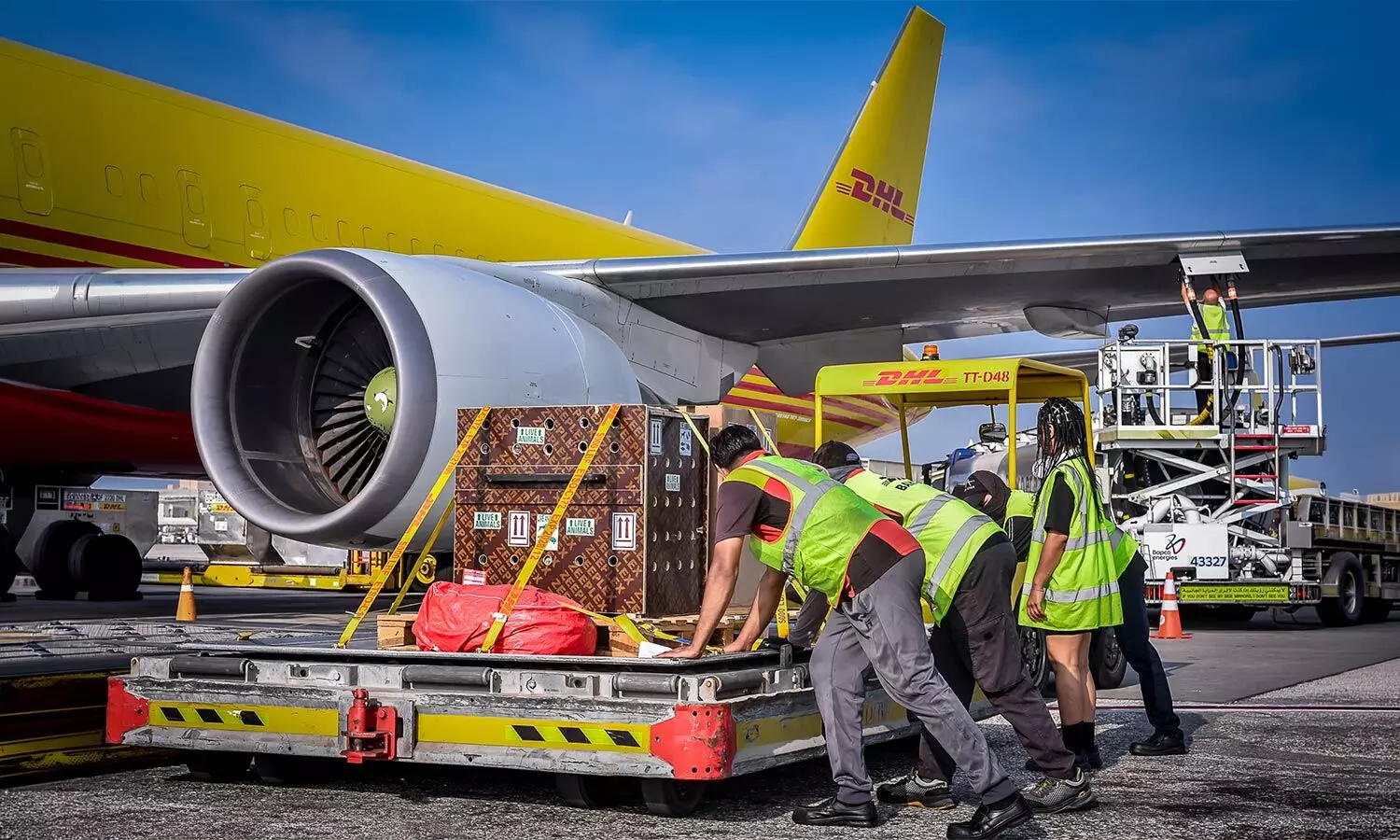
What appears to help, based on the evidence gathered across these different markets, is a combination of measures addressing different parts of the same supply chain.
Forwarders need more precise forecasting and stronger booking discipline, distinguishing between confirmed orders and optimistic projections rather than committing capacity based solely on last year’s numbers.
Contracts also need greater flexibility, following the type of structured approach described by CXTMS, allowing capacity commitments to change as the real demand picture becomes clearer.
Airports, meanwhile, need infrastructure capable of turning additional aircraft capacity into cargo that genuinely moves, supported by sufficient staffing, handling resources and coordination.
The empty half of the aircraft, in other words, is rarely solved simply by adding another aircraft.
It is addressed by ensuring that everything surrounding that aircraft — bookings, contracts, warehouses, infrastructure and people — can keep pace.
This holiday season, as much as any before it, success may depend less on how many aircraft airlines can put into service than on how effectively the industry manages everything that happens after those aircraft land.