



As technology continues to revolutionize the industries of the world, the maritime sector could be at the dawn of a new age of business opportunities driven by nuclear power and floating infrastructure.
One promising application that is gaining increasing interest is the development of floating datacentres. The idea is emerging in the United States at a time of rapid expansion of artificial intelligence, which is putting unprecedented pressure on electricity networks and generating growing opposition to large, energy-intensive data centers on land.
The breakthrough came in August, when Hornbeck Offshore, one of the leading offshore support vessel operators, announced a partnership and investment in Deployable Energy, a Houston-based start-up developing microreactors dubbed the “Unity Nuclear Battery”.
The technology is a 1-megawatt-electric micro-reactor that can be placed on vessels. The company could run for five years or more between refueling cycles, it said. Approval in Principle has also been received from Lloyd’s Register (Class LR) for Deployable Energy.
The partnership between the two firms is designed to marry the transportable microreactor technology of Deployable Energy with the marine operations experience of Hornbeck Offshore.
The goal is to explore the application of maritime nuclear for inland waterways, offshore vessels and platforms, national security logistics, autonomous vessels, power barges and floating data centers.
Offshoring data centers
The proliferation of artificial intelligence-based applications is driving demand for computing power, and data centers are becoming a major political and economic issue.
The issue has also entered the political debate ahead of the November mid-term elections in the United States. With increasing concern about the impact on electricity networks, voters are becoming more hostile to the rapid expansion of energy-guzzling data centers.
In some US states, new landside data center construction has even been put on hold temporarily. Against this background floating data centers are more and more discussed as a possible alternative.
This could be a substantial new market for the shipping industry.
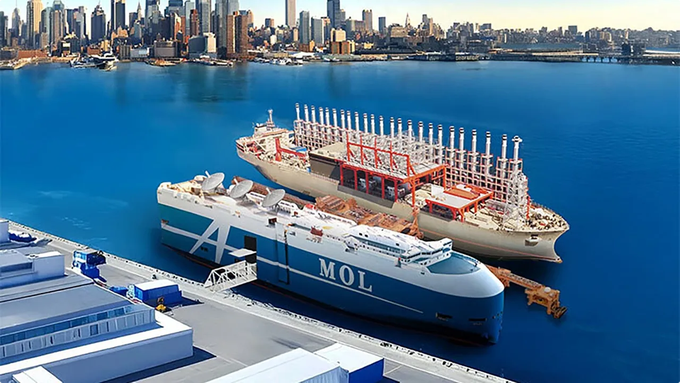
A first indication of this is in Brownsville, Texas, where Turkish firm Karpowership is looking at potential future projects around a shipyard it bought from Singapore’s Seatrium last year.
Karpowership’s U.S. subsidiary Karpower Valley is reportedly in discussions to put up to $3 billion into activities around the newly acquired Brownsville yard. The company could also lease more land in plans to convert older LNG vessels into floating power supply units linked to floating data centers.
The company has already taken steps elsewhere in this direction.
Karpowership subsidiary signed an agreement with Japanese shipping giant Mitsui OSK Lines to develop a floating data center platform powered by LNG in 2025.
There may be new financing models
The participation of large data center operators and so-called “hyperscalers”, which tend to have considerable financial muscle, could also change the way maritime infrastructure projects are financed.
In addition to traditional shipping finance, new financial structures could be introduced, involving infrastructure investors and project-based financing models, especially in relation to completed floating power plants.
Karpowership has already shown how such projects can be supported by alternative financing structures. It raised $400 million in secured debt in late 2025, in a syndicate led by Mauritius Commercial Bank (MCB).
The financing was structured as portfolio financing on a pool of signed Power Purchase Agreements (PPAs).
Small reactors and the emerging energy challenge
And beyond the seas, there may be a connection between data centers and nuclear energy.
It was recently discussed in the “Energy Forum” podcast from the Baker Institute of Public Policy at Rice University in Houston, Texas, called Thinking Big With Small Reactors.
Panelists in the discussion expressed concern about whether existing electricity grids will be able to meet the huge power requirements of expanding data center infrastructure.
A potential solution is the application of Small Modular Reactors (SMRs), which are increasingly considered as a way to provide reliable power for large scale energy consumers.
Nuclear power joins maritime infrastructure talk
Nuclear power is also beginning to feature more prominently in the discussion of maritime infrastructure.
Recent activity at the Port of Corpus Christi, Texas and the Port of Long Beach, California reflect increased interest in nuclear-powered maritime infrastructure.
U.S. Department of Transportation and Port of Corpus Christi Announce Partnership on Small Modular Reactor Technology for Maritime Applications
The USDOT said testing the newest SMR innovations could help revive U.S. shipbuilding, lower fuel costs and help restore America’s maritime dominance.
The announcement came on top of an agreement between Corpus Christi and small reactor developer Core Power to explore floating nuclear power capabilities.
It also follows a similar agreement signed a month ago between the Port of Long Beach and the U.S. Department of Transportation (USDOT).
“This is a first-of-its-kind partnership,” said Dr. Noel Hacegaba, port of Long Beach CEO.
“This pioneering partnership with MARAD provides us an opportunity to deploy strong federal leadership and private sector innovation to jump-start SMR technology as we safely and securely power the next generation of shipping,” he said.
As pressure grows on electricity grids and artificial intelligence drives unprecedented demand for computing power, the intersection of maritime infrastructure, floating power generation, nuclear technology and offshore data centers could unlock a whole new chapter for the shipping industry.
What was once a conversation about powering ships may increasingly become a wider conversation about how maritime infrastructure itself can deliver energy solutions for the digital economy.