



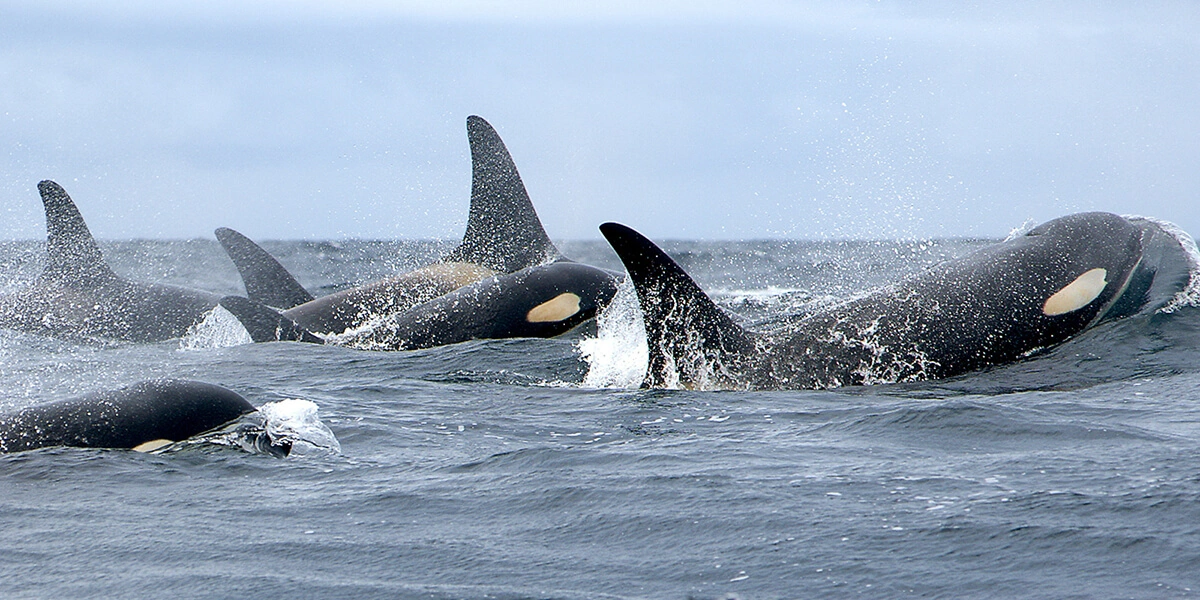
Several of Canada’s leading environmental organizations are intensifying pressure on the federal government ahead of legislation designed to accelerate the development of major projects, warning that proposed changes could put the country’s endangered Southern Resident Orcas at greater risk.
Environmental Defence has launched a new advertising campaign focused on the future of the Southern Resident Orcas, calling on Ottawa to reconsider elements of its proposed legislation before it is introduced during the fall sitting of Parliament.
The organization is particularly concerned about plans to establish “economic zones” covering transportation corridors, telecommunications networks and energy production and transmission. Under the proposal, the federal cabinet would determine which activities could take place within those zones, while ministers would have the authority to pre-approve projects.
“We’ve heard from MPs that changes are being considered from what was drafted initially,” Julia Nevin, associate director at Environmental Defence, told The Canadian Press.
“But the government has not said anything publicly around the direction and what that might look like, and specifically on the changes to species protections.”
Ottawa published two discussion papers in May outlining a series of proposed changes. Among them was a plan to transfer responsibility for assessing pipelines, transmission lines and offshore renewable energy projects from the Impact Assessment Agency to the Canada Energy Regulator.
The federal government has argued that industry representatives told officials the Canada Energy Regulator possesses specialized expertise in energy projects that is not available to the same extent within the Impact Assessment Agency.
The government initially gave stakeholders until June 7 to submit feedback on the proposals. Following significant criticism, particularly from environmental and Indigenous organizations, Ottawa extended the consultation period until July 22.
The timetable for introducing the legislation was also pushed back to the fall parliamentary sitting, which is scheduled to begin on Sept. 21.
Last month, the government said it had received more than 21,000 emails regarding the proposed changes. Ottawa also said a report summarizing the consultation process would be completed by the end of the summer.
However, a spokesperson for the Prime Minister’s Office said there was no update available on the status of that report.
Environmental groups focus on species protections
One of the most contentious elements of the proposals concerns the potential exemption of certain projects from legislation intended to protect species at risk.
The Marine Mammal Commission, an independent U.S. government agency established by Congress, estimated that just 74 Southern Resident Orca whales remained as of July 2025. The population is protected in Canada under the Species At Risk Act.
Environmental Defence is highlighting the whales’ dependence on the Salish Sea, where major shipping activity is already a concern.
“Their habitat is the Salish Sea — the exact waters oil and LNG tankers must pass through,” reads an excerpt from the organization’s new website.
“Underwater noise from these ships drowns out the orcas’ ability to hunt, communicate, and navigate — pushing them toward extinction.”
Ecojustice has also stepped up its campaign. The organization, which has labelled the pending legislation the “orca extinction bill,” launched its own media effort last week after Ottawa began the process of designating Roberts Bank Terminal 2 as a project of national interest.
The federal government says the terminal would increase the container capacity of the Port of Vancouver by nearly 50 per cent. It also says the project would help Canada double its exports to non-U.S. markets by 2035.
Designation as a project of national interest under the Building Canada Act would allow the government to bypass the Species At Risk Act, enabling the project to move forward.
Ottawa is separately proposing to give cabinet ministers what it describes as “limited” authority to exempt projects from the so-called “jeopardy test” under species-at-risk protections.
The government says such exemptions would only be possible when a project is in the public interest and its proponent has made all reasonable efforts to avoid or reduce impacts on species at risk.
“But only if it’s in the public interest and if the proponent has made all reasonable efforts to avoid or reduce impacts on at-risk species,” says a federal discussion paper outlining the proposal.
Ecojustice argues that the proposed changes could nevertheless weaken one of the key safeguards intended to prevent development projects from worsening the situation of endangered species.
“In plain terms: the law is meant to stop projects from pushing endangered species closer to extinction,” the organization said in a post on its website.
“The proposed changes could create a way for projects to get around that protection.”
The debate comes after environmental organizations spent time on Parliament Hill in June lobbying MPs against the proposed reforms.
At the time, Prime Minister Mark Carney rejected claims that the government was abandoning environmental safeguards, saying Ottawa was “absolutely not” throwing away environmental protections through its proposals.