




Cargo theft during the Labor Day period is more and more than just physical theft. Trusted freight networks are being accessed by criminals who hack carrier accounts, email systems, business telephone lines and compliance platforms. Once inside, they can change delivery instructions after a legitimate trucking company has taken possession of the shipment, potentially bypassing safeguards designed mostly to verify the carrier at the start of a transaction.
Verisk CargoNet has flagged this type of identity-based deception as an emerging threat, particularly during holiday periods when staffing levels, operating schedules and verification procedures may be different.
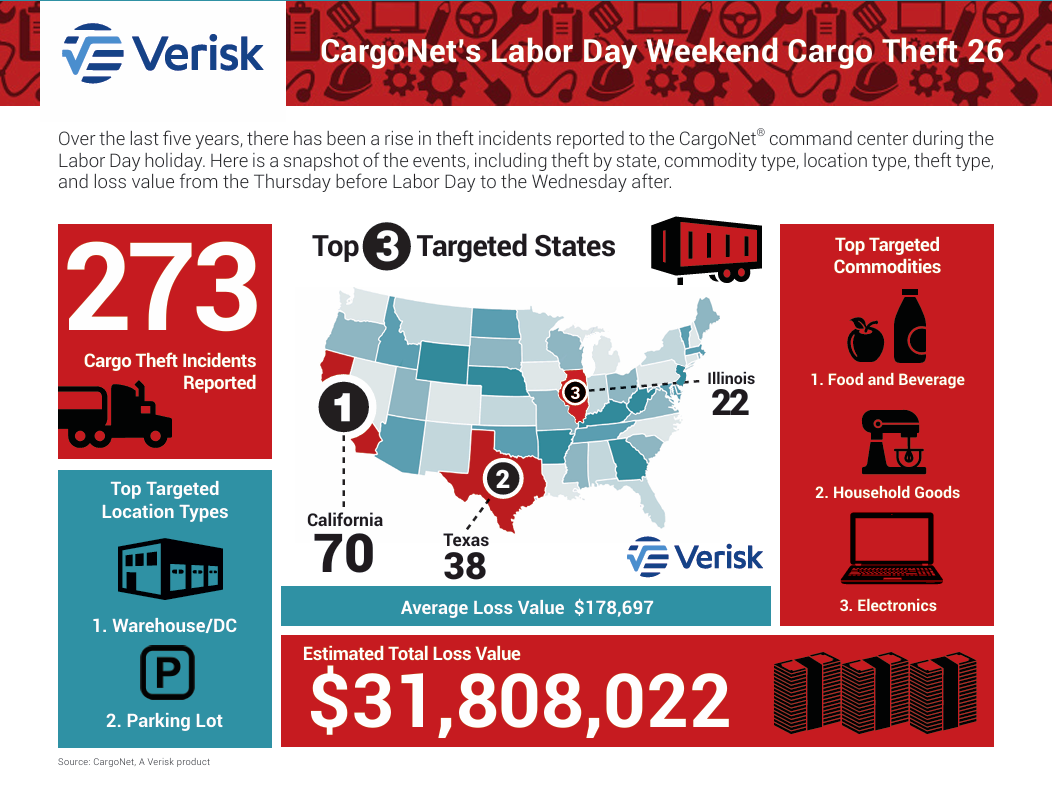
The warning comes after a five-year study of Labor Day periods spanning from 2021 through 2025. Verisk CargoNet recorded a total of 273 cargo theft incidents across the U.S. during the seven-day periods analyzed. The value of the commodities was estimated at approximately $31.8 million.
Verisk released the results Friday, ahead of the 2026 Labor Day weekend.
70% more thefts on Labor Day
The number of reported incidents grew consistently over the studied period. CargoNet reported 33 incidents in 2021 and 56 incidents in 2025, a 70% increase. The highest number of incidents was recorded in 2024, with 70 incidents, which was a five-year peak and shows that the risk was much higher than at the beginning of the period.
Friday was the busiest day of the week with 55 incidents. Tuesday was 49, then Thursday was 46 and Wednesday 44. Of the cases studied, 71 percent, or 194, were during the four weekdays.
The holiday and the weekend it encompassed saw fewer reported cases. There were 24 incidents Saturday, 28 Sunday and 27 Monday Labor Day.
CargoNet blames this distribution on the nature of deceptive pick-up and non-delivery schemes. “Such operations tend to depend on working telephone lines, on the availability of employees and on the flow of freight through established logistics channels.” Those conditions may be less favorable during business closures, before activity picks up again as normal operations resume around the weekend.
CargoNet has identified two overlapping areas of vulnerability during the holiday period.
The first is physical exposure. “When facilities shut down or schedules get out of whack, loaded trailers and other freight can sit for long periods of time, creating opportunities for criminals to target unattended shipments.”
The second is verification. The pressure to get freight moving, coupled with a shortage of people, can make it harder to validate last-minute changes, confirm identities or question odd delivery instructions. In this situation criminals may pose as legitimate carriers, alter instructions or give false contact details.
Three states had almost half of all incidents
Cargo theft activity was heavily concentrated in three large freight states, Over the five-year period California, Texas and Illinois were responsible for 130 incidents, or 48 percent of the total.
California takes first place with 70 incidents. Texas had the next highest with 38 and Illinois 22.
Verisk said the concentration is because of the states’ dense freight networks, large consumer markets and intermodal infrastructure, which all create ample opportunities to move and resell stolen goods.
The most targeted commodity were food and beverage shipments with 49 incidents. Household goods were next with 27. Electronics represented 25.
There were 20 other cases involving vehicles and accessories and 11 involving metals. CargoNet says these types of commodities continue to be attractive as they can be resold through a number of illicit channels.
The financial impact of cargo theft doesn’t stop on Labor Day. In the first half of 2026, CargoNet estimated more than $359 million in losses from cargo theft. The average value of the stolen commodities was about $341,518.
High value freight, including expensive metals, enterprise technology components and other commodities that can fetch big profits in illicit resale markets, is increasingly targeted by transnational organized criminal groups.
No data on particular cases is available.
The Labor Day analysis does not identify individual victims, suspects, carriers or investigations. Verisk also didn’t separate out how many of the incidents were physical cargo thefts vs. identity-based schemes.
Friday’s announcement also did not give individual loss figures or recovery results. So the figures available paint a broad picture of the threat, but do not reflect how much of the $31.8 million reported was eventually recovered, or how the losses were distributed across individual incidents.
Why it matters
The findings underscore that a holiday shutdown does not create or end a cargo theft exposure. Brokers, carriers and shippers are vulnerable before, during and after the Labor Day weekend, especially when routine verification processes are disrupted.
CargoNet’s analysis also uncovers a wider trend in the way criminals tackle freight theft. Rather than just stealing a shipment, bad actors may use trusted identities and legitimate logistics relationships to manipulate freight that is already in transit.
For companies doing business during the holidays, it is just as important to have reliable communication channels and to verify changes to carrier, contact and delivery information carefully as it is to physically secure freight.
The five year Labor Day data ultimately shows that normal business activity can create opportunities for criminals. Freight remains in trusted logistics channels as staffing and verification capacity varies.