




Borderlands Mexico is a weekly overview of key developments affecting cross-border trucking and trade between the United States and Mexico. This week: a trucker protest intensifies the dispute surrounding B-1 visas, CBP launches an extended-hours program for empty trailers at the Laredo border crossing, and Imperative Logistics strengthens its presence in El Paso through a deal with RM Customhouse Brokers.
Trucker protest raises stakes in Mexico-US B-1 visa dispute
Mexico’s trucking industry is stepping up pressure on U.S. authorities to provide greater clarity on the enforcement of B-1 visa regulations for cross-border truck drivers. Industry representatives warn that continued uncertainty could eventually disrupt freight flows between Mexico and the United States.
Officials from Mexico’s National Chamber of Freight Transportation (CANACAR) say Mexican drivers have been losing their visas following encounters with U.S. officials over alleged cabotage violations. However, carriers say they still lack clear and consistent information about how authorities determine visa eligibility and what constitutes a violation at different border crossings.
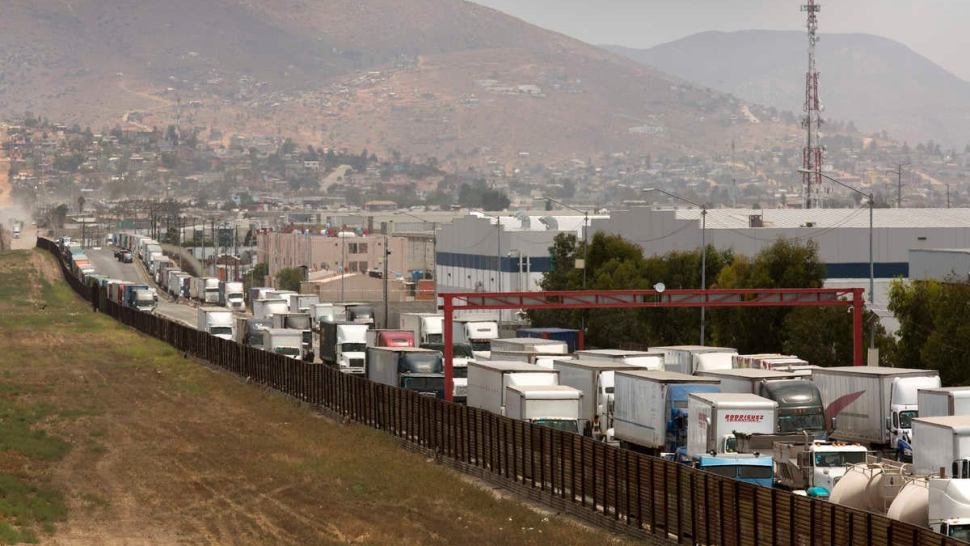
The dispute became highly visible on Thursday when truck drivers blocked commercial traffic at the Mexicali, Mexico-Calexico East, California, border crossing to protest a series of visa revocations.
In neighboring Tijuana, CANACAR officials have urged drivers not to organize similar blockades, warning that shutting down additional border crossings could significantly increase the economic consequences of the dispute.
Alfonso Millán Chávez, CANACAR delegate for Tijuana, Tecate and Playas de Rosarito, said the organization, together with other business groups, is seeking meetings with Mexican and U.S. officials to establish clearer protocols governing visa revocations linked to suspected cabotage violations.
According to Millán, disagreements often emerge over how U.S. authorities interpret what constitutes a prohibited domestic movement, particularly when empty trailers are involved.
“Sometimes we have had problems with the interpretation, for example with an empty trailer,” Millán said. “The empty trailer is there to be loaded with merchandise, and some officers interpret the empty trailer as merchandise.”
Cabotage generally refers to the transportation of goods between two points within the same country by a foreign carrier. Mexican truck drivers holding B-1 visas are authorized to transport international freight into and out of the United States, but they are generally prohibited from carrying out point-to-point domestic freight movements within the country.
CANACAR is now calling on U.S. authorities to establish clearer procedures for visa actions involving suspected cabotage violations. The organization is also seeking reliable statistics on the number of drivers who have lost their visas.
According to CANACAR estimates, more than 25,000 commercial driver visas may have been revoked along Mexico’s northern border, including potentially around 4,000 in the Tijuana area. These figures, however, are estimates compiled by CANACAR based on reports from members and information circulating on social media rather than official U.S. government statistics. The organization has requested additional information from the U.S. Embassy in Mexico and the U.S. State Department.
Visa dispute reaches boiling point in Mexicali
Pressure increased further on Thursday as truck drivers protested at the Mexicali commercial port of entry over what they described as a growing number of B-1 visa revocations.
Millán said CANACAR had anticipated that frustration among drivers could eventually reach this point.
“We understand the desperation of the drivers, and as a chamber and as an industry, I think we have been anticipating this over the last few months,” Millán said. “There hasn’t been a week when we haven’t raised the issue with various authorities in both Mexico and the United States.”
Despite the growing frustration, CANACAR is encouraging drivers to prioritize negotiations rather than extend the demonstrations to Tijuana.
Millán called on Mexico’s Interior Ministry and Ministry of Foreign Affairs to intervene with U.S. authorities, arguing that the dispute ultimately requires a binational solution. CANACAR, he said, has already raised the issue with both the U.S. Embassy and the State Department.
“My hope is that it does not extend to Tijuana,” Millán said of the protests. “The idea is that we be cautious with this issue.”
He added that CANACAR has consistently supported dialogue over actions that could interrupt cross-border commerce.
Ismael Reyes de la Rosa, a CANACAR official in Mexicali, has also expressed concerns about the way U.S. officers are handling B-1 visas at the border. Drivers are increasingly seeking clarity about which activities could lead to visa cancellations or revocations.
The concern is also spreading beyond Baja California.
Israel Delgado, CANACAR’s vice president for Mexico’s northwest region, has warned that the loss of qualified drivers could affect time-sensitive shipments, including medical products, technology, food and perishable goods moving from Mexico into the United States.
Industry warns of supply chain effects
The consequences of the visa dispute are beginning to extend beyond trucking companies and drivers.
José Luis Contreras Valenzuela, president of the Association of Industrialists of Mesa de Otay, said the situation has already contributed to delays in incoming supplies and deliveries of finished products.
Federico Serrano Bañuelos, president of Index Zona Costa, warned that companies relying on outsourced transportation services could be particularly exposed to the impact of visa losses.
Business organizations are now seeking to raise the matter with Mexico’s Ministry of Foreign Affairs in an effort to push for diplomatic discussions with U.S. authorities.
The dispute comes at a time when cross-border freight activity in the Tijuana region remains below previous peaks.
Millán recently said that approximately 3,000 export trucks are currently crossing the border each day, compared with as many as 4,500 during stronger periods.
Freight volumes in the region fell by nearly 30% in 2025 before showing some improvement this year.
Another issue that had recently raised concerns among Mexican drivers operating in the United States — enforcement of English-language proficiency requirements — appears to have become less pressing in the Tijuana area.
Millán said CANACAR had not recently received reports of drivers being placed out of service because of English proficiency violations.
“The current challenge is the revocation of visas for cabotage issues,” Millán said, adding that such violations are sometimes interpreted “in a very drastic way.”
CBP announces extended-hours program for empty trailers at Laredo bridge
While the visa dispute continues to create uncertainty for carriers and drivers, authorities in Laredo are preparing a separate initiative aimed at easing congestion at one of the key gateways for U.S.-Mexico trade.
The Port of Laredo, working in coordination with Nuevo León’s Border Zone Development Corporation, will launch a 90-day program extending weekday operating hours for empty tractors and trailers at the Colombia-Solidarity Bridge.
According to U.S. Customs and Border Protection, the program will begin on Monday, Sept. 14, 2026.
Under the initiative, empty trucks and trailers will be allowed to begin weekday operations one hour earlier, starting at 7 a.m. instead of 8 a.m. Operations will continue until midnight from Monday through Friday.
The extended schedule is designed to reduce morning northbound congestion for traffic traveling from Colombia, Nuevo León, to Laredo, Texas.
Program details
-
Effective date: Monday, Sept. 14, 2026
-
Duration: 90 days
-
Current weekday hours: Monday-Friday, 8 a.m.-midnight
-
Revised weekday hours: Monday-Friday, 7 a.m.-midnight
-
Applicable traffic: Empty tractors and trailers only
Imperative Logistics expands El Paso footprint with RM Customhouse Brokers deal
Imperative Logistics is also strengthening its position along the U.S.-Mexico border after joining forces with El Paso, Texas-based RM Customhouse Brokers.
The agreement expands Imperative Logistics’ customs brokerage expertise and cross-border capabilities in the strategically important El Paso-Ciudad Juárez trade corridor.
RM Customhouse Brokers traces its history back to 1948 and provides customs brokerage, trade compliance, bonded warehousing and cross-border logistics services.
Its El Paso operations combine customs clearance, storage and distribution capabilities, serving one of the most important manufacturing and trade corridors between the United States and Mexico.
“El Paso is an important addition to our network and gives our customers another critical gateway for U.S.-Mexico trade,” Imperative Logistics CEO Dante Fornari said in a statement.
Fornari highlighted the strategic importance of the El Paso-Ciudad Juárez region, which includes more than 330 maquiladora plants and handles nearly $150 billion in annual trade.
The market has become one of North America’s most significant manufacturing and cross-border freight hubs.
Elvia Miles Doyle, president and co-owner of RM Customhouse Brokers, said joining Imperative will allow the company to preserve its existing customer relationships while giving those customers access to a broader range of logistics solutions.
RM customers will continue working with the same team while gaining access to Imperative’s expanded capabilities in customs brokerage, cross-border transportation, global forwarding and integrated logistics.
Imperative Logistics specializes in expedited transportation, cross-border services, global forwarding and mission-critical logistics.
Why it matters
Mexican trucking companies depend on B-1 visa holders to transport international freight across the U.S.-Mexico border.
Ambiguous or uneven enforcement of cabotage rules could shrink the pool of drivers available for cross-border moves, curtail freight capacity and possibly spark more protests at key commercial gateways, industry leaders say.
The Mexicali situation shows that the controversy has already moved beyond administrative and regulatory issues. The issue could increasingly impact trucking operations, industrial supply chains and the broader flow of trade between the two countries, absent clearer protocols and coordinated action between Mexican and U.S. authorities.