



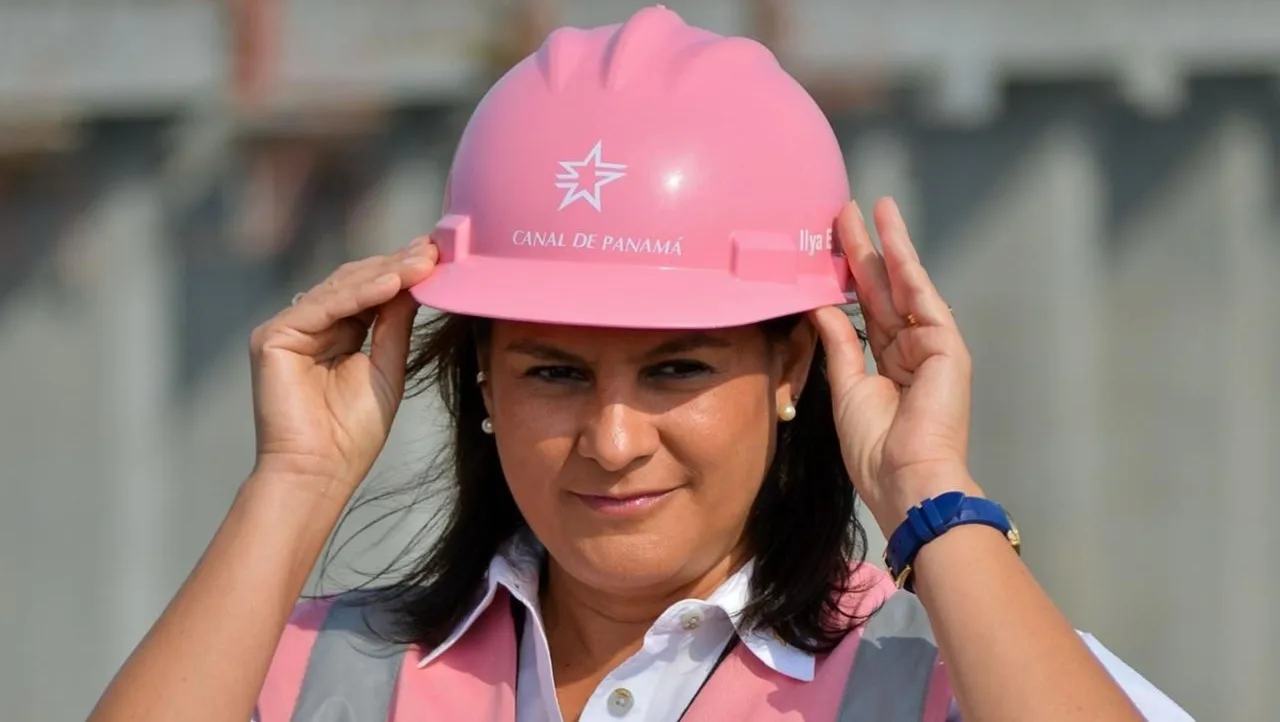
The Panama Canal Authority has welcomed a new Administrator, Ilya Espino de Marotta, who becomes the first woman to lead one of the world’s most strategically important waterways.
A 64-year-old marine engineer and graduate of Texas A&M University, Espino de Marotta will serve a seven-year term as Panama Canal Administrator, beginning on 7 September 2026 and continuing until 2033. She succeeds Ricaurte Vásquez, who assumed the position in September 2019.
Espino de Marotta was appointed Deputy Administrator in 2019 and later also took on the role of Chief Sustainability Officer. As she prepares to lead the Canal into its next chapter, her focus is firmly centred on delivering several major infrastructure projects considered essential to the future of the waterway.
Well known throughout the maritime and infrastructure industries for her distinctive pink hard hat, Espino de Marotta previously led the Panama Canal expansion programme and the construction of the Third Set of Locks after its former director, Jorge Quijano, became Panama Canal Administrator in 2012. At the time, she made history as the first woman to lead a project of such scale at the Canal.
Over the years, she has spoken internationally about the Canal expansion, the challenges surrounding water resources and the future of one of the world’s most important trade routes. Now, as she takes the organisation’s top position, the emphasis is shifting decisively towards execution.
“My priority is the $1.6 billion Río Indio project our signature project. My focus is on how we can expedite its completion, working closely with the communities while executing it according to the established design criteria.
“Río Indio is essential to maintaining reliability for our customers while providing water for the five districts with the largest population more than two million people and the highest concentration of economic activity,” she says.
The Río Indio project received approval from the Panama Canal Board of Directors in January 2025 and is now moving through its next stages.
“We recognise the urgency of moving the project forward. Since 2025, we have worked intensively with the communities of Río Indio, explaining the project and developing a compensation and resettlement programme through dialogue with residents.
“Our objective is to ensure that affected families have better conditions and opportunities in the neighbouring areas where they will relocate. We are currently working on the conceptual design and tender process for the main dam and its three smaller auxiliary dams. We anticipate beginning the four-year construction phase in January 2028, with completion expected around 2032.”
However, the Río Indio development represents only one element of a much broader investment programme being pursued by the Panama Canal Authority.
International attention is also increasingly focused on two new port terminals currently being promoted by the Authority: Telfers and Corozal.
“For both the Telfers and Corozal terminals, we are already in the pre-qualification and evaluation stages as part of our strategy to strengthen Panama’s role as a global logistics and maritime hub.
“Container terminals are among the most important components of the Canal’s supporting infrastructure, second only to the locks and navigation channels. Expanding port capacity is essential to maintaining the competitiveness of the Panama Canal route and meeting the evolving demands of global trade.
“For this reason, the Panama Canal is promoting the development of these two port terminals, which will strengthen connectivity and expand logistics services on both coasts.”
Another major project on the Canal’s agenda is a proposed gas pipeline, which has also entered the pre-qualification phase following the receipt of proposals on 23 July.
“There are several options to consider, and we must determine the best business model one that creates value for both the Panama Canal Authority and the future concessionaire,” Espino de Marotta explains.
The proposed energy corridor would extend over 76 kilometres and, together with its maritime terminals, could enable the transport of up to 2.5 million barrels of energy products per day between the Atlantic and Pacific coasts without passing through the Canal’s locks.
The infrastructure is being considered for the transportation of products including liquefied petroleum gas, ethane, butane and propane.
“Construction could take approximately two years. We are currently looking towards an international tender next year, potentially in the second or third quarter. Before that, however, we need to determine the optimal configuration including whether the project should involve one or more pipelines based on market demand.”
For Espino de Marotta, however, these projects are not isolated investments. Together, they form part of a broader strategy designed to ensure that the Panama Canal remains reliable, competitive and relevant as international trade continues to evolve.
“The Canal has always had to adapt to change. Today, our responsibility is not only to operate the waterway efficiently, but to prepare it for the future. That means securing the water we need, strengthening the competitiveness of the Panama route and developing the infrastructure and services that our customers and global trade will require in the years ahead.”
“We have important challenges before us, but also extraordinary opportunities. My focus will be on execution working with our people, our communities and our customers to ensure that the Panama Canal continues to serve Panama and world trade with the reliability and excellence that have always defined us.”