



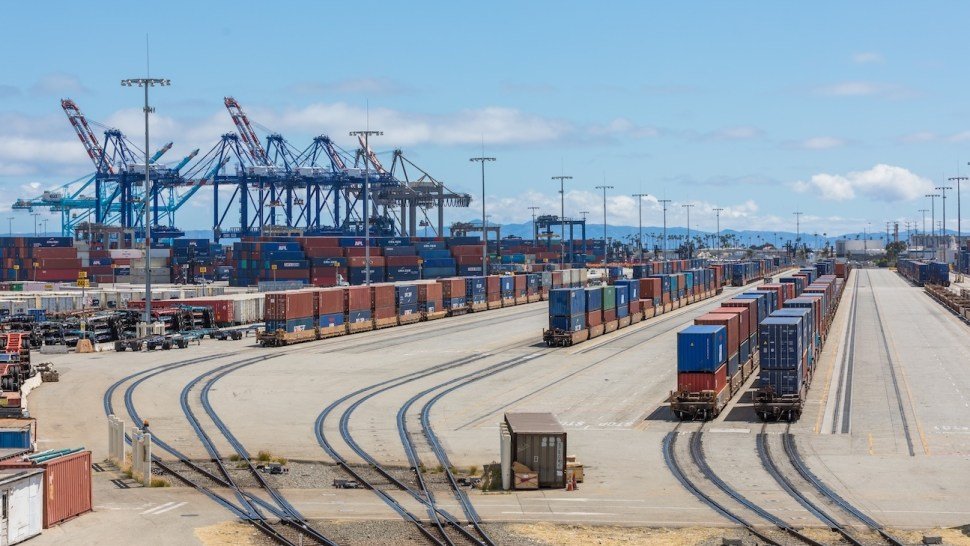
Container dwell times moved in different directions across the nation’s busiest port complex in August. While cargo destined for local truck pickup moved through marine terminals slightly faster, containers awaiting rail transportation spent more time at the Los Angeles-Long Beach gateway.
According to the Pacific Merchant Shipping Association, average local truck dwell fell modestly to 2.95 days in August, compared with 3.03 days in July. The figure remained broadly consistent with the sub-three-day levels recorded throughout much of the past year.
Rail-destined cargo, however, followed a different trajectory. Average rail dwell increased to 6.75 days from 6.34 days in July, extending a period of elevated intermodal dwell at the Los Angeles-Long Beach port complex.
The increase came as the ports processed close to a record 1.88 million twenty-foot equivalent units (TEUs). August throughput reached 1,875,899 TEUs, reflecting continued strength in import, export and transshipment activity even as terminal operations and inland rail capacity face pressure from the volume of freight moving through the gateway.
Truck Flows Remain Stable
The slight improvement in truck dwell indicates that local drayage operations and marine-terminal gate activity remained relatively fluid despite the high level of cargo moving through the ports.
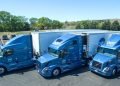
Truck dwell measures the average amount of time containers remain inside marine terminals before being collected by local trucking providers. At 2.95 days, August’s result remained broadly in line with the performance recorded over the previous year, suggesting that terminals continued to process locally handled cargo at a relatively stable pace.
That stability is particularly significant for the San Pedro Bay complex, where drayage plays a major role in moving containers to warehouses, distribution centers, transload facilities and nearby rail ramps throughout Southern California.
Keeping truck dwell below three days helps limit pressure on terminal yards while supporting appointment availability and the circulation of chassis used to transport containers.
Rail Cargo Under Greater Pressure
Rail dwell, meanwhile, reached 6.75 days in August, an increase of 0.41 days from July and a high point compared with the previous year.
The latest figure means containers scheduled to move inland by rail remained at marine terminals for nearly a week on average before departing.
The increase follows a slowdown in network performance among the Class I railroads serving the ports, Union Pacific and BNSF, during late spring as import traffic began to rise, although the initial increase in cargo volumes was relatively modest.
The situation has also raised questions about how Union Pacific would manage additional freight if its proposed merger with Norfolk Southern receives regulatory approval. Observers have questioned how UP would accommodate the substantial volume of freight it says it could capture from trucking under the proposed combination.
The contrast between truck and rail dwell times underscores the role of intermodal performance in maintaining overall cargo fluidity at the Los Angeles and Long Beach gateways.
A significant portion of the containers arriving at the complex is destined for inland U.S. markets, including major distribution centers and logistics regions across the Midwest and South. As a result, the reliability of on-dock and near-dock rail services remains an important factor in terminal productivity and the movement of freight beyond Southern California.
Pacific Merchant Shipping Association officials said marine terminals and transportation providers continue to adapt as cargo patterns change.
“Cargo volumes moving through the San Pedro Bay ports remain strong, with truck dwell holding steady and rail dwell experiencing some additional upward movement,” said Natasha Villa, senior manager of public affairs for PMSA.
“Marine terminals, drayage providers, and rail partners are adapting to changing cargo patterns to maintain fluid operations, demonstrating the strength and resilience of our supply chain in the face of continued global uncertainty.”
The August figures indicate that the local delivery network has so far handled strong cargo volumes without a significant deterioration in truck-side performance.
Rail dwell, however, will remain an important metric for beneficial cargo owners, ocean carriers, railroads and terminal operators as the fall shipping period approaches. If cargo demand remains elevated, inland intermodal capacity could face additional pressure.
Why It Matters
Higher rail dwell at the busiest U.S. maritime gateways can point to a developing bottleneck in the movement of imports from Southern California into inland markets, even when local truck operations continue to perform relatively steadily.