



France-based Sogestran subsidiary Compagnie Maritime Nantaise has awarded Guangzhou Shipyard International (GSI) a contract to build a new hybrid ro-ro vessel designed to serve the European space industry. The ship will be equipped with wind-assist propulsion and is scheduled for delivery in 2030.
The vessel will be primarily dedicated to transporting satellites, launch vehicles and other cargo supporting Europe’s space sector. French naval architecture firm VPLP will be responsible for the vessel’s design.
Cargo operations will be centred around several dedicated areas. These include a large main ro-ro deck for rolling cargo on and off the ship, a dedicated compartment for space-related cargoes maintained under controlled environmental conditions, and a flexible modular outer deck.
Marc-Antoine Girardet, chairman of the maritime division of Sogestran Group, the parent company of Compagnie Maritime Nantaise, said the new vessel represents another step in the company’s development in the European space sector.
“This new vessel represents a further step in the development of our business serving the European space sector. It has been designed to meet our customers’ growing demands in terms of safety, reliability and logistical flexibility,” Girardet said.
He added that the contract follows several years of joint and interdisciplinary work involving Sogestran Group, Compagnie Maritime Nantaise and Avio.
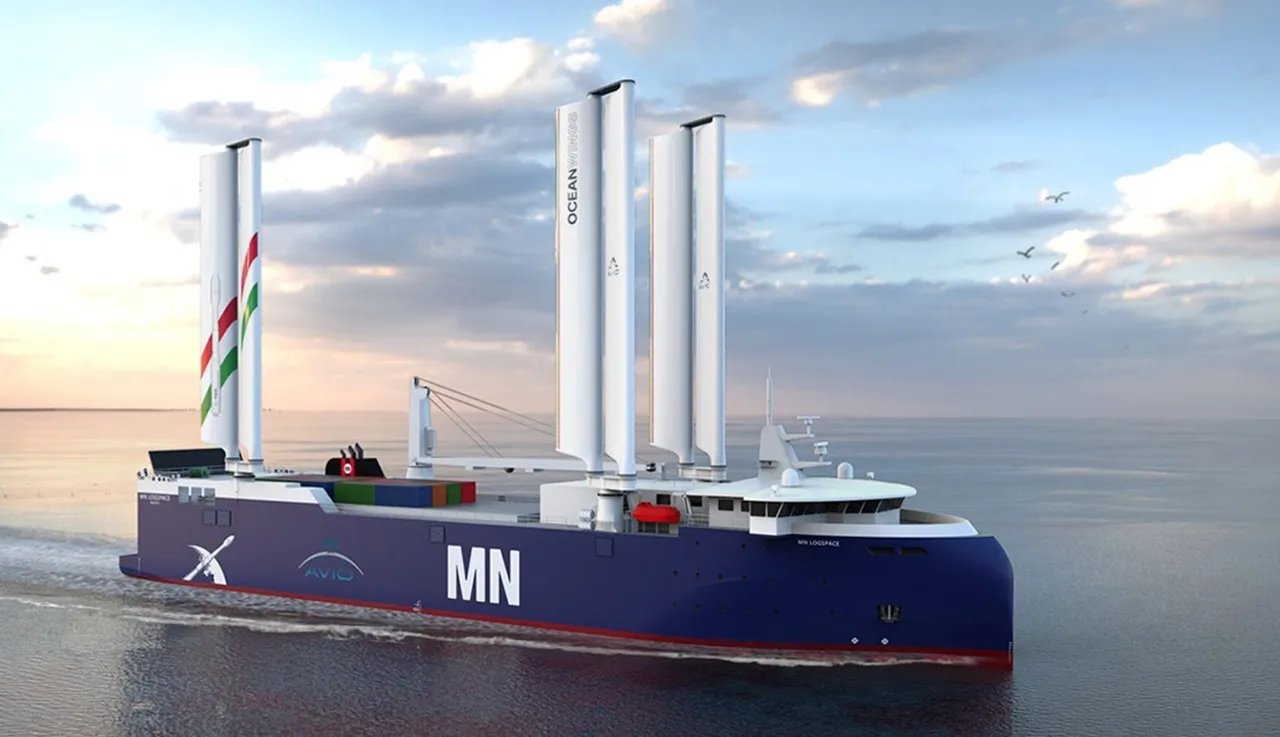
The vessel’s propulsion system will combine conventional mechanical propulsion with a wind-assisted system based on three automated OceanWings rigid sails.
The design also incorporates a range of measures intended to reduce the ship’s environmental impact. These include sail-assisted propulsion, efficient mechanical propulsion, hull optimisation, advanced meteorological route planning, system automation and compatibility with biofuels.
Image placement: Rendering of Compagnie Maritime Nantaise’s hybrid Ro-Ro vessel with rigid sails in the upright position. Credit: VPLP.