



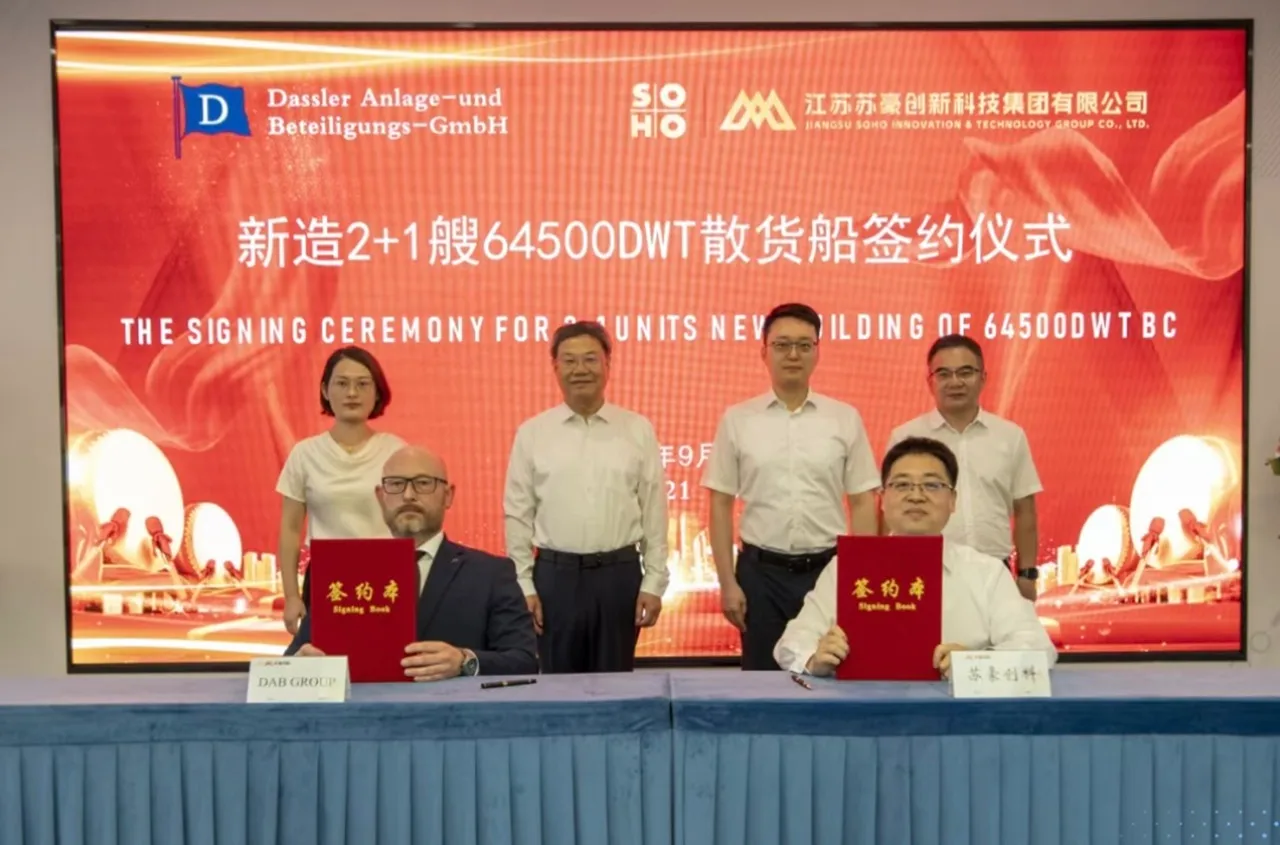
Germany’s Dassler Anlage-und Beteiligungs-GmbH (DAB) Group is entering the shipowning business with an order for two new bulk carriers at China’s Soho Innovation & Technology, with an option for a third vessel.
The agreement officially signed between the two companies covers 64,500-dwt bulk carriers and represents a significant breakthrough for the Chinese shipbuilder, marking its first order from a European owner.
Based in Germany and linked to the Scholler Group, DAB Group operates across maritime consulting and professional shipping services. The newbuildings will be the company’s first vessels under ownership.
The bulk carriers will measure 199.9 metres in overall length, with a beam of 32.26 metres, a depth of 18.9 metres and a structural draft of 13.5 metres. The vessels are designed to operate at a service speed of 13.5 knots, with a maximum endurance of 20,000 nautical miles.
For Soho Innovation & Technology, the order further strengthens a shipbuilding portfolio that has expanded since the company was restructured from the former Shuntian Shipbuilding (Yangzhou) in 2024. Since then, the yard has secured 60 shipbuilding orders, primarily from domestic Chinese owners.
“This landmark cooperation not only signifies Soho Innovation & Technology’s first order for the 64,500 dwt bulk carrier model but also stands as a crucial milestone in its in-depth expansion into the European high-end maritime market, fully validating its robust comprehensive competitiveness in the global shipbuilding arena,” the company said.
The Chinese shipbuilder has also been building its international customer base. Earlier this year, it secured two newbuilding contracts from Hong Kong-based Agricore Shipping and KC Maritime. Agricore Shipping ordered two plus two bulk carriers, while KC Maritime placed an order for a pair of bulkers.
The latest agreement comes as shipyard capacity across China becomes increasingly constrained, with many yards already booked through to 2030. As a result, some international shipowners are turning to smaller and less-established Chinese shipbuilders to secure available newbuilding slots.