



India’s shipbuilding industry is gaining momentum as government funding combines with international technical expertise to accelerate the development of local yards.
The progress is clearly visible at Swan Defence and Heavy Industries (SDHI), which has secured orders for six chemical tankers and four dual-fuel bulk carriers. The contracts underline how quickly India’s emerging shipbuilding sector is expanding.
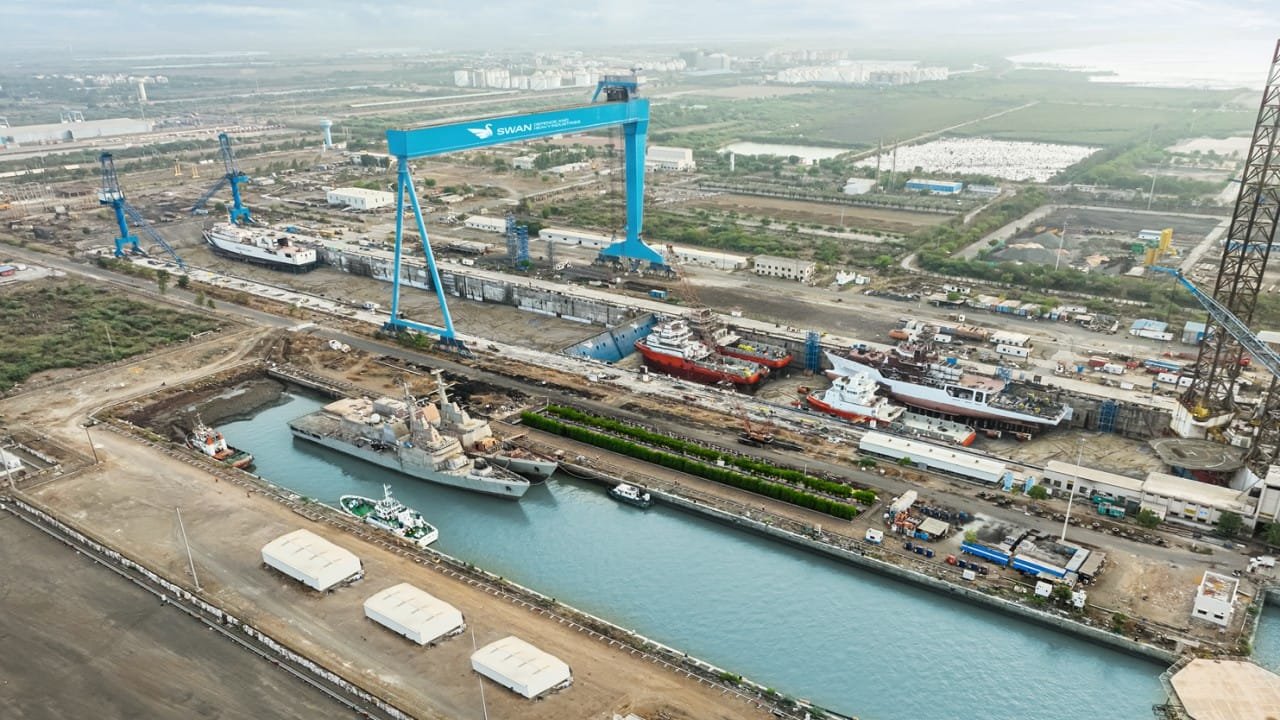
Government subsidies have helped SDHI secure orders and establish its business in a relatively short period. Swan Corporation took over the bankrupt yard just two and a half years ago, and the company is now preparing to build deepsea vessels.
SDHI managing director Vivek Merchant told Seatrade Maritime News that the yard has secured six chemical tanker orders from family-owned Norwegian operator Stenersen.
“They’ve built 14 ships in China, and we have managed to move them away from China and get them to India and build with us now,” Merchant said.
The vessels will have a capacity of 18,000 dwt and will be powered by dual-fuel LNG systems. The contract also includes six options. The ships will be built to ice-class and IMO Tier 3 standards.
SDHI has also secured orders from UK-based Energy One for four 92,500-dwt bulk carriers powered by dual-fuel ammonia technology.
“The tankers will be delivered in the first half 2029 and the bulkers will be delivered first half 2030 onwards, with three to four months between each vessel,” Merchant said.
These first major orders are regarded as essential to the yard’s longer-term development. Merchant said the company expects the next two to three years to focus heavily on building out its supply chain and reaching sustainable production levels.
“Over the next two to three years, we see the shipyard’s supply chain being built out to sustainable levels where we can meet the indigenisation required and produce a cost effective, timely product for customers globally,” he said.
SDHI’s management has studied the shipbuilding sector for more than six years and is now putting its development strategy into practice with support from international partners.
The company has already established a strong repair and maintenance base. “Over the last 12 months, we’ve completed about 30 dry dockings at our facilities,” Merchant said.
The yard initially concentrated on vessel repairs before progressing into the construction of tugs, barges and mini bulk carriers.
An initial $280 million investment was used to secure certification and maintain critical equipment at the yard. But Merchant identified employee training as one of SDHI’s most important achievements.
“We have a little more than 1,000 people on ground today,” he said. Another 550 employees are expected to join by March next year, working both on the docks and in offices. The company plans to continue expanding its workforce, with investments expected to require around 5,000 additional employees over the next two to three years.
Further investment is also planned. Merchant said SDHI has earmarked another $220 million over the next two to three years for technology upgrades and the modernisation of the yard.
Training is a central part of that expansion. The company has invested in a centre of excellence where employees receive classroom instruction before moving onto the shop floor for practical, on-the-job training.
That transfer of technical knowledge to Indian engineers and naval architects has also been supported by major international companies, including DNV, Samsung Heavy Industries, Dutch dredging and defence company Royal IHC and Norway’s Kongsberg.
Government support from New Delhi is playing a major role in the rapid development of the sector, as Merchant acknowledges.
Around $10 billion has been earmarked for India’s maritime sector through 2036. The funding includes the Shipbuilding Assistance Scheme, which provides direct subsidies for vessels constructed in India equivalent to between 15% and 25% of the ship’s value.
“This subsidy support is over the life cycle of the shipbuilding process, it’s not at the fag end of the delivery process, so that also helps ease your working capital requirements since this is a capital-intensive business,” Merchant said.
Another component of the programme provides government-backed ship equity, with support of up to 49% for vessels built in India.
“The other part of that same development fund is basically a CapEx fund which supports brownfield and greenfield shipyard expansions,” Merchant said.
That funding mechanism has helped SDHI and other Indian yards accelerate their expansion programmes. Under the government scheme, SDHI has received support for a second Goliath crane at its dry dock, as well as an E&L crane.
The combination of state funding, international expertise, workforce development and newbuilding contracts is giving SDHI a pathway from a recently rescued shipyard to a facility capable of delivering deepsea vessels for international customers.