



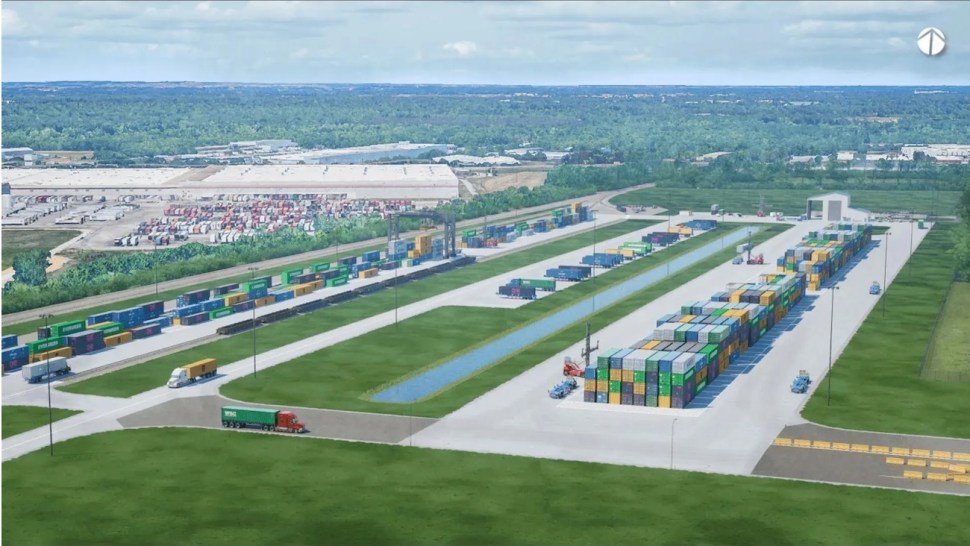
Construction of the Alabama Port Authority’s Montgomery Intermodal Container Transfer Facility remains on schedule for an early 2027 opening, with major groundwork already completed and rail infrastructure now taking shape.
The $100 million, 272-acre terminal is being developed as an inland extension of the Port of Mobile’s container gateway. The facility will connect manufacturers, distributors and exporters across central Alabama to Mobile through direct CSX rail service, offering an alternative to truck drayage between the Gulf Coast and the Montgomery market.
The Alabama Port Authority and the Montgomery Regional Chamber of Commerce toured the site in January, less than a year after construction officially began with the project’s February 2025 groundbreaking. By that point, crews had completed site grading and underground utility installation, while work was advancing on a new rail siding and a bridge crossing the CSX main line.
“The Montgomery ICTF is a critical investment in Alabama’s supply chain infrastructure,” Alabama Port Authority Director and Chief Executive Doug Otto said during the site visit, according to the authority.
The port authority said the project remains on track to begin operations in early 2027.
Rail-served extension of Mobile
The Montgomery facility is being designed specifically as a container-transfer terminal rather than a traditional inland river port. Containers moving through the Port of Mobile will be transported by CSX rail to Montgomery, where they can be transferred between trains, trucks and the terminal yard for regional distribution or export consolidation.
Comparable facilities are already operating in South Carolina, Virginia and on the West Coast.
Once fully operational, the terminal is expected to handle as many as 60,000 container units a year, equivalent to approximately 30,000 40-foot containers. Operations are planned for five days a week, supported by daily express rail service between Mobile and Montgomery.
Current plans include more than 25,000 feet of rail track. That network will feature two 3,500-foot process tracks, a 3,500-foot support track and approximately 10,000 feet of lead track running alongside the existing CSX main line.
The facility will also include container storage areas, truck access, administrative and maintenance buildings, as well as new access and signalization improvements near U.S. 31.
The terminal is being built on Alabama Port Authority-owned land near Montgomery’s Interstate 65 and Interstate 85 corridors, a strategic location designed to serve the area’s automotive, manufacturing and distribution industries.
The Federal Railroad Administration completed the project’s environmental review in October 2024, clearing a major step ahead of construction.
Equipment and construction milestones
In September, the authority awarded Finnish equipment manufacturer Konecranes a contract to supply two rubber-tired gantry cranes for the terminal. The cranes will be used to move containers between trains, trucks and the storage yard, with delivery scheduled for late 2026.
Construction contractor Ragnar Benson is continuing work on stormwater drainage, subgrade stabilization, reinforced-concrete pavement preparation and the rail-siding bridge.
Major work still to be completed includes pavement installation, track connections, lighting and markings, along with finishing the bridge and the terminal buildings.
The project’s cost has been cited at $94 million in earlier announcements and construction-industry reports. However, the Alabama Port Authority’s 2026 progress update and other recent reports put the total investment at $100 million.
According to authority officials, the project is funded largely through federal appropriations.
Regional logistics bet
The Alabama Port Authority is positioning the Montgomery terminal as a potential catalyst for industrial development along the city’s Interstate Industrial Corridor.
The Montgomery Regional Chamber has said the project has already contributed to attracting industrial interest to surrounding sites. Ultimately, however, the terminal’s long-term cargo volumes will depend on shipper commitments, the reliability of rail service and the competitiveness of the Mobile-Montgomery intermodal route.