



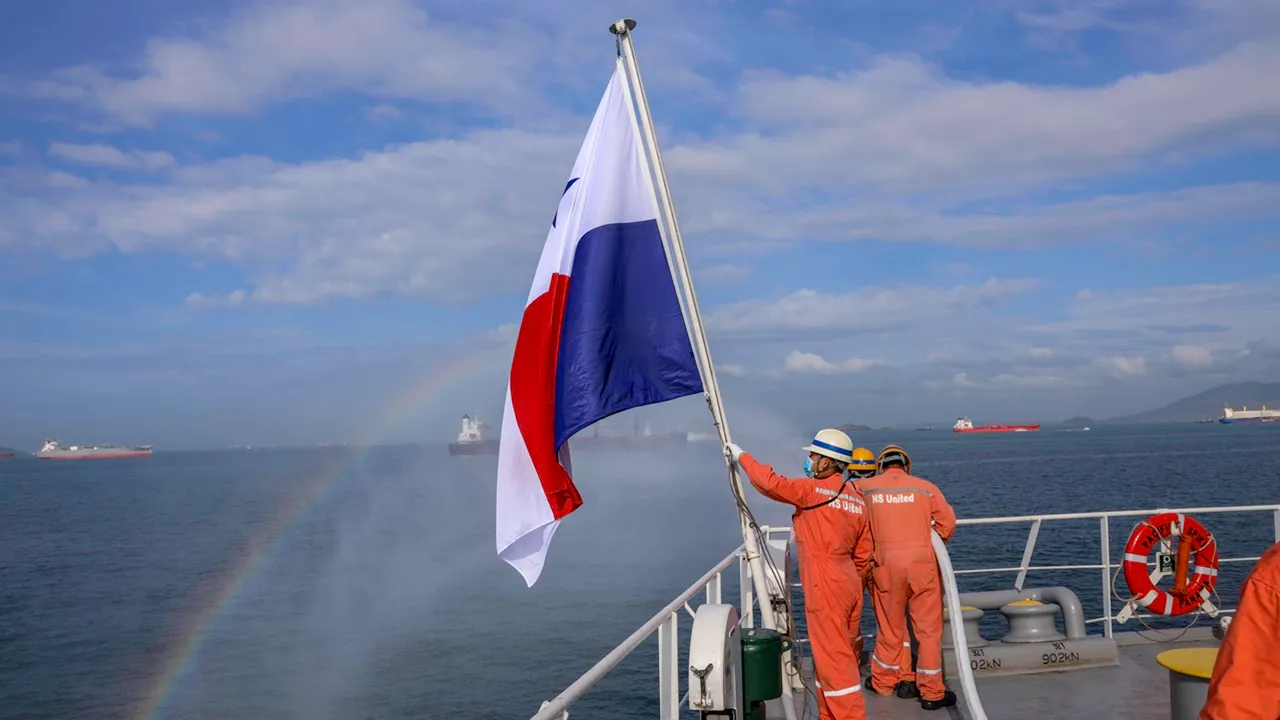
The Panama Ship Registry has fallen to third place globally by gross tonnage, according to the 2026 edition of the Clarkson Research World Fleet Register, after facing pressure from U.S. sanctions, vessel removals and a rise in detentions of Panama-flagged ships at Chinese ports.
Panama now accounts for 202.1 million gross tonnes (gt) across 7,677 vessels. It is behind the Marshall Islands, which has moved into second place with 209.4 million gt and 4,732 vessels, while Liberia remains the world’s largest registry with 314.6 million gt and 6,138 vessels. The Clarkson World Fleet Commercial and Merchant report covers vessels above 100 gt.
For Ramon Franco, head of the Panama Ship Registry, the decline in tonnage should not simply be viewed as a setback. Instead, he describes it as a new phase focused on the quality of the fleet.
“At the moment, our priority is to ensure that the vessels in our fleet are the best. If this means being more selective – by refusing to register certain vessels or by cancelling the registration of those whose performance is not up to standard – we will do so.”
He added that the measures form part of a broader effort to build a more selective, safer and higher-performing fleet.
“Through these measures, taken as part of a move towards a more selective, safer and higher-performing fleet, the Register reaffirms its commitment to pursuing excellence in the service of its clients and the global maritime industry,” Franco said.
Sanctions and Chinese port detentions
The Panama Ship Registry has removed a substantial number of vessels from its books in order to comply with U.S. sanctions. At the same time, the registry has faced difficulties involving Chinese detentions amid a wider geopolitical dispute over port concessions in Panama.
The development matters well beyond the registry itself. Vessel registration in Panama is significant for law firms and companies representing the Registry, while changes in Panama’s international position and image have consequences for a sector that generates substantial revenues for the country’s maritime industry.
“It is a shame to see this decline in the Panamanian Register, although unfortunately it is not entirely surprising,” said a maritime executive who declined to be identified.
The executive pointed to the scale of the change recorded by Clarksons. Between the end of 2025 and August 2026, the Panama-flagged fleet declined from 230.5 million gt to 202.1 million gt, representing a 12.3% reduction.
During the same period, the Marshall Islands increased its tonnage by 7.0% to 209.4 million gt, moving into second place. Other registries also recorded significant growth: the Bahamas expanded by 10.7%, Barbados by 13.6%, while Vanuatu posted a very significant increase from a considerably smaller base.
“The rise in detentions of Panama-flagged vessels in Chinese ports clearly caused concern in the market and coincided with a shift in tonnage towards other flags,” the executive said. “According to the information we have seen within the industry, the Marshall Islands have been one of the main beneficiaries, but not the only one.”
Competition between registries intensifies
The executive argued that Panama’s response should extend beyond the loss of its position in the global ranking.
“Rather than focusing solely on the loss of a position in the ranking, I believe Panama needs to understand precisely what tonnage it is losing, why it is leaving, and what other registers are offering that is currently more attractive to shipowners.”
The scale and recognition of the Panama flag remain significant advantages, the executive said. However, competition among ship registries is increasingly focused on fleet quality, technical capability, customer service, risk management and preventing Port State Control issues.
“That analysis should be the starting point for a strategy to retain and recover high-quality tonnage,” the executive added.
Flor Torrijos, a maritime lawyer and executive director of InterMaritime Group, also called for changes in the way the Panama Maritime Authority interacts with shipowners.
She said the authority needs to improve customer service and listen more closely to the needs of its users. In her view, it must remain an institution that rigorously applies international regulations while also offering efficient, responsive and practical support.
“This is the only way Panama can regain the trust and confidence of shipowners worldwide,” Torrijos said.
Panama defends a quality-over-quantity strategy
The Panama Ship Registry maintains that the reduction in fleet size is linked to a deliberate policy of prioritising quality over quantity.
According to the Registry, it has been applying a rigorous policy focused on new vessels and younger fleets in an effort to promote more efficient and sustainable ships. This includes strengthening its fleet performance monitoring programme and actively removing non-compliant vessels, including ships with poor performance or those subject to sanctions.
The Registry also said cancellations requested by the parties concerned were recorded as part of its normal administrative procedures.
“However, during certain months of 2026, there was an increase in such requests, coinciding with a rise in detentions at certain ports,” the Panama Ship Registry said.
As a result, inspections were increased on vessels classified as “high risk” by their flag state. According to the Registry, this category represented a significant proportion of the cancellations processed.
The authority said the measures demonstrate Panama’s commitment to acting as a responsible flag state and to prioritising maritime safety rather than focusing solely on gross fleet volume.