



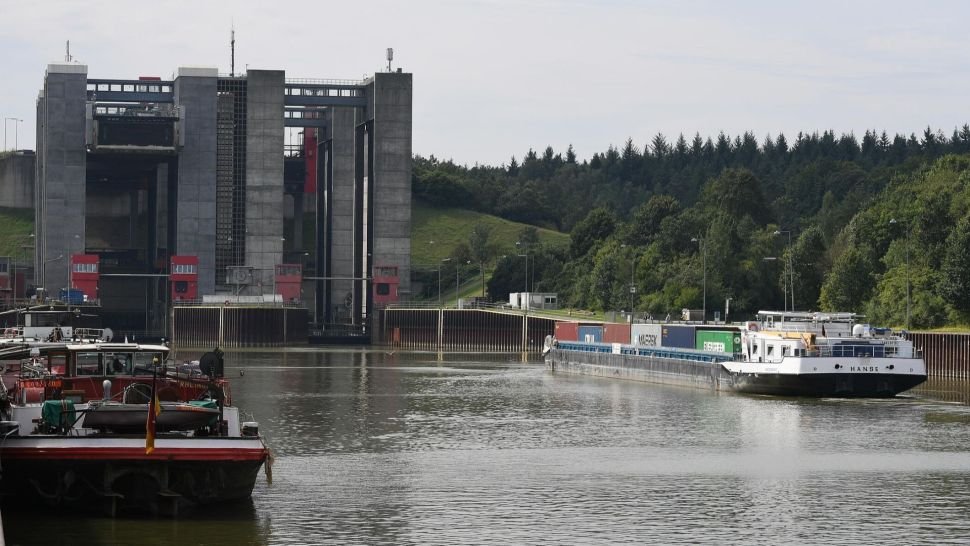
Water levels along the shallowest middle section of the Rhine have fallen to 16 centimeters below the low-water threshold, putting one of central Europe’s most important supply chain corridors at risk of a near-total shutdown for barge traffic.
The river has already been operating under severely reduced conditions since early summer as drought persists, and there is little relief in sight. Germany’s Federal Waterways and Shipping Administration reported that the actual navigable depth on Monday was only about 4.25 feet. In Switzerland and southern Germany, voyages have virtually come to a standstill.
The consequences are spreading well beyond inland shipping. The loss of capacity on the Rhine is making it increasingly difficult and expensive to move large volumes of containers and bulk cargo between major North Sea ports and inland European logistics centers. Companies and their logistics providers are now dealing with higher costs, operational bottlenecks and fewer available transport options.
Why It Matters: Falling water levels force barges either to wait at ports or reduce their payloads to keep their draft low enough for navigation. That cuts available capacity, pushes freight rates higher and forces shippers to move cargo by other, often less efficient, transport modes and routes.
“Nothing like this has happened before. The impact is massive and it’s just starting now. I think it’s going to get worse and I don’t think any of us are ready for it. The impact this is going to have on trucking in Europe is monumental in terms of price, access to capacity, delays. And this can affect all modes air and ocean. It’s going to be really tough,” said Mark Chadwick, president of the Global Shippers Association, during the Aug. 19 episode of the Freight Buyer’s Club podcast.
At the time, businesses were already reporting water levels below 3.3 feet, a level that prevented most barges from operating through the upper and middle sections of the Rhine. Conditions have deteriorated further over the past month.
Previous periods of extremely low water in Europe have generally occurred in late summer or fall, when dry summers were compounded by low snowmelt. The fact that rivers are now drying out so early in the season is making it difficult for experts to predict how the situation will develop.
The Rhine is a critical link between the major North Sea ports of Rotterdam, which handles 14.2 million standard container units annually, and Antwerp, with 13.6 million units, and cities throughout Europe’s interior.
Only very small vessels, or barges operating with loads of around 20% of their capacity, can currently navigate the upper and middle Rhine, according to Oliver Haas, general manager of HGK Intermodal, a terminal operator at the Port of Cologne. Haas spoke during an August webinar hosted by DHL Global Forwarding.
The Rhine is not the only major European waterway under pressure. The Elbe and Danube rivers are also experiencing historically low water levels as severe drought and extreme heat continue. Cargo ships almost completely stopped operating on some sections during the summer, according to Hungary’s Ministry of Transport and Investment.
With less cargo carried on each individual trip, significantly more voyages are needed to move the same overall volume. That is increasing demand for available barges as well as empty containers.
A single barge can carry the equivalent of about 200 trucks. But simply adding more barges is not an easy solution. Many vessels were shifted to the Danube Delta during the Ukraine war, and that waterway is also now facing low-water conditions, Haas said.
Limited options for shippers
For importers, the situation is translating into longer transit times. Reduced barge availability is coinciding with capacity constraints on road and rail networks that are already struggling to absorb freight volumes normally moved by inland waterways, said Thomas Kowitzki, head of multimodal transport in Europe for DHL Global Forwarding.
The disruption is also reducing flexibility for cargo owners. Last-minute booking changes are becoming more difficult, transit times are less predictable and the risk of missing import delivery deadlines or planned vessel connections for export shipments is increasing.
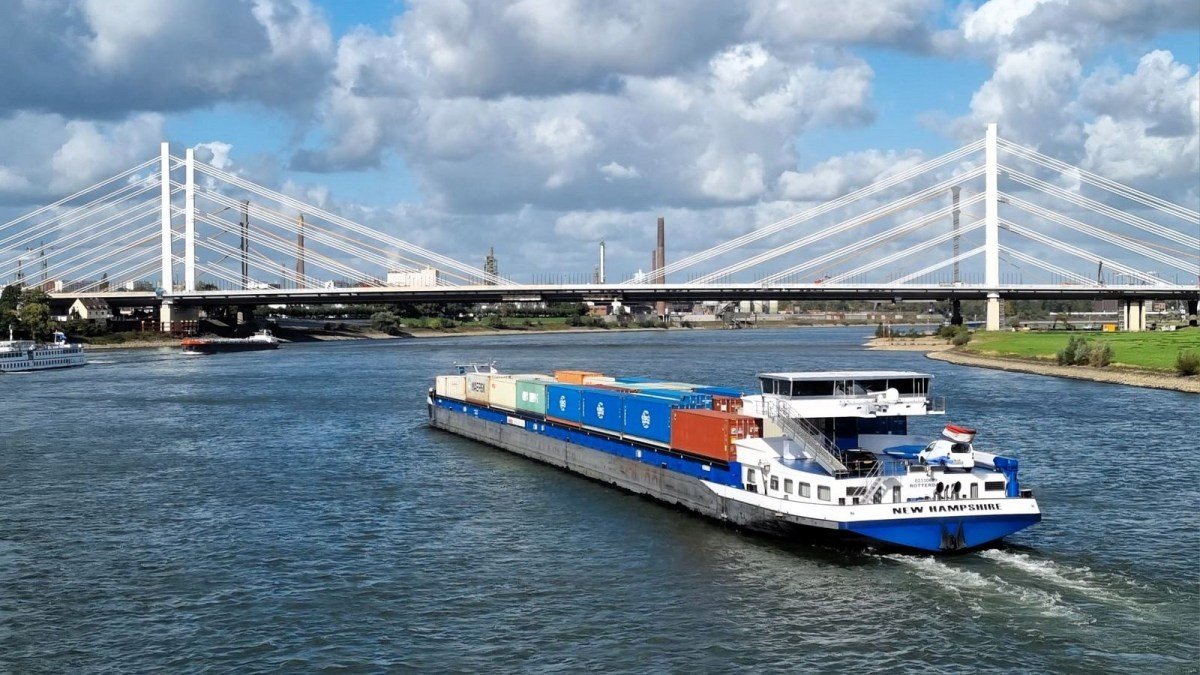
A container barge transits the Rhine River when water levels are normal. (Photo: HKG Intermodal)
Adding more rail capacity is also difficult. Haas said the North Sea ports do not have the infrastructure to accommodate significantly more train sets, nor do they have enough space to handle additional barges. At the same time, truck drivers remain difficult to find.
Shippers are therefore facing a combination of higher transportation costs and additional container repositioning expenses when cargo has to be rerouted by rail or road. On top of that, demurrage and detention storage charges are becoming another concern as congestion builds at ocean and inland terminals that lack sufficient room to process containers quickly.
Some importers are attempting to avoid the most congested gateways by shifting cargo through German ports such as Hamburg, Bremerhaven and Wilhelmshaven, which are connected to the Elbe and Weser rivers, while also turning to alternative transport modes.
Other options include the Adriatic ports of Koper in Slovenia and Trieste in Italy, as well as Genoa and Barcelona in the Mediterranean.
“In same situations, multimodal solutions combining barge, rail, and truck can provide the best balance between costs, service reliability, and transit time,” said Florian Woebb, head of intermodal for Europe at DHL’s forwarding unit. “Our recommendation is to evaluate transportation decisions from an end-to-end supply chain perspective, not simply to replace barge transport.”
Even securing replacement capacity can take considerable time. Finding a truck may take as long as two weeks, while booking an intermodal rail shipment can take up to six weeks.
DHL is advising shippers to identify critical shipments and determine which cargo should be prioritized, extend the planning horizon for routing and transportation decisions, secure truck and rail capacity as early as possible and remain flexible as conditions evolve.
“This is not a couple-of-week problem. This is going to be many months. If you think how much it is going to have to rain in Europe to get these levels back up to where they need to be that’s going to take a long time,” Chadwick said.
The Panama Canal has also been affected by drought conditions, although officials have not so far introduced draft restrictions there.
Transito launches bundled ocean-river service
Against this backdrop, Dutch chartering company Transito launched a new service Monday combining ocean freight and inland shipping under a single contract.
The initiative comes as low water and other disruptions continue to complicate cargo flows between European seaports and inland destinations in Germany and the Netherlands.
Under an agreed range, Transito will also absorb waiting time associated with transfers between seagoing vessels and river barges without charging additional fees. Normally, when low water, port congestion, vessel delays or missing documentation disrupt transshipment between the ocean and inland legs, the resulting additional costs are typically passed on to cargo owners.
Transito’s Total Freight solution is designed for industrial buyers and mid-sized traders that do not have an in-house freight department. The service is particularly aimed at companies moving agribulk, building materials, fertilizers, minerals, recycling cargo and project cargo.
Transito manages the shipment from the overseas origin port through to the inland port and can adjust schedules when conditions change. The objective is to relieve shippers of the need to coordinate separately with multiple transport providers.