

• Latest
  • Trending
Beyond the Ocean: How Maersk Expanded Its U.S. Logistics Footprint

Beyond the Ocean: How Maersk Expanded Its U.S. Logistics Footprint

October 1, 2026
Ocean rates highest in a year amid US-China trade truce

Ocean rates highest in a year amid US-China trade truce

October 1, 2026
DoorDash launches retail returns service and its own drone delivery system

DoorDash launches retail returns service and its own drone delivery system

October 1, 2026
ADVERTISEMENT
Daimler Truck’s bet on owning the entire autonomous truck system

Daimler Truck’s bet on owning the entire autonomous truck system

October 1, 2026
Another strong week for industrial rail freight

Another strong week for industrial rail freight

October 1, 2026
Cargo thieves are ‘laundering freight’ through the supply chain, Cornell warns

Cargo thieves are ‘laundering freight’ through the supply chain, Cornell warns

October 1, 2026
PlusAI trailers stolen in California turn out to be carrying 40,000 pounds of sand

PlusAI trailers stolen in California turn out to be carrying 40,000 pounds of sand

October 1, 2026
3 CPGs discuss automation, sourcing and logistics risks

3 CPGs discuss automation, sourcing and logistics risks

October 1, 2026
Quito Airport strengthens international connectivity as Air Canada returns

Quito Airport strengthens international connectivity as Air Canada returns

October 1, 2026
DHL Express announces average 5.9% rate increase for 2027 in the United Kingdom

DHL Express announces average 5.9% rate increase for 2027 in the United Kingdom

October 1, 2026
DHL supports Gorilla relocation from Nigeria to Congo

DHL supports Gorilla relocation from Nigeria to Congo

October 1, 2026
Ethiopian Airlines signs for 8 Boeing 777-8Fs and 2 777Fs

Ethiopian Airlines signs for 8 Boeing 777-8Fs and 2 777Fs

October 1, 2026
Could the auction model for Santos’ new container terminal finally be settled?

Could the auction model for Santos’ new container terminal finally be settled?

October 1, 2026
  • Home
  • About Us
  • Press Room
  • Podcasts
  • Media Kit
  • Contact Us
  • Careers
Thursday, October 1, 2026
  • Login
  • Register
The Logistic News
  • Logistic
  • Air
  • Maritime
  • Land
  • World
  • Business
  • Tech
  • Events
  • Advertise
No Result
View All Result
  • Logistic
  • Air
  • Maritime
  • Land
  • World
  • Business
  • Tech
  • Events
  • Advertise
No Result
View All Result
The Logistic News
No Result
View All Result
Home Air

Beyond the Ocean: How Maersk Expanded Its U.S. Logistics Footprint

The carrier is building a broad North American ground freight network while connecting e-commerce, contract logistics and air freight into a more integrated offering.

The Logistic News by The Logistic News
October 1, 2026
in Air, Business, Cargo, Land, Logistic, Maritime, Tech
Reading Time: 4 mins read
0
Beyond the Ocean: How Maersk Expanded Its U.S. Logistics Footprint
ADVERTISEMENT

The name Maersk has long been synonymous with ocean shipping. In North America, however, the company is increasingly seeking to be known for much more than moving containers by sea.

Speaking to Supply Chain Dive, Maersk President of North America Ditlev Blicher said the company has become a significant player in the domestic market, with capabilities extending across supply chains.

“When I look at our setup here, we’re now a material player in the domestic space in North America, actually across supply chains,” Blicher said.

ADVERTISEMENT

That transformation can be traced back to 2021, when Maersk set out to move beyond port-side flow logistics and expand into omnichannel fulfillment and e-commerce. The strategy followed its 2020 acquisition of Performance Team, which was intended to provide a stronger foundation for warehousing, distribution and fulfillment.

At the time, Performance Team operated 24 warehousing facilities covering approximately 800,000 square meters. Those assets were expected to effectively double Maersk’s warehousing and distribution footprint.

The expansion has since developed into a much broader landside operation across the United States.

A growing U.S. ground freight network

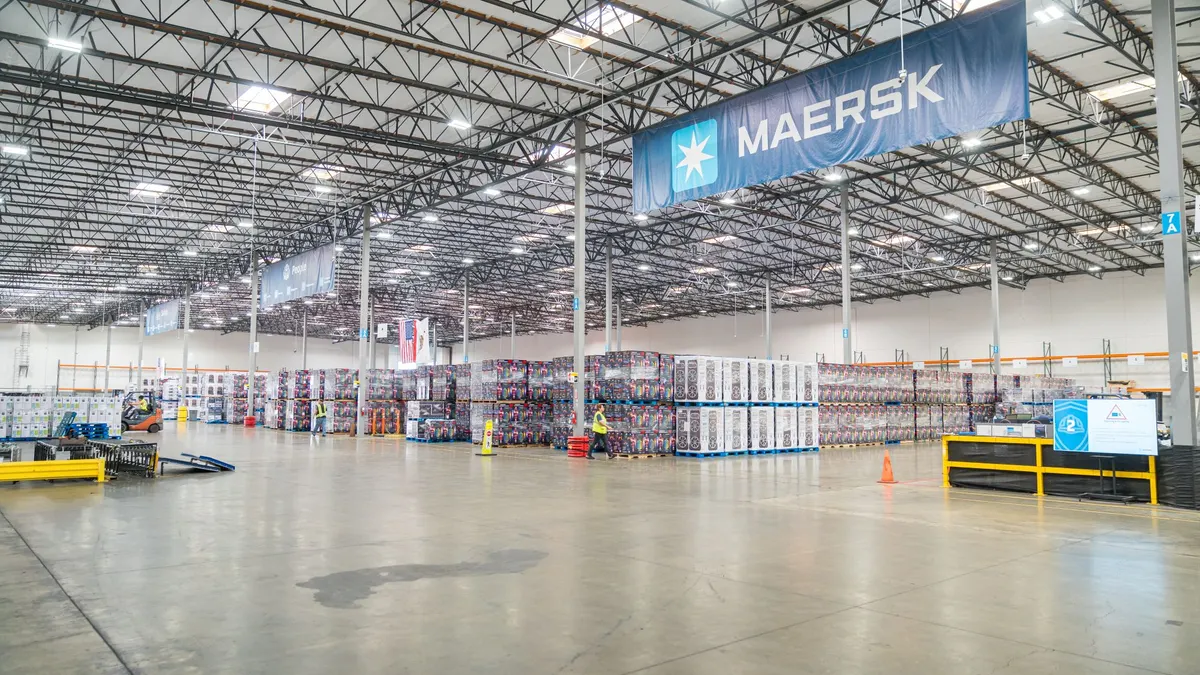
Maersk Ground Freight now operates approximately 470 owned or leased trucks and more than 4,000 owned trailer assets. Its agency network spans around 140 locations, while the company maintains 58 stations across the United States and seven linehaul hubs.

Its e-commerce operation adds another substantial layer to the network, handling about 5 million home deliveries every year.

Those deliveries are not limited to conventional parcel shipments. Maersk handles large and bulky products, including sofas and refrigerators, while integrating its e-commerce capabilities with other logistics services such as Maersk Contract Logistics and Maersk Air Freight.
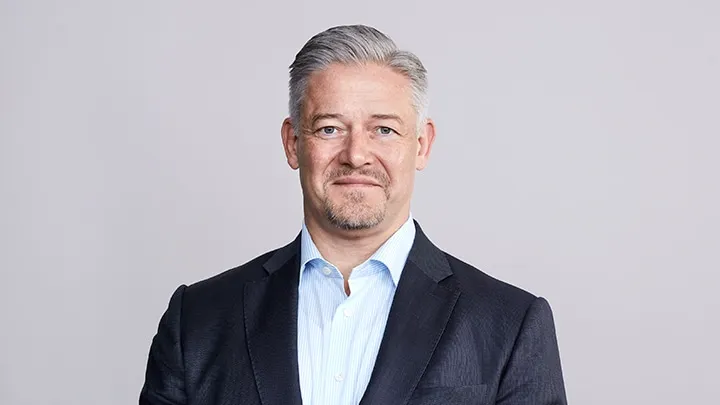
Ditlev Blicher, Maersk President of North America

Maersk’s combination of ground, fulfillment and other logistics services is designed to give the company greater visibility and control over its operations while broadening the range of services it can provide to shippers.

Blicher said the objective is not necessarily to become a one-stop shop for every logistics requirement. Instead, Maersk wants to maintain multiple capabilities within the supply chain so it can remove inefficiencies and improve the quality of the overall service.

That means reducing disruptions during transloads, avoiding unreliable networks and eliminating duplicated infrastructure and systems.

The transload challenge at the heart of Maersk’s hub strategy

One of the operational issues Maersk has been trying to address is what Blicher describes as the “transload problem.”

Historically, moving a container from one vessel to another at a hub could take at least a week.

“Every time you had to shift a container from one vessel to another in a hub, it would take at best a week,” he said.

Maersk has invested more than $3 billion in addressing that problem, including digitizing its hubs and substantially expanding their operational capabilities.

Those investments have enabled the carrier to move its East-West trades away from the traditional string principle and toward a hub-and-spoke model.

The approach is visible in the Gemini Cooperation between Maersk and Hapag-Lloyd. Under the model, the two carriers make two or three vessel calls at origin and destination ports, a structure intended to improve reliability for shippers when a disruption affects one of the ports.

The traditional string model, by comparison, has vessels moving sequentially from port to port throughout the network.

Blicher illustrated the vulnerability of that structure by pointing to a port sitting third in a string of 22 calls. A disruption at that point can create a domino effect across the remaining rotation, or force the carrier to omit a subsequent port to recover lost time.

Since Maersk shifted toward the new model in May of last year, Blicher said reliability has for the most part remained around 90% or higher. The company has also cut transload times in half, according to Blicher.

Omnichannel fulfillment becomes a core capability

Another important aspect of its overall logistics expansion is the company’s fulfillment strategy.

One of Blicher’s core strengths is Maersk’s omnichannel fulfillment capabilities. The model allows you to manage inventory and services for wholesale, retail and e-commerce in one pool.

The flexibility is especially relevant because different channels have different operational requirements. For instance, wholesale customers might need palletized warehouse operations, whereas e-commerce businesses require individual sorting and handling of inventory.

Maersk says integrating those activities into one omnichannel model will simplify operations and reduce the number of separate systems a customer needs throughout their supply chain.

Many of these capabilities came with the acquisition of Performance Team. Maersk further expanded that expertise in 2022 with its acquisition of Asian logistics company LF Logistics, strengthening its position in omnichannel fulfillment and the global e-commerce market.

The strategy has also resulted in dedicated customer operations.

In 2024 Maersk opened a fulfillment center in Groveport, Ohio, serving Levi Strauss & Co.’s wholesale, retail and e-commerce channels. The facility was designed to improve on-time performance, cut the time for handling containers and increase speed and efficiency.

Then in July, Maersk announced plans to build a second fulfillment hub in Hopedale, Massachusetts. The project is aimed at expanding the company’s logistics footprint and supporting a major e-commerce customer, but Maersk has not revealed the identity of the customer.

The expansion illustrates how Maersk is seeking to link its ocean network with expanding inland, fulfillment and air freight capabilities rather than operate each service as a separate business.

But the company still has a lot of room to grow and believes its current platform is scalable and getting good traction with its North American customers, Blicher said.

“We’re in a good place right now. “We’re not even close to done, but we’re a scalable player in the market and it’s resonating really, really great with the fantastic clients that we have in North America,” Blicher said.


Previous Post

Quito Airport strengthens international connectivity as Air Canada returns

Next Post

3 CPGs discuss automation, sourcing and logistics risks

Next Post
3 CPGs discuss automation, sourcing and logistics risks

3 CPGs discuss automation, sourcing and logistics risks

Leave a Reply Cancel reply

Your email address will not be published. Required fields are marked *

A D V E R T I S E M E N T

Popular News

  • Drone Delivery Takes Flight: Amazon Partners with UPS for Trial Program

    Drone Delivery Takes Flight: Amazon Partners with UPS for Trial Program

    0 shares
    Share 0 Tweet 0
  • Rail Cargo Group Strengthens European Network with Captrain Netherlands Acquisition

    0 shares
    Share 0 Tweet 0
  • Automotive Inbound Logistics Market: Navigating Future Challenges

    0 shares
    Share 0 Tweet 0
  • Global Inflation Cools to Target After Three Years, Central Banks Face Policy Dilemma

    0 shares
    Share 0 Tweet 0
  • Dubai Mercantile Exchange Rebrands as Gulf Mercantile Exchange Following Saudi Tadawul Group Acquisition

    0 shares
    Share 0 Tweet 0

Recent News

Ocean rates highest in a year amid US-China trade truce

Ocean rates highest in a year amid US-China trade truce

October 1, 2026
DoorDash launches retail returns service and its own drone delivery system

DoorDash launches retail returns service and its own drone delivery system

October 1, 2026
Daimler Truck’s bet on owning the entire autonomous truck system

Daimler Truck’s bet on owning the entire autonomous truck system

October 1, 2026

Discover a new era of logistics reporting with The Logistic News, your go-to platform for breaking news, insightful features, and exclusive interviews shaping the global logistics and freight landscape. Trust us to deliver accurate, timely, and relevant information that empowers professionals and enthusiasts alike in navigating the intricacies of this vital sector.

Navigation

  • Home
  • About Us
  • Press Room
  • Podcasts
  • Media Kit
  • Contact Us
  • Careers
  • Privacy Policy
  • Terms of Use

© 2024 - thelogisticnews.com

Welcome Back!

Login to your account below

Forgotten Password? Sign Up

Create New Account!

Fill the forms below to register

All fields are required. Log In

Retrieve your password

Please enter your username or email address to reset your password.

Log In

SIgn Up Newsletter

This will close in 20 seconds

Manage Cookie Consent
We use technologies like cookies to store and/or access device information. We do this to improve browsing experience and to show (non-) personalized ads. Consenting to these technologies will allow us to process data such as browsing behavior or unique IDs on this site. Not consenting or withdrawing consent, may adversely affect certain features and functions.
Functional Always active
The technical storage or access is strictly necessary for the legitimate purpose of enabling the use of a specific service explicitly requested by the subscriber or user, or for the sole purpose of carrying out the transmission of a communication over an electronic communications network.
Preferences
The technical storage or access is necessary for the legitimate purpose of storing preferences that are not requested by the subscriber or user.
Statistics
The technical storage or access that is used exclusively for statistical purposes. The technical storage or access that is used exclusively for anonymous statistical purposes. Without a subpoena, voluntary compliance on the part of your Internet Service Provider, or additional records from a third party, information stored or retrieved for this purpose alone cannot usually be used to identify you.
Marketing
The technical storage or access is required to create user profiles to send advertising, or to track the user on a website or across several websites for similar marketing purposes.
Manage options Manage services Manage {vendor_count} vendors Read more about these purposes
View preferences
{title} {title} {title}
No Result
View All Result
  • Logistic
  • Air
  • Maritime
  • Land
  • World
  • Business
  • Tech
  • Events
  • Advertise

© 2024 - thelogisticnews.com