



HANNOVER, Germany – Daimler Truck is taking a vertically integrated approach to autonomous trucking, dividing the challenge into two fundamental pieces: the truck itself must be capable of operating safely without a human at the controls, while software must effectively take over the role of the driver.
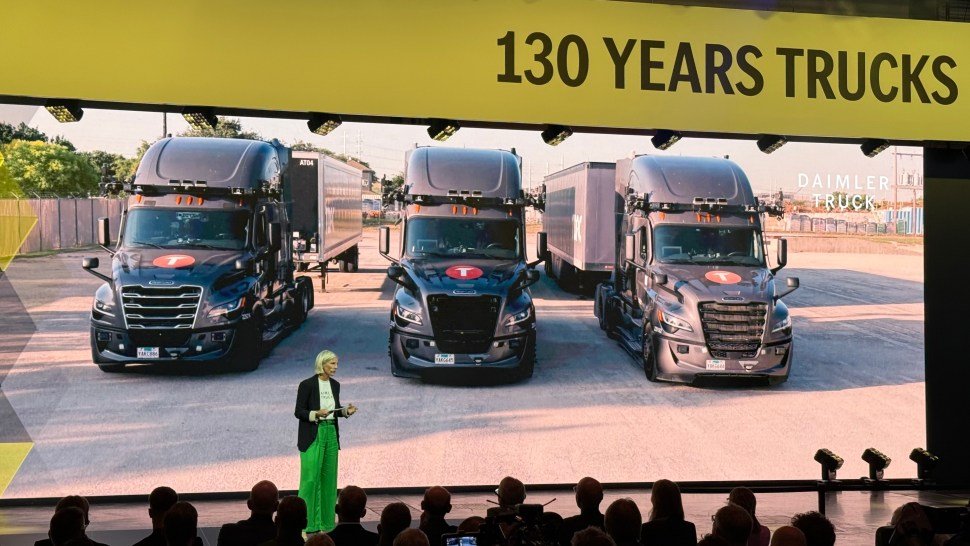
That distinction was laid out by Daimler Truck CEO Karin Rådström during the company’s Media Night ahead of IAA Transportation 2026. Daimler Truck North America (DTNA) is responsible for developing the truck platform, including redundancy in critical systems such as steering and braking. Torc Robotics, Daimler Truck’s independent autonomous-driving subsidiary, is developing the software that will serve as the virtual driver.
“This setup differentiates us from any other player in the industry,” Rådström said at the event. “We’re building the entire autonomous trucking system, from the truck platform and vehicle architecture to the hardware integration and also the autonomous driving software.”
Torc is targeting public-road operations without a safety driver in the cab before the end of 2026, followed by the first commercial freight operations in 2027. The company then expects to begin scaling its autonomous trucking operation in 2028.
The autonomous-driving subsidiary has already demonstrated its ability to operate without a driver in controlled conditions. In November 2024, Torc completed driver-out validation on a multi-lane closed course in Texas at speeds of up to 65 mph, according to the company. Rådström described the next move onto public roads as “a major step towards commercialization.”
“For the first time, a Torc truck will be able to drive itself on public roads not on a test track and without a safety driver in the cab,” she said.
Why Daimler Is Starting in North America
Daimler Truck plans to launch its first driverless freight operations on long-haul routes in North America, and Rådström said there are clear reasons behind that choice.
“Why North America? Why not Europe? Because trucks in the U.S. typically travel more than twice the distance every day compared to trucks in Europe, and believe it or not, driver shortages are even more difficult in the U.S. than they are in Europe,” she said.
The company also enters the program from a strong position in the North American heavy-duty truck market. Through its Freightliner brand, Daimler Truck is “the clear number one” in the region, according to Rådström.
Freightliner and Western Star together accounted for 37.8% of the North American Class 8 market through June 2026, according to Daimler Truck’s second-quarter investor presentation, with the figure based on the company’s internal analysis.
The company has also sold more than 1 million Cascadia trucks in the United States since the model was introduced in 2007, Rådström said.
How DTNA and Torc Split the Work
The autonomous program has been deliberately structured around the two complementary responsibilities.
“At Daimler Truck North America, we’re developing the autonomous-ready truck platform with built-in redundancy for critical systems like steering and braking,” Rådström said.
“At Torc, we’re developing the AI-driven autonomous system, including the perception, planning and driving capabilities that will operate the truck safely and efficiently within its intended operating domain.”
The division of responsibility also extends into procurement and supplier management.
Speaking to media on the sidelines in Hanover, Rådström explained that Torc defines the sensors it needs and specifies its technical requirements, while DTNA’s global purchasing organization supports purchasing activities, supplier management and the establishment of the industrial flow.
“It’s a collaboration, actually,” she said.
Factory-Fit Hardware for Autonomous Trucks
Daimler Truck also wants autonomous-driving hardware to become part of the manufacturing process rather than something added later.
“It’s really adding the sensor suite and the compute, which we want to be able to do factory-fit,” Rådström said. “We think that’s one of our strong points compared to some competitors.”
The initial manufacturing work will rely on Daimler’s existing production footprint.
On Aug. 6, 2026, DTNA announced plans for a new U.S. manufacturing plant. Construction is scheduled to begin in late 2026, with production expected to start in 2029.
That timeline, however, comes after Torc’s stated scaling target for 2028. Daimler therefore expects some of the autonomous truck production preparation to take place within its current manufacturing network before the new facility is fully operational.
“We’ve actually prepared some of our existing network to do that, because the SOP and when we start scaling, it could be that that happens even before the new plant is actually fully operational,” Rådström said.
Torc’s Three-Phase Path to Driver-Out
For Torc, the immediate priority is straightforward: prove that the autonomous truck can operate without a driver on public roads.
“The big target right now, and what the team is fully focused on, is getting to driver-out on public roads,” Rådström said.
The program is following a three-phase crawl-walk-run approach. Through the end of 2026, Torc plans to progressively expand the system’s operating time while exposing it to a broader range of road conditions.
The objective is to build confidence incrementally before moving into production and commercial operations.
“If that works, we are obviously even more confident that we have a good path to start production and really scaling,” Rådström said.
DTNA is supplying the trucks used in Torc’s test fleets, Rådström added.
Assuming the driver-out program progresses as planned, 2027 will focus on addressing the remaining edge cases that are not covered by the crawl-walk-run testing, completing production readiness and beginning commercial freight operations with a limited number of trucks.
“Provided that works, I think during 2027 it’s really about closing all those edge cases that aren’t covered by the crawl-walk-run, getting everything production-ready, and starting with a small number of trucks to do commercial freight, and then going into ’28 to be really ready to scale the operation,” she said.
The strategy ultimately gives Daimler Truck control over both sides of the autonomous vehicle equation: the redundant heavy-duty truck platform and the AI-based driving system designed to operate it. The next major test will be whether Torc can translate its controlled-course achievements into reliable, driverless freight operations on public roads.