




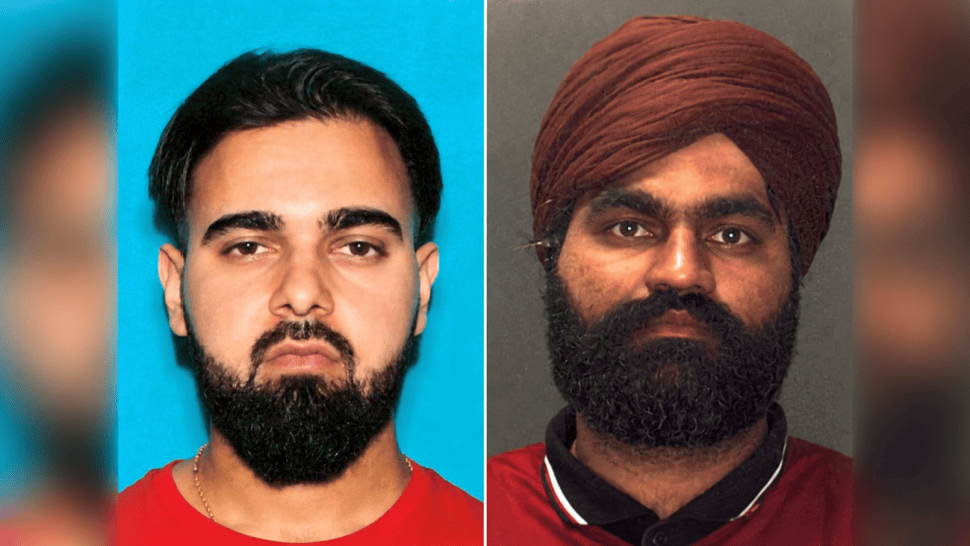
LOS ANGELES (AP) – A federal jury has found two men guilty in a nationwide cargo theft scheme that prosecutors say resulted in at least $2 million in losses and employed established trucking companies to gain access to legitimate freight.
Arshpreet Singh, 28, of Sacramento and Vikramjeet Singh, 31, of Fontana, California, were determined to have participated in a scheme involving the purchase or fraudulent use of real trucking companies to obtain legitimate transportation contracts. When the loads were picked up from the warehouses, they were allegedly rerouted instead of being delivered to their destination.
Federal prosecutors said the criminal activity occurred from March 2024 through June 2025.
The operation targeted a wide range of high value consumer goods including televisions, laptops, vacuums, LED lights, appliances, foot wear, tires and solar panels. Investigators linked the thefts to locations across Southern California and Grand Prairie, Texas. The activity involved Fontana, Long Beach, Compton, Chino, Commerce and several surrounding communities.
Legitimate freight was made available by established carriers
The operation was based on the purchase of an existing trucking company.
Arshpreet Singh met the owner of Z&F Transportation LLC, a Texas carrier, in March 2024. According to evidence presented at trial, Singh purchased the existing company for about $22,000.
Later that month, a co-conspirator picked up a shipment of televisions in Fontana under the company’s name. The televisions were to be shipped from California to a destination in Florida. Instead, the shipment never came to pass, the U.S. Justice Department said.
The deal showed how an existing transportation company could give the group access to legitimate freight without having to build a carrier operation from the ground up.
Evidence at trial showed the same approach was later used with another trucking company.
Co-conspirators purchased Skyways Trucking LLC in May 2024. The company was then used to steal laptops, televisions, solar panels and other items.
The group used freight brokers such as Uber Freight to get assignments for transportation and then took ownership of the loads after the shipments were booked. The goods were then not delivered to the destinations agreed in the transport contracts.
Two defendants convicted following seven-day trial
The federal trial in Los Angeles took seven days before the jury returned its verdicts Tuesday.
Arshpreet Singh and Vikramjeet Singh were both found guilty of conspiracy to commit theft from interstate or foreign shipments.
Arshpreet Singh was convicted of conspiracy to commit wire fraud. But Vikramjeet Singh was acquitted on a separate wire fraud conspiracy charge.
U.S. District Judge Anne Hwang set sentencing hearings for Jan. 20, 2027.
Arshpreet Singh faces a statutory maximum of 20 years in federal prison while Vikramjeet Singh faces a statutory maximum sentence of five years. These are the maximum penalties allowed by law and do not represent the sentences that the court will ultimately impose.
Investigators followed the operation through California and Texas.
The investigation was a multi-agency effort involving federal, state and local law enforcement agencies in California and Texas.
The investigation was conducted by the FBI’s Inland Violent Crime Suppression Task Force and IRS Criminal Investigation. Assistance also came from police departments in Fontana and Fort Worth, Texas.
Other law enforcement agencies involved in the case include sheriff’s departments from San Bernardino, Riverside and Los Angeles counties.
In the end, the investigation linked the defendants to a larger scheme that used genuine freight contracts and real carrier names.
Why this case matters for freight security
The case shows a major weakness in the freight transport system: freight thieves don’t have to invent fictitious companies to get their hands on the valuable cargo.
The group could then buy or use established carriers so it could present itself as a legitimate transportation business, bid on authentic freight opportunities and collect merchandise from warehouses.
The purchase of Z&F Transportation LLC for approximately $22,000 illustrates the value of an established carrier identity. A relatively modest acquisition opened up legitimate freight opportunities that could involve shipments worth substantially more.
The case also points out how cargo theft can go beyond the physical theft of goods. The use of carrier IDs, freight contracts and broker relationships can be a major part of the criminal operation before a shipment goes missing.