




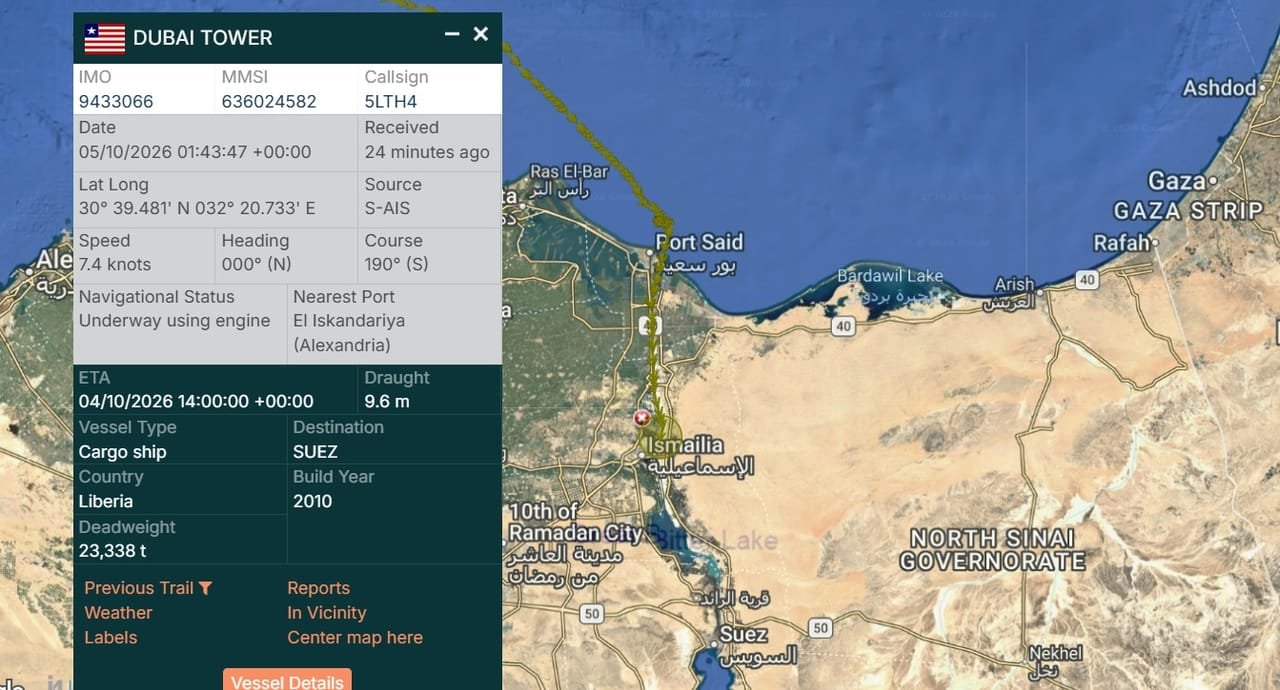
The return voyage of the Dubai Tower, the first container ship deployed on Chinese carrier Sea Legend’s new weekly Arctic service between China and Europe, is taking a different route from its outbound journey.
After sailing to Europe through the Northern Sea Route (NSR), the vessel is now heading back to Asia via the Suez Canal rather than retracing its Arctic route. The move comes as Sea Legend plans eight weekly sailings between China and Europe using the Russian Arctic route, a service that began in August and has attracted significant attention across the shipping and logistics markets.
The first voyage, linking Ningbo–Zhoushan with the UK, highlighted the potential of the NSR during the summer ice season. Compared with routing around the Cape of Good Hope, which has become common over much of the past three years, the Arctic passage can significantly reduce transit times. It also provides an alternative to the security risks affecting Red Sea shipping amid the ongoing conflict in the region.
However, the Dubai Tower is now taking precisely that Red Sea alternative on its return journey. After making calls at ports in the UK and Northern Europe, the vessel headed into the Mediterranean and was, at the time of writing, transiting the Suez Canal, according to ship-tracking data.
Pole Star Global data showed the Liberia-registered 1,740 teu Dubai Tower midway through its southbound transit of the Suez Canal in the early hours of 5 October.
The vessel departed Ningbo on 15 August and had initially been scheduled to reach Felixstowe in the UK on 5 September after sailing through the Northern Sea Route. Its arrival was delayed, with its first port call taking place on 9 September at a multipurpose terminal in Teesport, in northern England.
From Teesport, the Dubai Tower proceeded to Felixstowe before calling at ports across Northern Europe and the Baltic. Instead of returning to Asia through the Arctic, however, it continued towards the Mediterranean before joining the Suez route.
The voyage illustrates that container shipping through the Arctic is technically feasible during the summer ice season. The bigger question, however, is whether such passages can consistently develop into a reliable scheduled logistics service.
Sea Legend’s second vessel on the service, the Riyadh Mukaab, appears to be following the planned itinerary and is currently making its return voyage via the Arctic.
The third vessel assigned to the service, the Athens Odeon, is currently being tracked at Gdansk, Poland, after completing a transit of the Northern Sea Route.