



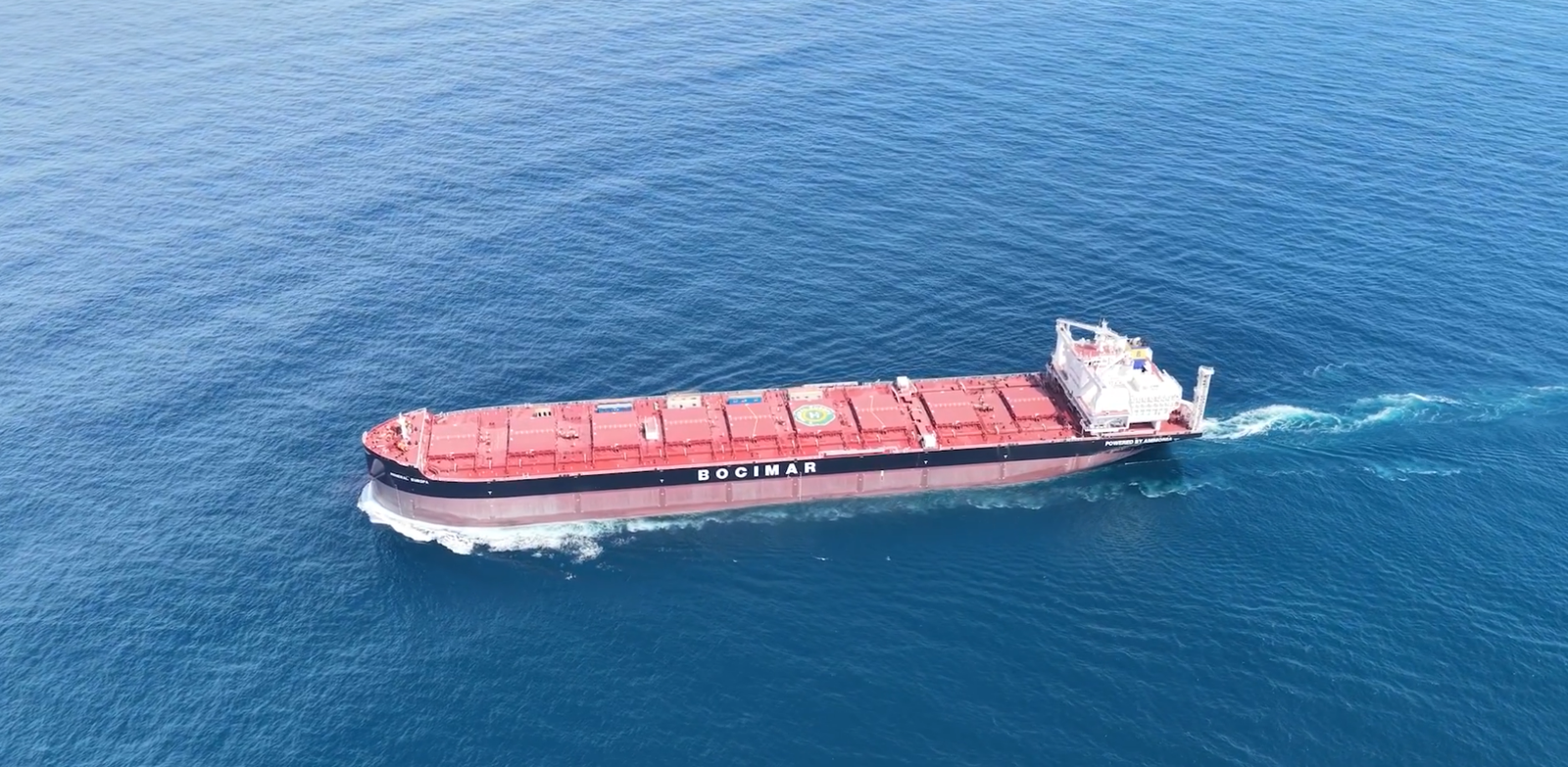
CMB.Tech’s Mineral Europa has completed its sea trials, marking a significant milestone in the development of ammonia-powered commercial shipping. The Belgian shipowner describes the vessel as the world’s first ammonia-powered dry bulk carrier, bringing the alternative fuel closer to deployment on large ocean-going cargo ships.
Built at Qingdao Beihai Shipyard in China, the Newcastlemax-class vessel has a deadweight capacity of 210,000 metric tons. It will operate under a charter agreement with Australian mining company Fortescue, using a dual-fuel engine capable of running on either ammonia or conventional marine fuel.
Following the completion of its sea trials, Mineral Europa underwent a ship-to-ship bunkering operation at Zhoushan, China, where it received 1,000 metric tons of green ammonia. The vessel departed for Australia on its maiden voyage on October 14.
CMB.Tech prepares to expand its ammonia-powered fleet
The vessel represents the first step in a wider fleet development programme. CMB.Tech, headquartered in Antwerp and listed on the New York Stock Exchange under the ticker CMBT, plans to take delivery of 21 ammonia-powered vessels by 2029. The programme includes 18 dry bulk carriers, one containership and two chemical tankers.
In an announcement dated October 9, the company indicated that most of these vessels were expected to be delivered within the following nine months.
“Mineral Europa is the first of its kind, but many more will follow in the months and years ahead,” said CMB.Tech Chief Executive Alexander Saverys.
The expansion reflects the company’s ambition to introduce ammonia as an alternative marine fuel on a broader commercial scale, although economic and operational challenges remain significant.
The high costs are still a major barrier to ammonia uptake
For shipowners investing in ammonia propulsion, the primary objective is decarbonization rather than saving on fuel costs. The commercial argument is that the higher costs of vessels and alternative fuels could be offset in the long run by long-term contracts for cargo, lower emissions-related costs and protection from future environmental regulations, especially in Europe.
But the economics are still tricky. Maritime risk analyst DNV says fuel costs are the biggest barrier to making ammonia-powered shipping commercially viable.
DNV estimates that newbuilds designed to run on ammonia are usually 15% to 20% more expensive than conventional vessels. Green ammonia in Europe costs about $2,900 per metric ton on an energy basis, or about five times the cost of diesel fuel.
Ammonia also needs almost 3 times the amount of fuel to diesel to provide the same amount of energy. This imposes additional design and operational constraints, forcing shipowners to balance the tank capacity for fuel with cargo space, vessel range and the frequency of bunkering operations.
These will continue to play a key role in how quickly ammonia powered ships can be commercially viable.
Fortescue charter links new tech with big cargo demand
Fortescue’s involvement offers a direct connection between the evolution of ammonia propulsion and a key customer in the dry bulk shipping industry.
In June, Australian mining firm agreed to charter up to 12 Newcastlemax vessels from CMB.Tech. According to the report, up to three vessels are expected to be delivered with dual-fuel ammonia engines while the rest of the vessels will be prepared for future ammonia operation.
The deal provides a path to scale the technology to large-scale cargo transport, and simultaneously gives the wider fleet the ability to add ammonia capabilities over time.
Bunkering infrastructure is key to fleet growth
In addition to vessel construction, CMB.Tech is also investing in the infrastructure to support ammonia-fuelled shipping. Among its initiatives are the construction of fuel storage facilities and bunker barges to help supply ammonia to ships.
The company has emphasized that the deployment of ammonia-powered ships is only one part of the transition. You will also need to be able to deliver fuel reliably, safely and efficiently if you are going to roll out the technology across a larger fleet.
The availability of suitable bunkering infrastructure will thus be an important determinant of operational reach and commercial viability of ammonia-powered vessels.
Green Ammonia and the Challenge of Decarbonization
CMB.Tech promotes green ammonia as a fuel produced with renewable electricity, water and air. The company also says that ammonia combustion does not directly emit carbon dioxide.
That distinction applies to the burning of ammonia itself. The mineral Europa can run on conventional marine fuel and so its environmental performance depends partly on the fuel that is used.
The vessel’s entry into service is a major step for alternative marine propulsion, but wider adoption will depend on resolving the cost of green ammonia, meeting its greater volumetric fuel requirements and building the infrastructure for safe and reliable supply.
With CMB.Tech continuing with its scheduled deliveries through 2029, Mineral Europa will be an early demonstration of how ammonia propulsion can be used in large scale dry bulk shipping.