



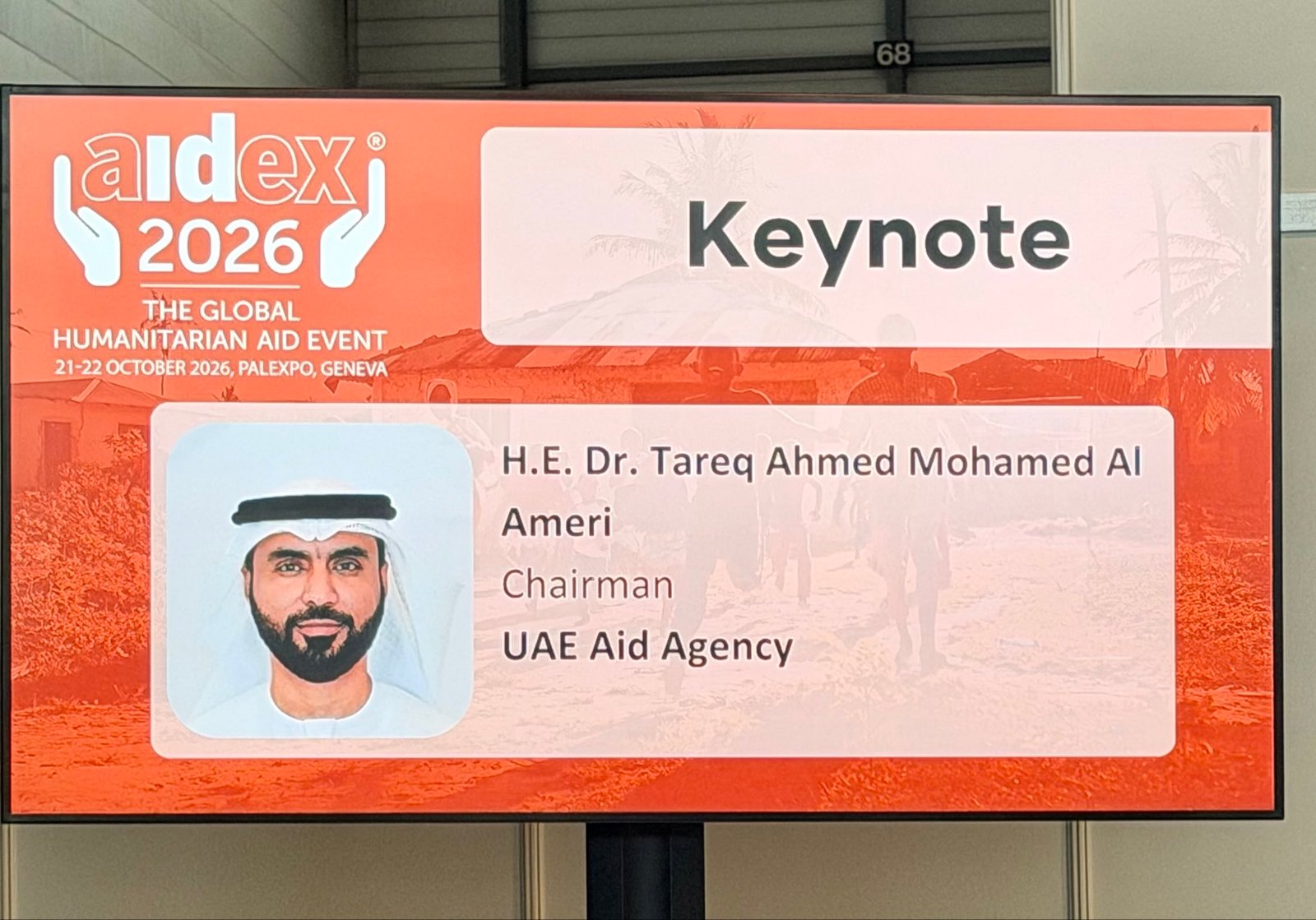
As humanitarian crises grow in scale and complexity, strengthening the supply chains that deliver life-saving assistance has become an increasingly urgent priority. At AidEx 2026, held on 21 and 22 October in Geneva, Switzerland, Dubai Humanitarian called for closer international cooperation and more resilient, diversified and interconnected logistics networks to ensure aid can reach affected populations despite mounting global disruptions.
Throughout the two-day exhibition, the organisation presented its humanitarian ecosystem and highlighted the role of its free zone in supporting international relief operations. Its participation brought together humanitarian organisations, international partners and private-sector companies to explore opportunities for collaboration and reinforce the capabilities needed to sustain emergency assistance worldwide.
Dubai Humanitarian also used the event to showcase the resources and expertise available within its international community, encourage new organisations to join the hub and outline progress towards a comprehensive Global Safety Net. The initiative seeks to connect humanitarian hubs, essential resources, operational data and logistical capabilities across different regions, creating a more coordinated framework for responding to emergencies.
Humanitarian, logistics leaders discuss growing operational pressures
A major contribution of Dubai Humanitarian was a high-level panel entitled “Sustaining Humanitarian Response Under Pressure: Partners in Motion for a Stronger Global Safety Net. The session convened representatives of major humanitarian groups and international logistics providers to discuss how better partnerships can help deliver lifesaving supplies in times of global crises.
Giuseppe Saba, CEO of Dubai Humanitarian, kicked off the conversation by noting that successful preparedness involves ongoing discussions between humanitarian organizations, governments and logistics partners.
He said the ongoing exchanges between these stakeholders have helped to establish a common understanding of the challenges facing global humanitarian supply chains. Resilience, Saba says, has to be more than just reacting to a disruption when it happens. It also demands preparedness in advance, multiple routes of transport, interlinked systems and partnerships that can be activated when circumstances call for an immediate response.
“The priority now is to translate this shared understanding into better coordination and practical solutions for ensuring the flow of humanitarian assistance, even in the most difficult operating conditions,” he said.
The panel was moderated by Benjamin Safari, Head of Supply Management Service of the United Nations High Commissioner for Refugees (UNHCR). The participants were Alex Marianelli, Chief Inter Agency Supply Chain Services, World Food Program; Cecile Terraz, Global Director, Humanitarian Services & Supply Chain Management, International Federation of Red Cross and Red Crescent Societies; Grete Kjaer, Global Key Client Manager, Aid & Relief, A.P. Moller-Maersk; Jean-Cédric Meeùs, Chief Global Transport & Logistics, UNICEF; and Sayed Harris, Manager of Cargo Global Commercial & Special Products, Emirates SkyCargo.
Diversify routes and increase supply chain visibility
Discussions centered around the increasing constraints on humanitarian operations, including continuing conflicts, maritime insecurity, airspace restrictions and major disruptions to established transport corridors. These challenges are further exacerbated by increasing humanitarian needs and limited operational funding, which puts greater pressure on organizations that have to deliver essential relief supplies.
Participants discussed how humanitarian agencies and private-sector logistics providers can improve their collaboration to better anticipate disruptions before they occur, diversify transport routes and improve real-time visibility of the movement of humanitarian goods.
The exchanges also addressed the need for improved coordination on procurement, compliance and emergency logistics. The report identified humanitarian hubs as a strategically important asset for improving global preparedness, and greater interoperability and sharing of infrastructure were seen as opportunities for improving the efficiency and resilience of international relief operations.
The session brought together stakeholders from the humanitarian and commercial logistics sectors and highlighted the need for coordinated planning and complementary capabilities to enable access to critical supplies when traditional transport networks are under stress.
Dubai Humanitarian strengthens its role as global relief hub
Established in 2003 as an independent free-zone authority under the leadership of His Highness Sheik Mohammed bin Rashid Al Maktoum, Vise President and Prime Minister of the UAE and Ruler of Dubai, Dubai Humanitarian is recognized as the world’s largest humanitarian hub.
The organization has more than 80 members including United Nations agencies, non-profit organizations and commercial enterprises. The facilities average $200 million in pre-positioned humanitarian supplies that allow for rapid mobilization of assistance during emergencies.
Dubai Humanitarian’s participation in AidEx 2026 reinforced its objective of building stronger relationships between humanitarian organizations, logistics providers and regional centers. The overall goal is to build a more flexible and integrated global supply chain network that can respond more efficiently to growing humanitarian needs and disruptions on global transport corridors.