



DSV posted a 19.5% rise in operating profit before special items year-on-year in the third quarter, driven by cost synergies from its takeover of Schenker and better performance in air and sea freight and contract logistics. These gains offset poor results in the trucking segment where integration-related disruptions continued to hurt operations.
The group, based in Denmark and now the world’s biggest freight forwarder after the acquisition, reported earnings before special items and taxes of 6.606 billion Danish kroner, or $990.9 million. This included gains of $45 million on sales of property. Revenue increased 12.1% year-on-year to $12.11 billion and gross profit increased 3.8% to $3.04 billion.
Earnings growth led by air, sea and contract logistics
DSV’s air and sea division generated earnings before interest and taxes (EBIT) of $641.7 million, excluding special items, up 18.9%. Integration related savings helped improve the conversion ratio (the proportion of gross profit converted to operating profit) significantly to 45.8% from 38.6% a year ago.
Contract logistics delivered an even stronger performance. EBIT before special items grew 50.3% to $251 million, reflecting the positive impact of integration synergies, higher productivity and improved capacity utilization.
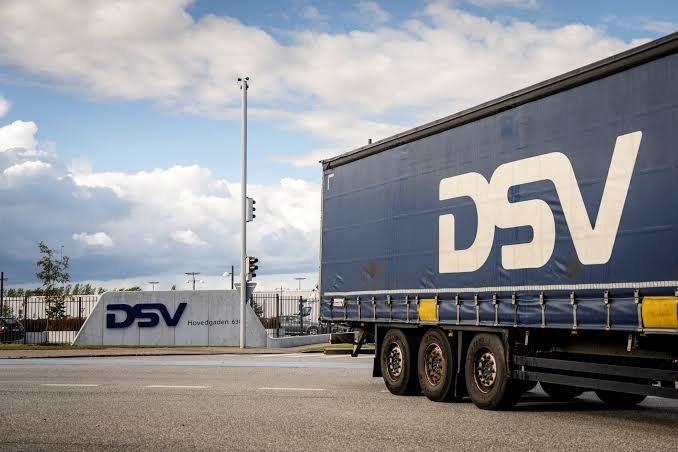
But trucking was still the group’s biggest weakness. EBIT before special items in the division decreased 35.1% to $78.9 million, including $29.3 million in gains on sale of property. DSV blamed the drop on lower volumes and lower productivity resulting from service disruptions around the Schenker integration across Europe.
Operations returned to more normal levels toward the end of the quarter, the company said. Now management is looking to productivity improvements and improved commercial performance to get the segment back on track.
Schenker integration continues; some savings delayed
DSV said that the integration of Schenker was largely going to plan. Almost all countries had either finalized the integration process or were on the verge of doing so by the end of the third quarter.
As part of its efforts to reshape the acquired business, DSV announced plans to divest USA Truck in October 2025. The US carrier did not fit with the company’s largely asset-light business model, it said.
DSV maintained its target of $1.35 billion in annual synergies from the acquisition. However, some of the remaining savings in trucking and certain group functions will not be realized until 2027, due to operational challenges.
The delays underscore the difficulties involved in integrating two large logistics networks, especially in road freight where service continuity, productivity and operational co-ordination are still key to performance.
Integration costs mount, full-year outlook tightens
DSV revised down its 2026 forecast for EBIT before special items to between $3.6 billion and $3.75 billion. Its previous guidance was a wider range of about $3.53 billion to $3.83 billion.
The company now expects about $825 million in integration-related special items in 2026, with some costs expected to be pushed into 2027. It continues to expect total transaction and integration expenses of about $1.65 billion.
The revised outlook reflects the ongoing financial and operational impact of the integration of Schenker into the group and the anticipated benefits from cost reduction and efficiency improvement.
Cash flow improves with lower leverage
It reported adjusted free cash flow of $965.9 million for the third quarter, and reduced its debt-to-equity ratio to 2.5 times.
$478.4 million in property disposals also helped cash generation. Nonetheless, working capital remained elevated, partly because of higher freight rates and fuel prices.
The company also announced a $225 million share repurchase program to be executed between October 21, 2026 and February 1, 2027.
Demand outlook remains shrouded in economic uncertainty
Despite the better earnings, DSV warned that its outlook for demand is still threatened by broader economic and geopolitical developments.
Factors that could impact market conditions and customer demand included continued macroeconomic uncertainty, higher energy prices, global inflation, tensions in the Middle East and trade tariffs, the company stated.
Why this matters: DSV’s third-quarter results indicate that the Schenker acquisition is starting to deliver significant improvements in profitability, especially in air and ocean freight and contract logistics. But the ongoing disruption in European trucking operations demonstrates there are significant operational risks in combining two global logistics businesses. The fact that some synergies are not expected to be realized until 2027 also emphasizes the necessity of execution as DSV pursues its savings target.