



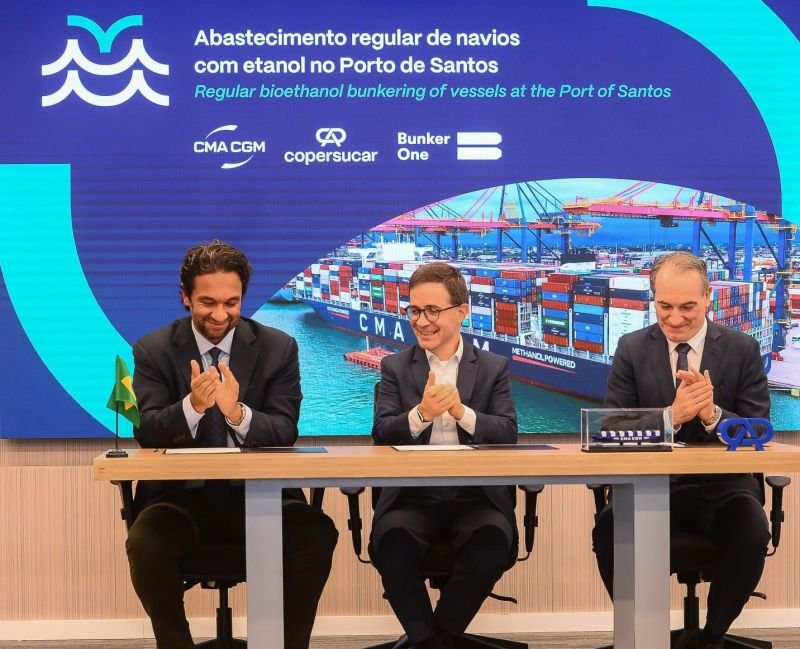
The Port of Santos has entered a new phase in the development of alternative marine fuels, with the launch of regular ethanol bunkering operations. The initiative brings together the Port of Santos Authority (APS), CMA CGM, Copersucar and Bunker One, making the Brazilian port the first in Latin America to provide this service on a regular basis.
The first operation under the new arrangement took place on 19 October, when the 13,000-TEU container ship CMA CGM Iron received an ethanol refuelling. The vessel is equipped with the world’s first tri-fuel engine certified to operate on ethanol, an Everllence-B&W G95ME-C10.5-LGIM engine.
According to the Port of Santos Authority, this operation marks the shift from an initial pioneering trial to a regular commercial supply system. The development strengthens Santos and Brazil’s position as emerging hubs for lower-carbon fuels in the maritime sector.
Further ethanol bunkering operations involving CMA CGM vessels and fuel supplied by Copersucar are planned before the end of 2026.
A supply chain designed for maritime decarbonization
The ethanol used in these operations is sourced from an existing and approved production chain. RenovaBio, Brazil’s biofuels program, contains tough sustainability requirements, including criteria to limit deforestation.
The Copersucar affiliated mills’ ethanol is supplied and transported to the Port of Santos by Evolua Etanol, a company of the Copersucar ecosystem. AGEO Terminais holds the fuel and supplies it for the bunkering of ships.
In the operational phase bunkering will occur at a Santos Brasil operated terminal. Bunker One has developed a pioneering bunkering protocol for Latin America, supported by months of technical studies and specialized crew training. Ethanol has a very low flash point, which is an important safety factor when working with the fuel.
“This is an important step toward the integration of ethanol in commercial maritime operations,” says CMA CGM Brazil CEO Giovani Grassi.
“After the first operation in July, we are now entering a new phase, demonstrating that ethanol can be safely and reliably integrated into maritime operations at commercial scale. This initiative strengthens CMA CGM’s commitment to accelerating the adoption of low-carbon solutions and to supporting the development of new energy ecosystems for the maritime industry.
Tomas Manzano, president of Copersucar, also stressed the importance of putting ethanol into normal commercial use. “The initiative brings together Brazil’s production and logistics potential with the international demand for decarbonization, an important milestone for both ethanol and the shipping industry,” he said.
Santos prepares for transition to alternative fuels
It also reflects the role of port infrastructure and logistics operators in the transition of the maritime industry toward the use of lower-carbon energy sources.
“We are working hard to reduce the carbon footprint of our own activities and our customers,” said Carlos Sepulveda, CEO of Santos Brasil. “That is part of a broader effort to help the shipping industry transition to energy,” he added.
Flavio Ribeiro, CEO of Bunker One LatAm, highlighted Brazil’s long history with ethanol and the strategic opportunity the new service provides.
«Brazil has known the potential of ethanol for decades… “With this initiative, the Port of Santos is positioning itself as a strategic destination for shipping lines that want to reduce their emissions, while other markets are still developing regulations for this type of bunkering,” he said.
Santos says the deal will provide a regular supply and refueling arrangement, and is intended to provide shipping companies with another alternative as they work to reduce emissions. The initiative also connects domestic biofuel production to the operational needs of international maritime transport.
A billion-litre market
The companies cited data from classification society DNV, which said 159 vessels are already running with methanol-fitted engines. The engines can also be adapted to run on ethanol, which suggests the fuel could play a larger role in maritime applications.
The size of the global marine fuel market further demonstrates the opportunity. Annually, demand for marine fuels is over 270 billion liters worldwide. The difference in energy content between fuels means that replacing 10% of current consumption would result in an additional market of approximately 50 billion liters per year of ethanol.
The commencement of regular bunkering at Santos is more than an operational milestone for the port and its partners. It establishes a commercial supply route for ethanol for marine transport and an opportunity to connect Brazil’s established biofuels industry with shipping companies looking for alternatives to conventional marine fuels.